
Trends in health tech investments
Funding the Future of Health
Executive summary
A year ago, our annual insights report revealed a fast-growing health tech sector. We noted that nimble and consumer-focused health tech innovators had begun to fill the gap between current and future needs, enabling a path toward the Future of Health™.1 But a year is a long time in this fast-paced sector—and 2020 was an exceptionally long year. As it did for all industries, the COVID-19 pandemic created an unprecedented crisis for the health care industry. It triggered rapid and large-scale responses, such as a reliance on virtual care delivery, an increased focus on mental health and well-being, and a push for quicker drug and vaccine candidate discoveries. Health tech innovators were critical to this response.
Venture capital funding for health tech innovators is often considered an important indicator of their value propositions and potential for long-term success. The Deloitte Center for Health Solutions recently analyzed the latest venture capital funding data from Rock Health’s Digital Health Funding database and interviewed 15 health tech investors—venture capitalists (VC), private equity investors, and corporate venture capitalists (CVCs)—to understand their focus and long-term priorities. Here is an overview of our findings:
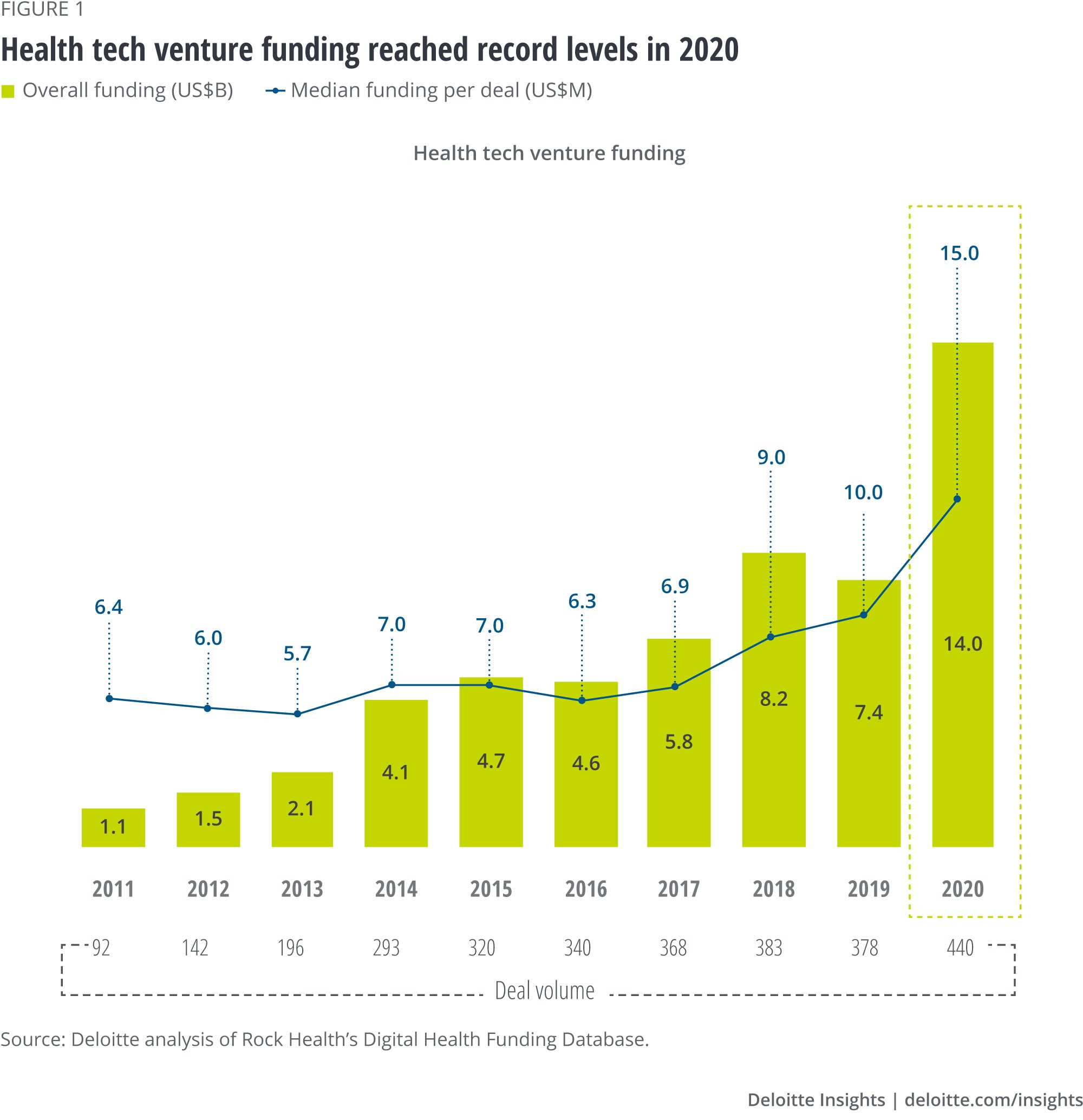
- Venture funding for health tech innovators, at US$14 billion, almost doubled in 2020 compared to 2019 based on Deloitte’s analysis of Rock Health database, and the growth will likely continue unabated in 2021. Many investors, including CVCs, see the postpandemic era as the beginning of a multiyear opportunity rather than a bubble.
- Health tech innovators focused on developing products that align with Deloitte’s vision for the Future of Health. Specifically, products and solutions that address well-being and care delivery, along with open, secure data and interoperable platforms, are likely to continue receiving the lion’s share of funding in 2021 and beyond.
- Health tech initial public offerings (IPOs) and large-ticket mergers and acquisitions will likely accelerate. In addition, special purpose acquisition companies (SPACs) have emerged as a possible viable avenue for innovators seeking to go public.
- Outside of the United States, Israel and China are emerging as countries with interesting innovator and investor activities.
At the intersection of health care and technology, health tech innovators have a unique place in the Future of Health, but they face some challenges. These include demonstrating effectiveness and market opportunity beyond pilots, managing sales cycles and capital, and navigating regulations—to sustain and thrive in this future.
Investors, especially CVCs,can support the innovators and the industry in general. Innovators could bring transformative business models and a consumer-centric approach. However, it is imperative for investors, including industry incumbents, to coach innovators and support them with industry and regulatory expertise, in addition to capital, to accelerate toward the Future of Health together.
Growth in venture capital funding for health tech innovators, at record levels in 2020, will likely continue unabated in 2021
In 2020, venture funding for health tech innovators crossed a record US$14 billion. Even as the economy and industries, including the health care industry, reel under the impact of the COVID-19 pandemic, venture funding for these innovators nearly doubled in 2020, compared to 2019 (figure 1).
“The health tech funding infrastructure has been laid, but we’re still at the very beginning of a trillion-dollar opportunity”
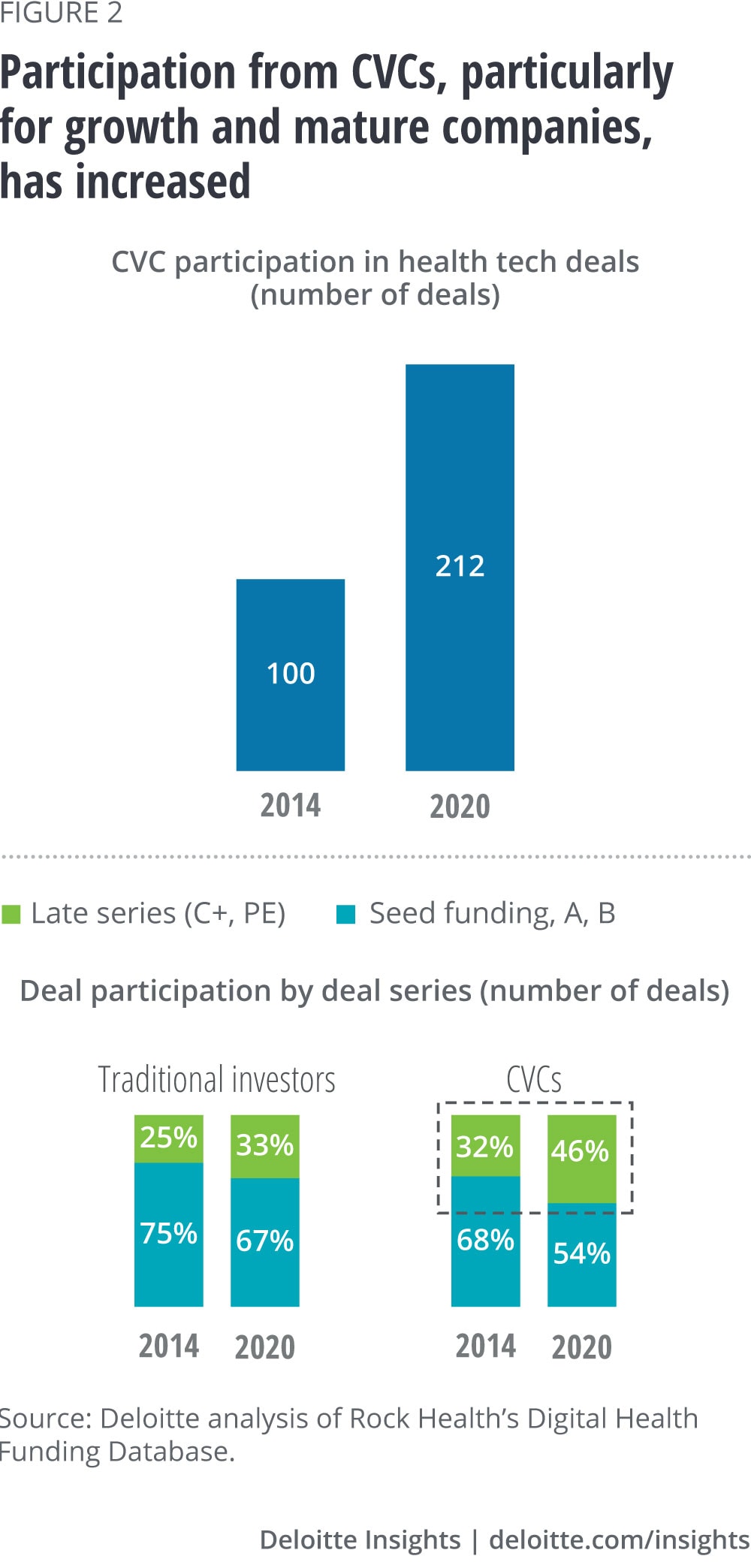
Close to two-thirds of total funding was advanced series funding—Series C and above—as investors focus on innovators with proven value propositions and existing relationships. Investors are ready to pay a premium to support innovators that show a solid return on investment. As a result, valuations of many innovators are at record highs. When asked about current valuations, most interviewees said they did not think there was a valuation bubble, but that this was the beginning of a multiyear opportunity in health care innovation.
Participation from CVCs has increased. Compared to previous years, CVC participation has generally shifted to later-stage deals (figure 2). For VC arms of large health systems and health plans, investment gives them first access to innovative solutions and the ability to pilot extensively and shape the solutions rather than just be customers. Interviewees said CVCs go beyond getting access to emerging solutions; some are focused on investments as a stepping-stone to full-scale acquisitions, others are focused on financial returns and diversifying their revenue sources.
Venture arms of big tech companies have also been active investors. Interviewees told us that they see interest from big tech companies as more of an opportunity than a threat to health care incumbents. They said that big tech will likely stick to their core competencies while funding innovators that fill gaps in their health offerings.
“Everybody’s (industry CVCs) got a horse in the race. It’s a question of who is investing in building it out.”
Health tech innovators focused on the Future of Health will likely continue to receive the lion’s share of funding in 2021 and beyond
Innovators focused on well-being and care delivery models received a record US$6.4 billion funding in 2020 (figure 3). The pandemic accelerated funding for innovators with alternative forms of care delivery, such as remote monitoring and virtual health, as providers who had not already invested in these technologies had to pivot to them quickly. Virtual health is expected to continue postpandemic, even as in-person visits resume. A challenge will be finding an effective, scalable balance between virtual and in-person visits. Interviewees suggested that major focus areas for 2021 and beyond include on-demand health outside of traditional health care settings, mental health, and fitness.
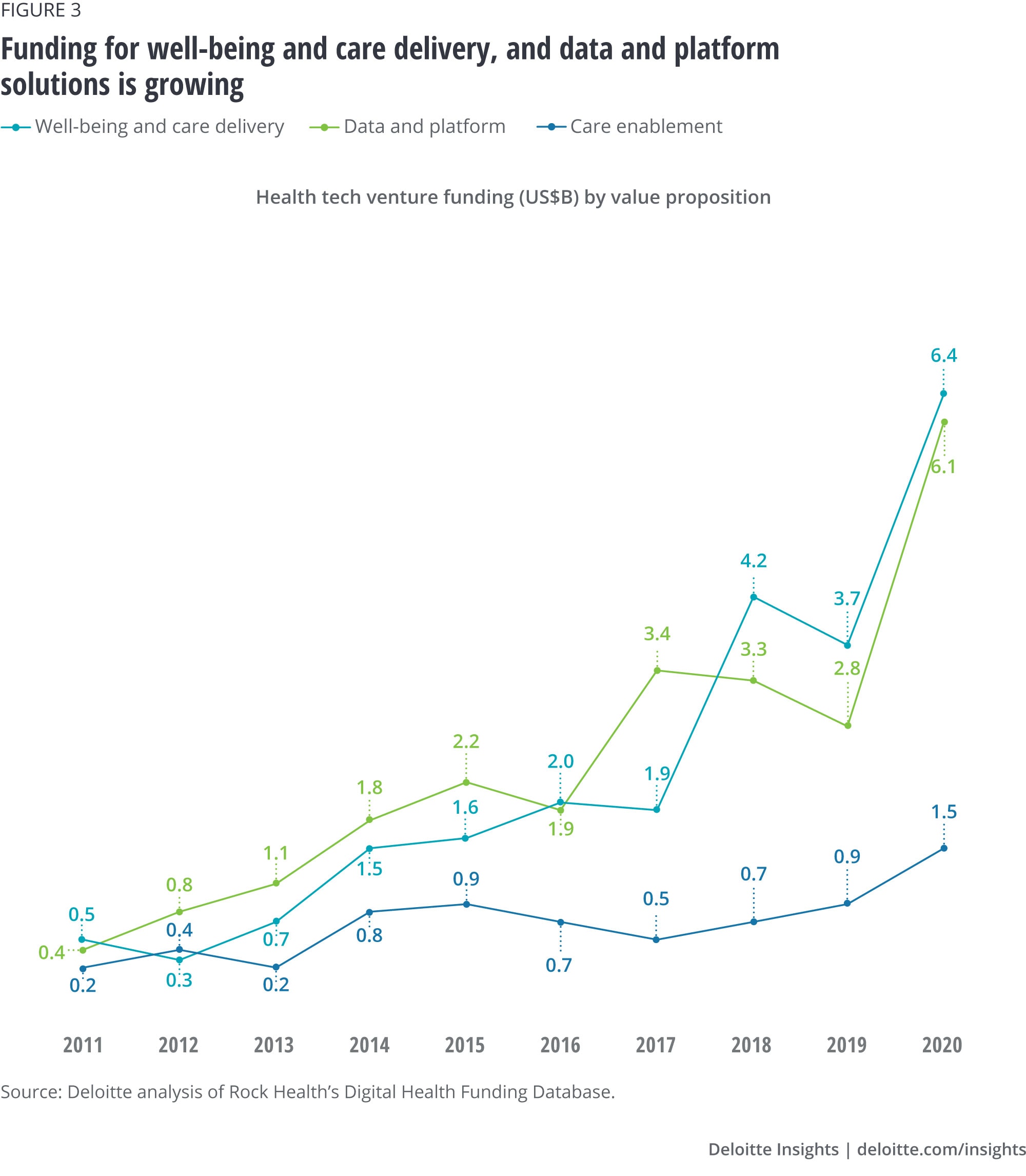
Right behind well-being and care delivery, data and platform innovators received US$6.1 billion funding in 2020 (figure 3). Data and platform innovators in 2021 and beyond are expected to address back-office solutions, such as reporting, data collection, prior authorization, revenue cycle management, and interoperability solutions, among others.
What types of advanced technologies underpin these offerings? Well-being and care delivery innovators are, not surprisingly, leveraging the Internet of Things (IoT) to a greater extent than other technologies (figure 4). Data and platform innovators are focused on artificial intelligence (AI) and machine learning (ML).
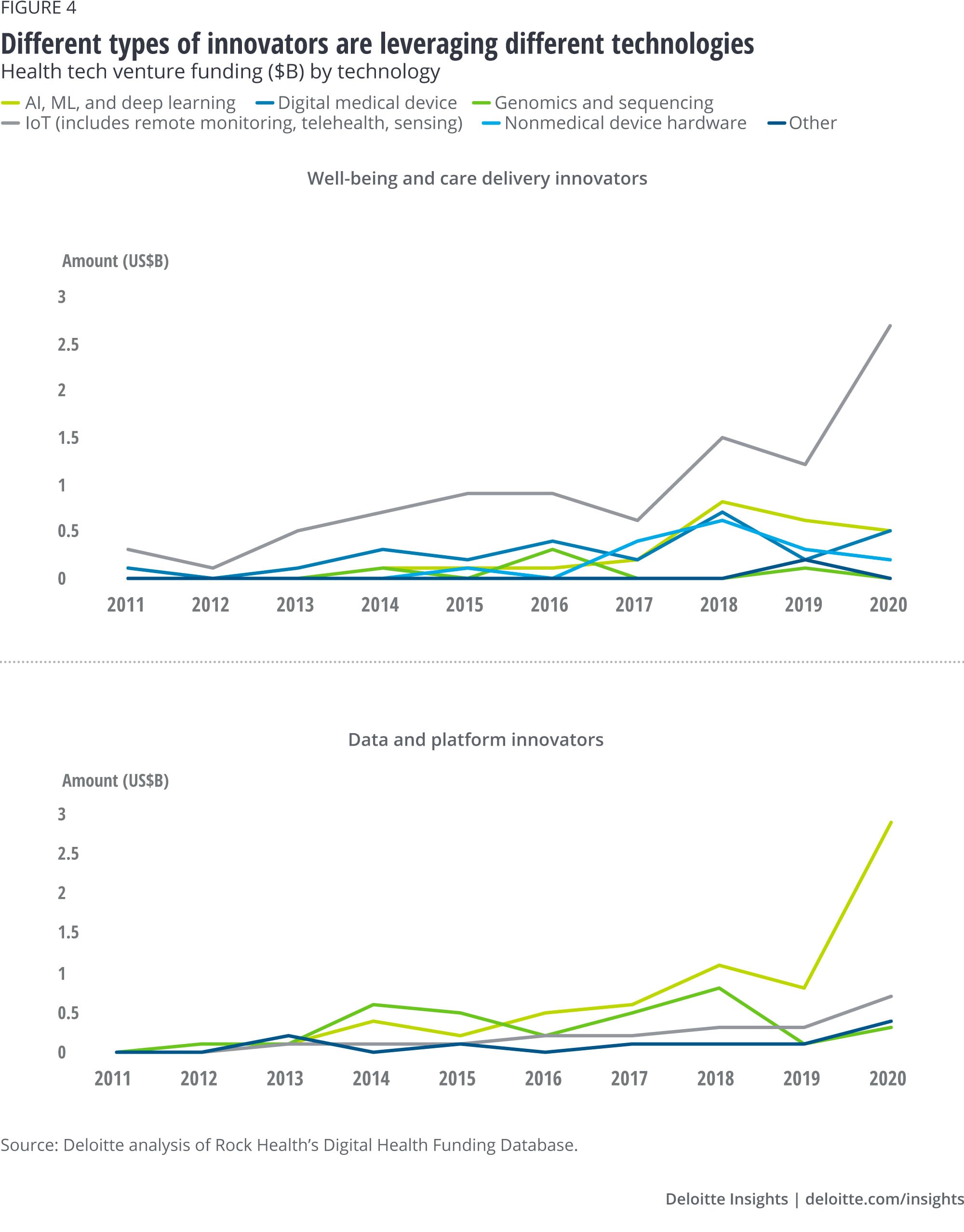
Going forward, interviewees believe that scalable, disruptive business models that can show a return on investment will be most successful. AI/ML and deep learning will be table-stakes. Investors are interested in innovators that use automation and robotics (including RPA) technologies combined with AI/ML. Data security is not a major focus but should be, according to our interviewees.
“AI applications, combined with things like RPA and computer vision, will help achieve several low-hanging fruits in terms of efficiency.”
Health tech IPOs and large M&A deals will likely accelerate
Public offerings are one of the biggest indicators of potential success for companies. The market is very receptive to health tech IPOs. A record 11 health tech innovators have gone public in the last two years. Interviewees attribute this trend to a combination of factors—the pandemic, as bad as it was, gave innovators an opportunity to demonstrate their value (e.g., remote care, well-being, data and interoperability, drug discovery) more quickly and at a larger scale. Amid economic headwinds, investors saw potential value in health innovation. Interviewees believe the success of these IPOs will push several late-stage innovators to consider going public in the next year or two. In 2020, 33 innovators raised US$100 million or more in late series funding (C+), based on our analysis of Rock Health data.
Apart from the traditional IPO route, investors and innovators have recently considered SPACs as an avenue to go public. SPACs are shell companies that acquire a private company and take it public before their acquisition target is identified. In 2020, close to 20 SPAC transactions were focused in the health care industry, higher than during the last four years combined.4 Interviewees said that SPACs require a lot of capital, but in certain cases could make sense as a strategy for some investors.
“It’s completely changed in the past 12 months. It’s now viable to go public, and there are increased M&A opportunities.”
SPACs have the potential to create a business that crosses a larger spectrum with increased opportunities. For instance, last November, GigCapital2 Inc., a SPAC, merged with Uphealth Holdings, a digital care management and digital pharmacy company, and Cloudbreak Health, a telehealth provider, to create a public digital health company valued at US$1.5 billion.5 The combined entity, through complementary offerings and channels, may end up being more than the sum of its parts.
Interviewees cautioned that SPACs have potential pitfalls. With a time constraint of two years to invest in innovators and going public or a deadline to return the money, the quality of innovators may be affected, increasing the risk for investors in the longer term.
Even as the public market route has opened up considerably, the traditional merger and acquisition (M&A) route will also accelerate, according to the interviewees. In the past few years, M&A volume for health tech deals declined slightly before rebounding in 2020. Interviewees pointed at an increase in mega-deals as a larger trend. Interviewees told us they expect two major trends to continue to drive large-scale M&A:
- Consolidation among innovators—As innovators with point solutions mature, it is often beneficial for them to broaden their solutions into “full-suite” offerings. Consolidation is occurring through sales partnerships and/or vertical integration. The US$18.5 billion merger of Teladoc and Livongo late last year is a case in point. Company leaders say the new entity will offer “a longitudinal relationship between clinicians and patients, bringing doctors, digital tools, and data science together for better health.”6
- Large industry and tech firms acquiring innovators—Several large health plans, health systems, and life sciences companies are acquiring innovators to strengthen their own internal capabilities and to diversify revenue sources, according to the interviewees. For example, in January 2021, UnitedHealth subsidiary Optum announced the US$13 billion acquisition of Change Healthcare. Change Healthcare’s sizeable clinical and financial data platforms will complement Optum’s provider offerings, especially around value-based care.7 Apart from incumbents, big tech companies, and large firms from other industries such as retail will also continue to be active M&A participants in their efforts to enter and gain a larger share of this industry.
Global health tech investment trends—Israel and China are countries to watch
Silicon Valley still has a significant gravitational pull for many investors and innovators, but it is no longer the center of the universe. Not only are investors and innovators spreading out to other areas of the United States, but talent and good ideas can be found around the globe. Global markets grew in 2020, despite the pandemic.9 Of note, Israel has been and continues to be a major hub of health tech innovation, with several innovators focused solely on exporting their intellectual property to the US market. While there are challenges to trying to sell solutions into a different health care market, interviewees noted that key success factors for innovators include capital efficiency, talent quality, and a supportive local infrastructure. Specifically, partnering and strong relationships with local organizations are key.
China stands out among emerging markets, having invested US$7 billion in health tech in 2020, while the number of Chinese investors participating in US deals has increased.10 Chinese big tech companies (e.g., Baidu, Tencent) are active investors in US health tech. In India, several innovators with a focus on consumer health and preventive care are emerging, but lack international investments so far, according to interviewees.
European investment activity continues to be robust, and health tech activity has mirrored US trends. However, interviewees noted a few challenges: different reimbursement models across countries, innovators preferring local VCs with local knowledge, and some investors taking more of a wait-and-see approach.
What’s next for innovators in the Future of Health?
Health tech innovators have a key place in the Future of Health, but they aren’t without their challenges. They need to overcome a few hurdles to sustain and thrive in this future:
- As technologies rapidly evolve and simultaneously become table-stakes, innovators will succeed if they have agile business models and the ability to scale. A winning value proposition today may be a me-too tomorrow. Innovators should be ready to rapidly steer and drive technology changes and show value to customers.
- Innovators selling to incumbents will often encounter long sales cycles and cash flow challenges. Sales leadership, channel partnerships, and creation of a marketplace ecosystem can help shorten sales cycles and alleviate investor and market concerns over cash flow. Innovators should also be mindful of how they price their solutions, even with an initial anchor client. Undercutting their value early on can make it difficult to be profitable in the long term.
- While the current regulatory environment is encouraging, with the relaxation of regulations to encourage virtual health and guidance on interoperability rules, shorter- and longer-term uncertainties may remain as situations around the pandemic and other market activities may still evolve. Innovators should remain aware of and be able to adapt to changes.
Conclusion
As the health tech market continues to grow, successful innovators should move beyond pilots to demonstrate market opportunity to their customers through improved quality, decreased costs, and/or a better experience. According to investors, scalability and key return on investment metrics will separate the winners and losers.
Investors, especially CVCs,will have important responsibilities toward innovators as well as the industry in general. In addition to providing capital, they should assume the role of a coach and bring their industry and regulatory expertise to innovators to move the industry as a whole toward the future of health.
BY
Peter Micca
Christine Chang
Simon Gisby
Maulesh Shukla
Madhushree Wagh contributed significantly with the quantitative analysis and assisted in writing the report.
The authors would also like to thank Rahul Mehendale, Brian Whisnant, Joseph Bakutes, Boris Kheyn-Khefets, David Betts, Neal Batra, Laurel Pea, Sarah Thomas, Claire Cruse, Ramani Moses, Laura DeSimio, Apoorva Singh, and the many others who contributed to the success of this project.