
Digital transformation
From a buzzword to an imperative for health systems
Executive summary
The COVID-19 pandemic accelerated the convergence of several trends in the health care industry, particularly consumers prioritizing convenience and access to care. Leading health systems view digital transformation as a way to become more consumer-friendly while simultaneously changing their operations, culture, and use of technology.
The Deloitte Center for Health Solutions collaborated with the Scottsdale Institute to better understand how health systems are using digital to transform health care. To understand the digital transformation journey of health systems, we engaged Scottsdale Institute members in multipronged research: We conducted a survey of technology executives of 25 health systems, interviewed five health system technology leaders, and facilitated a moderated panel discussion of technology leaders from three health systems. We found that:
- Health systems consider digital capabilities a path to fundamentally transform their relationship with consumers. Most survey respondents are hoping to achieve better patient experience (92%) as the top desired outcome from digital transformation. Health system interviewees and panelists discussed taking a consumer-centered, outside-in approach—designing processes and experiences from a consumer’s perspective as a way to build their trust and loyalty—to improve patient experience and build on newer forms of care delivery using digital technology.
- While the digital transformation journey is long, health systems are focusing on interim milestones to show value. When asked how far they are from an ideal digital state, most survey respondents (60%) rated their organizations as midway through their journeys. Health system interviewees and panelists acknowledged that the transformation journey is longer than they had initially expected as the opportunities and definition of digital transformation expand. They also discussed a need to create frequent checkpoints to measure the value of the initiatives, rather than waiting until the completion of the initiatives to measure returns on investments (ROIs).
- Talent, data, and setting key performance indicators (KPIs) are challenges to overcome, in addition to budget. Survey respondents, interviewees, and panelists alike discussed how the quality and quantity of talent to support digital transformation initiatives was one of the biggest barriers to overcome. And, one-third of respondents said talent is their top investment priority in the next 3 years. To address challenges with data, survey respondents and interviewees reported investments in data interoperability and creation of the right KPIs as top priorities in the next 3 years. Despite budget being a top reported constraint, two in three respondents expect investments in digital transformation initiatives as a percentage of total information technology (IT) budget to increase in the next 3 years.
- An executive champion is key to digital transformation success. Survey respondents consider leadership (80%) and management of implementation (68%) to be the key accelerators of digital transformation, and culture (60%), communication ownership, and transparency (48%) the key barriers. Health system interviewees and panelists recognized organizational leadership as a crucial factor for the success of their digital transformation efforts.
Our recent health care consumer survey findings show that consumers are increasingly exercising agency, engagement, and control over most decisions about their health and well-being.1 To meet consumers where they are, health systems should consider accelerating their digital transformation efforts by establishing a governance model, creating a digital culture, recruiting and retaining the right talent, and measuring the success of their initiatives.
Introduction
Over the past two decades, many hospitals and health systems adopted digital technologies in their various functional areas. In many cases, however, they took a piecemeal approach to numerous initiatives—from installing electronic health record (EHR) systems to building apps to trying disruptive technologies such as artificial intelligence (AI)—while remaining largely focused on the same business and customer models.2
The COVID-19 pandemic significantly altered this status quo for the health care industry. Virtual health and care delivered in the home became the model of not only necessity but also preference. But this change was not as sudden as it might look. The pandemic was an accelerator of several trends, including shifting consumer preferences, rapidly evolving technologies, newer talent models, and clinical innovation. In the face of these trends, as hospitals and health systems work toward adapting their businesses, a well-defined approach toward digital technologies will likely be at the core of this transformation strategy.
Key research findings
Health systems consider digital capabilities a path to fundamentally transform their relationship with consumers
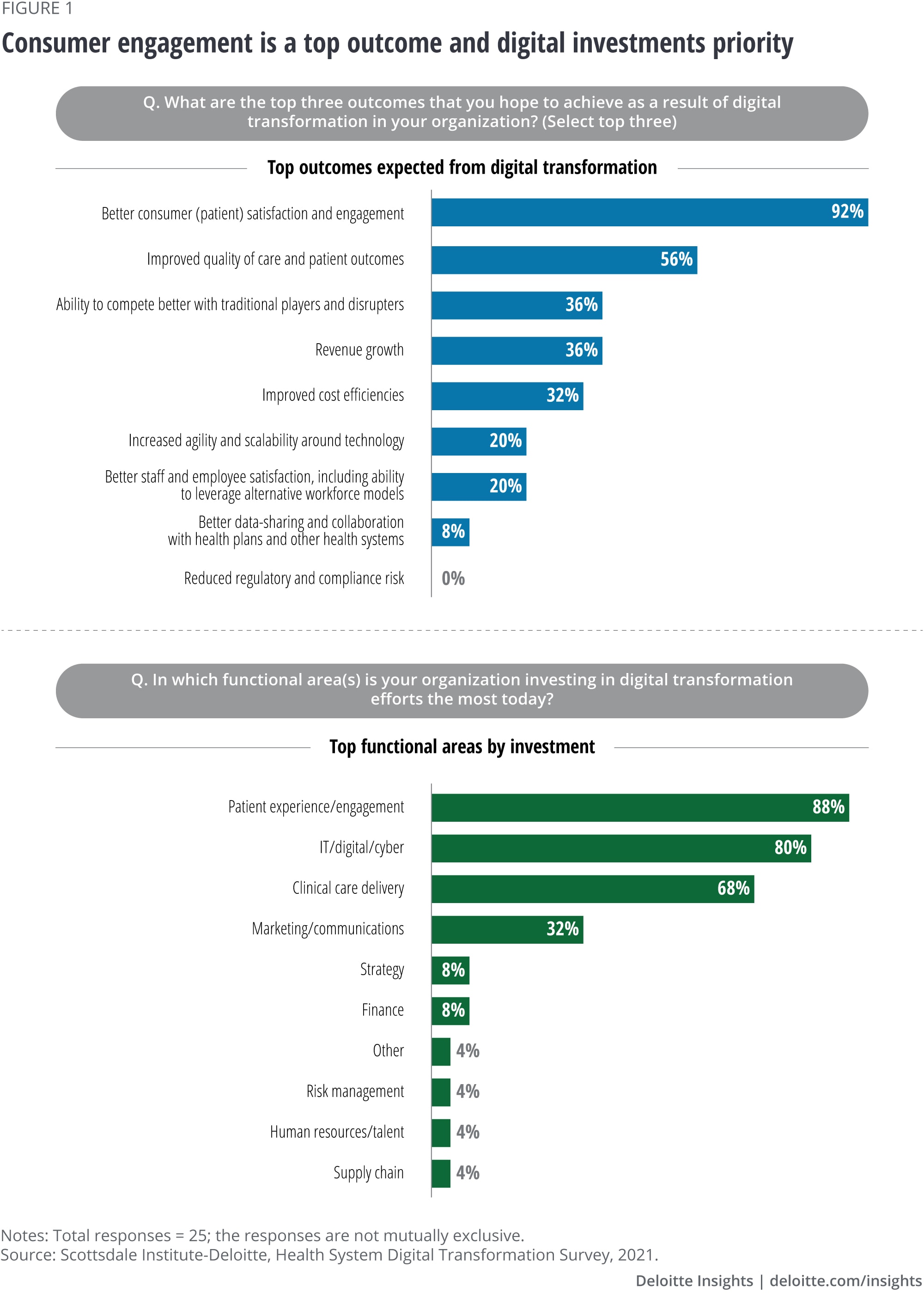
Health systems acknowledge the acceleration in consumer agency and activation in the last few years.3 As consumers increasingly take charge of their health decisions, health systems are aligning digital investments to their overall business strategy—a strategy focused on consumers, according to roundtable panelists and interviewees. Almost all our survey respondents (92%) noted that better consumer satisfaction and engagement are the top outcomes their organizations want to achieve from digital transformation, followed by improved care quality (56%). Closely aligned to the top outcomes, functions receiving most digital investments today are patient experience (88%), IT/cyber (80%), and clinical care delivery (68%) (figure 1).
Health system interviewees likewise discussed taking a “consumer-centric” approach, focusing their digital investments on improving patient experiences and newer forms of care delivery, especially since the onset of the pandemic. This is consistent with our recent research on opportunities for consumer-facing technologies in health systems to build a better health care experience. As one of the interviewees said, “With COVID-19, it became necessary to accelerate consumer-facing technologies, and now there’s no looking back.”
In addition, taking a nonconventional approach toward user experience, akin to consumer technology companies, was a recurring theme for interviewees and roundtable panelists. For example, one of the interviewees mentioned how digital technology is aiding more real-time feedback from patients, and they do not have to wait for months to get results from regulatory reporting (e.g., HCAHPS survey). This quick feedback obviously helps resolve consumer issues much more rapidly than previous nondigital solutions. Similarly, one of the panelists discussed how their organization is taking a “design-thinking approach to reimagine all their processes—both clinical and nonclinical.” Using this approach, they initiate planning with the starting points for different consumers and how they might access their health care services.
“A patient’s journey is not just in the hospital. There is a “before” and an “after” (or a “not at all”) and what we need to do is be able to stitch that together, making sure we are caring and understanding the context and then where we can leverage those digital tools to be there for them.”
We also asked our survey respondents how they planned to achieve the transformation—what technologies they were investing in now and what they planned for the next few years to transform their business and customer models. Respondents reported investments in insights and analytics (76%), virtual health services (68%), and cloud (56%) as top priorities today. Health system interviewees corroborated these are top investment priorities. They said their focus is on building unified data and business intelligence (BI) capabilities. This forms a strong base for real-time business analytics, predictive analytics, and AI. One interviewee noted they need to focus on the entire technology spectrum, not just on next-in-class technologies. For them, better communication technologies for their call centers are just as important an investment as AI pilots.
While the digital transformation journey is long, health systems are focusing on interim milestones to show value
Digital transformation means something different to every health system, every stakeholder. However, most survey respondents and interviewees agree that it is more than just transferring paper processes to a digital environment. Digital transformation is a new way to deliver care, improve processes, and meet the well-being needs of consumers. Deloitte defines digital transformation as the use of digital technologies to radically improve the performance or reach of an organization. In a digitally transformed business, digital technologies enable improved processes, engaged talent, and new business models. This can take significant time and can expect scrutiny of efforts. It therefore requires a thoughtful approach to ensure alignment with end goals while also demonstrating value along the way.
“Four years ago, digital transformation made it onto our health system strategy map. Then, I would have said, [we would be completely integrated] 5 years from where we started. But today, realizing the challenge of the work, I don’t know the way we will look 5 years from now. Lots of work to do, so can’t say [how long digital transformation will take].”
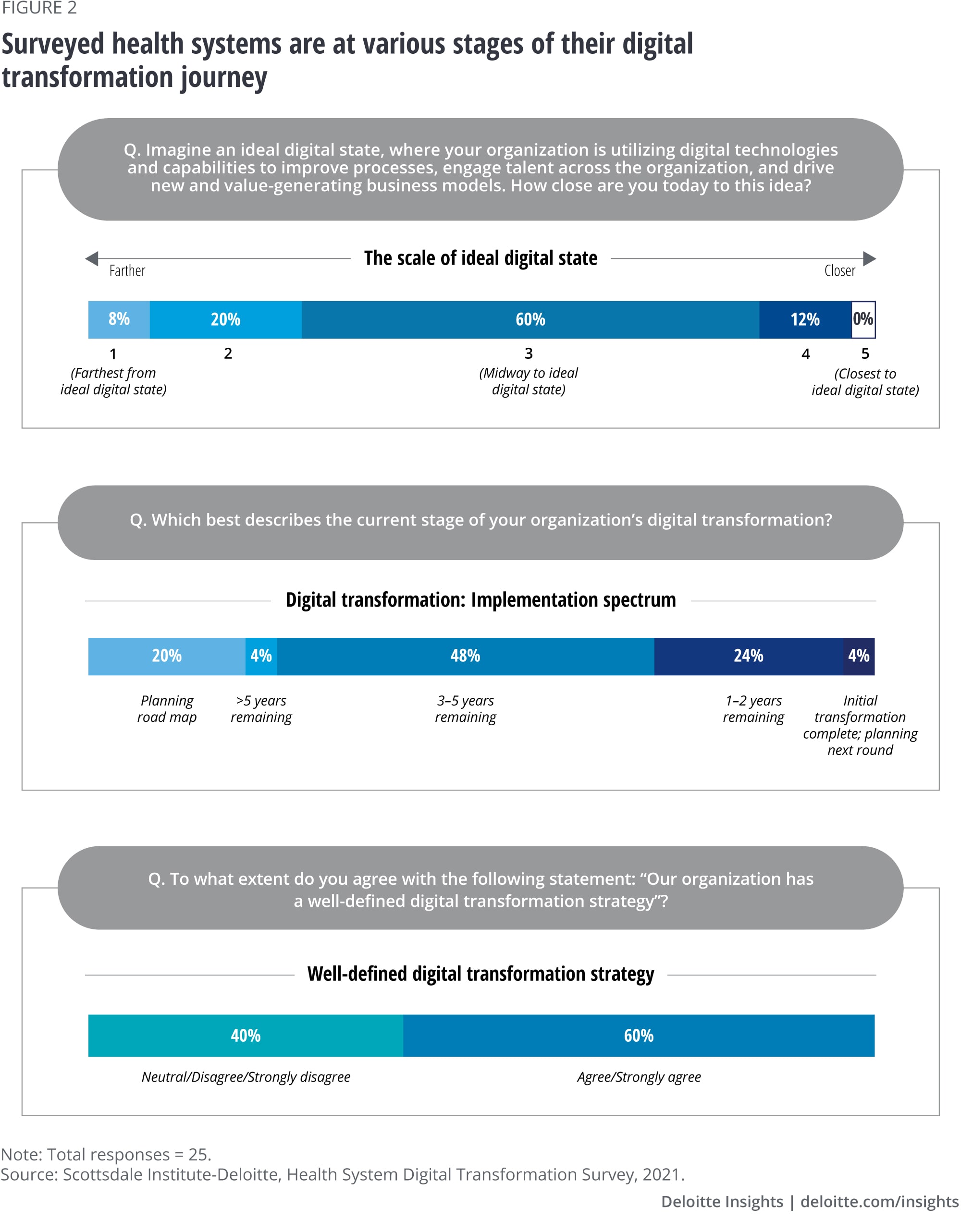
While survey respondents were at different stages in the digital transformation journey, none of them said they were close to an ideal digital state. Most survey respondents (60%) said their organizations were no more than midway through their digital transformation journey. Slightly more than half of respondents said they have 3 or more years left until completing their digital transformation. In addition, 20% are still in planning stages and another 40% may not have a well-defined strategy (figure 2).
Expansion of opportunities for digital transformation has made the journey longer than they had initially expected, according to some health system interviewees. As these health systems progress further into their longer-term strategies, they are realizing that they are still at the beginning of their digital transformation journey, and that this journey is not just about digital technologies but about transforming health care as a whole. They also discussed a need to create frequent checkpoints to measure the value of the initiatives—rather than waiting until the completion of the initiatives to measure ROI—because it is such a lengthy journey. Organizations should consider setting goals for specific milestones at different stages to ensure value at various stages and check whether they are on course for end objectives.
Talent, data, and appropriate KPIs are challenges to overcome, in addition to budget
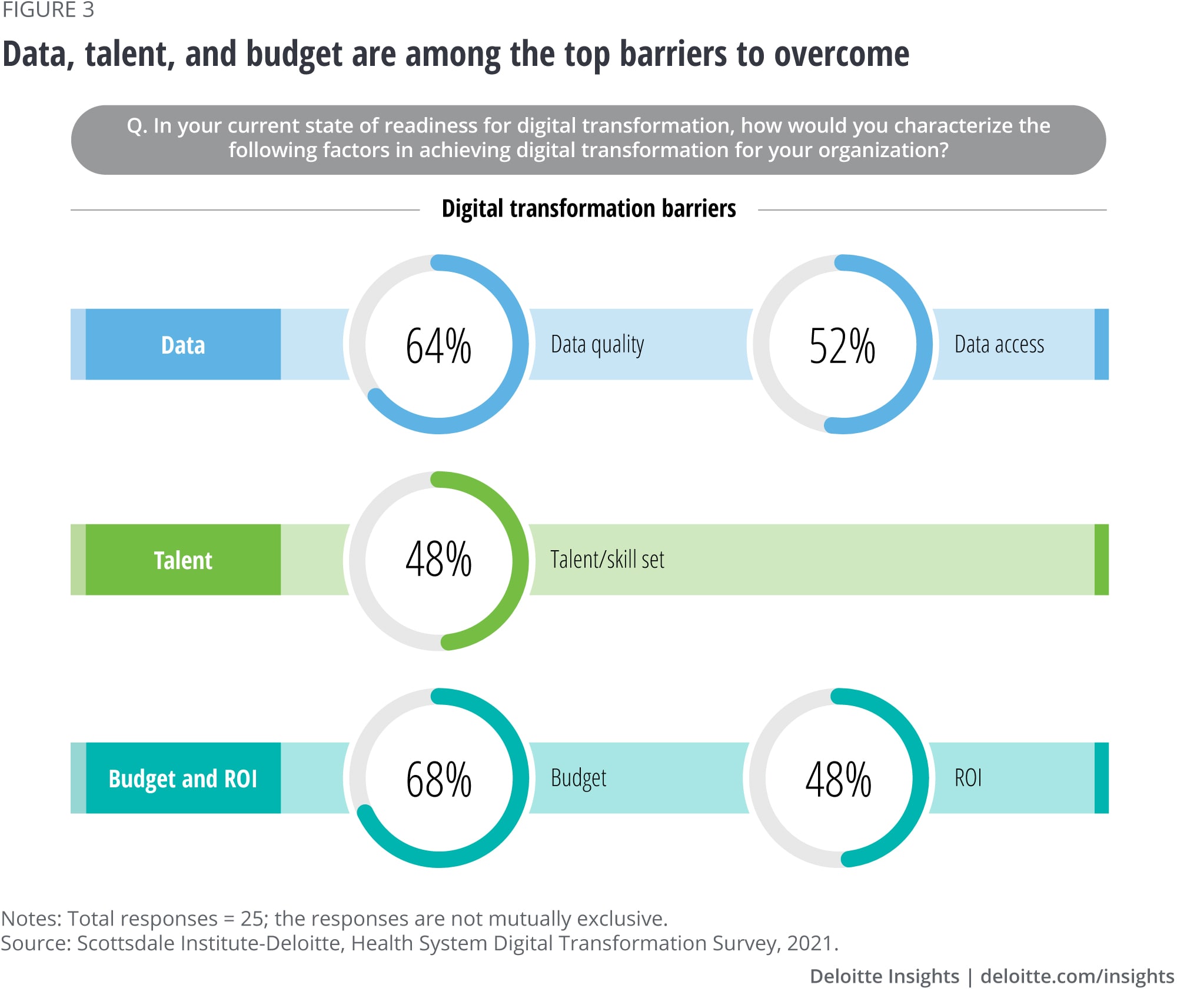
Health care leaders face several challenges on their transformation journey. Data quality and access and talent were major barriers to digital transformation for survey respondents (figure 3). Budget is also important. Survey respondents, interviewees, and panelists shared how they are addressing these challenges.
- Data and measurement: To address challenges with data, survey respondents reported investments in data interoperability and API solutions as top priorities for the next 3 years. Beyond regulatory compliance, interoperability can help achieve broader goals of increased care coordination, value-based care, and health equity.5 In addition, the majority of survey respondents said they have created KPIs to measure some or most of their digital transformation initiatives. Interviewees discussed how KPIs have evolved over time. For example, a few years ago, the “number of app downloads” was an important KPI to measure patient uptake. However, many organizations now are measuring advanced metrics such as monthly active users and average session length to measure engagement and satisfaction. Interviewees and panelists also discussed the need to create and measure some bold, nonconventional concepts. For instance, an interviewee mentioned how their organization has started measuring the “lifetime consumer value.” This health system is willing to refer patients to competitors if they cannot provide the service themselves, with the hope that patients will return to them with their next health care question. The objective is to build a long-term relationship with the patient and become a trusted advisor over a lifetime, not merely a provider at one point in time.
- Talent: Survey respondents, interviewees, and panelists alike discussed how the dearth of talent to support digital transformation initiatives was one of the biggest barriers to overcome. Only 12% of respondents said they had enough full-time equivalents (FTEs), and only a third had the right skill sets to support digital transformation. However, a third of respondents also said talent is their top investment priority for the next 3 years. Panelists discussed the need to expand the talent pool beyond traditional areas—both geographically (taking advantage of virtual work and the expanded geographic scope they can recruit from) and outside of the industry (e.g., consumer-tech companies with different perspectives and skill sets).
- Budget: Despite budget being the top constraint, two in three respondents expect investments in digital transformation initiatives as a percentage of total IT budget to increase in the next 3 years compared to today. One panelist discussed how several potential capital investments across the organization, not only digital, are vying for limited budgets. Hence, ROI becomes the key criterion for prioritizing budget allocations.
“When you are tracking everything, you are tracking nothing. We are trying to reduce that. The first question we have is, ‘How does this attach to the KPIs we have in the organization?’ The decision is made by the highest level of the organization.”
An executive champion is key to digital transformation success
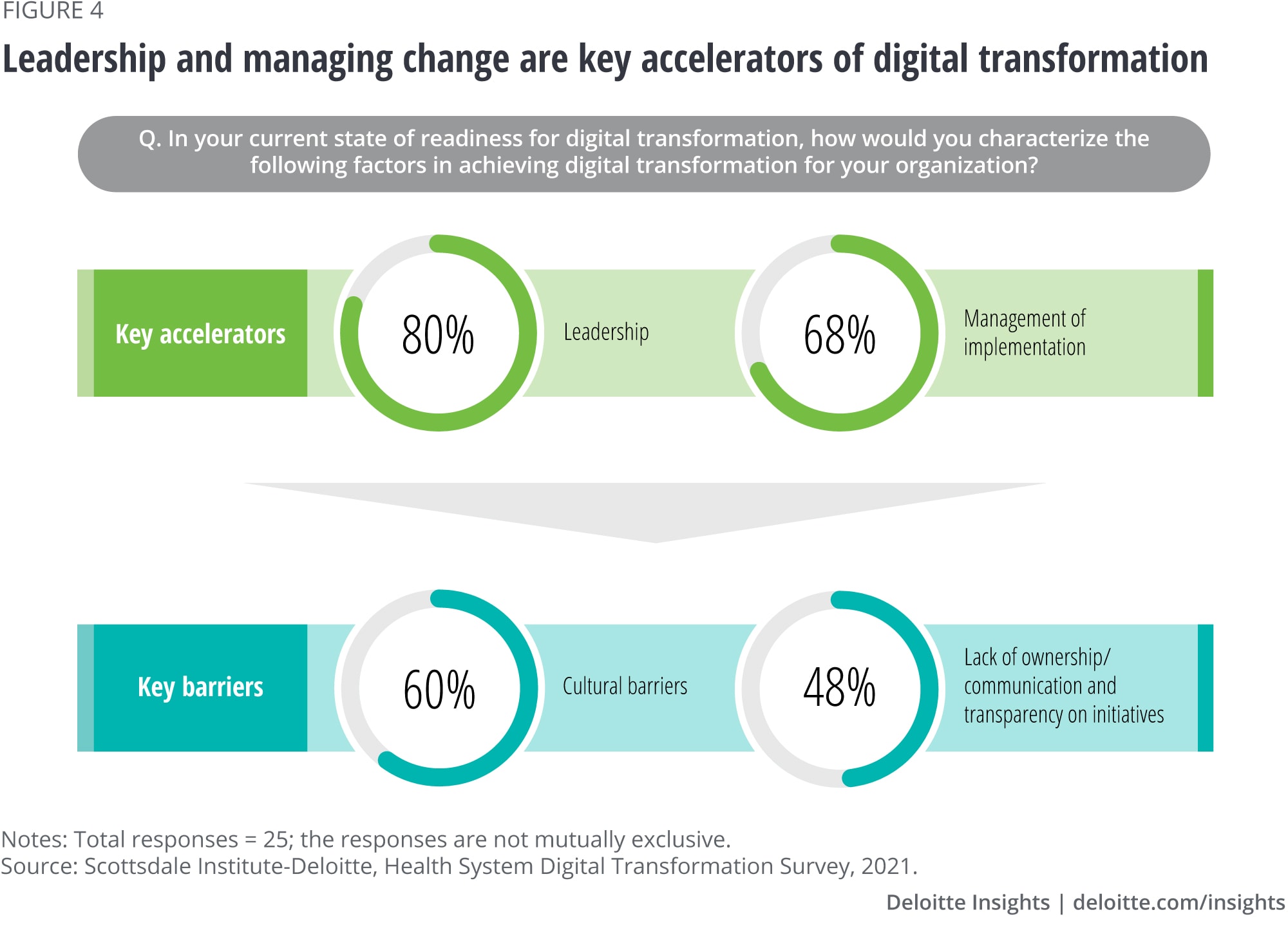
According to survey respondents, leadership (80%) and management of implementation (68%) are accelerators of digital transformation (figure 4). Interviewees underscored the importance that organizational leadership understands and supports digital transformation efforts and follows through with appropriate resources, staffing, and decision-making authority. This allows digital transformation leaders to think outside the box, speed up product development cycles, and change organizational culture around digital.
“C-level support is really important. We have to be partners with other teams but having a separate entity (specific governance for digital transformation) was a key to success.”
Similarly, interviewees stressed how important change management is in the process of digital transformation. Without coordination and communication across teams, implementation becomes much more difficult. This parallels survey findings where respondents stated that organization culture (60%) and lack of ownership/communication (48%) are barriers to digital transformation. Because multiple teams, including digital transformation, IT, cybersecurity, innovation, clinical, and front office, can be involved in consumer-facing initiatives, a governance process should be in place to prioritize projects and give all stakeholders a shared understanding of goals.
Conclusion
Health systems recognize that digital transformation is essential to improving health care and strengthening customer relationships. It is more than just investments in technology—it results in changes in organizational culture and employee engagement; it is an enterprise investment that requires enterprisewide participation. To move forward digitally, many leading health systems are embracing six key principles:
- Create a digital leadership and governance structure aligned to overall business strategy.
- Build a culture for digital with leadership driving support through communication and transparency at all organizational levels.
- Prepare for next-generation talent with a focus on right quantity and quality of workforce.
- Understand that cybersecurity is the other half of digital and should be integrated at every stage of digital implementation for stronger risk management.
- Play the long gamethrough flexibility and scalability of implementation to manage ever-evolving technologies.
- While the journey is long, create measurable, accountable, and scalable KPIs to understand the success of digital initiatives with multiple milestones along the journey.
The impact of digital transformation will be felt across all aspects of health care, helping enable easier access to care, improving quality, and decreasing the cost of care. Consumers can connect quickly and conveniently with their preferred provider. In addition to stronger consumer relationships, digital transformation can also help improve operational and financial efficiencies and bring health systems’ long-term strategies into reality.
BY
Chuck Appleby
Janice Wurz
John Hendricks
Chris Shudes
Christine Chang
Maulesh Shukla
Project team: The authors would like to thank Madhushree Wagh who assisted in designing the survey tool and the interview guide, interpreting the survey data and analyzing interview findings, and writing sections of the report. Wendy Gerhardt provided invaluable guidance on shaping the project, and helped editing and reviewing the paper.
The authors would also like to thank Nick Wong, Stacy Tucker, Courtney Olson, Laura DeSimio, Zion Bereket, and the many others who contributed to the success of this project.
This study would not have been possible without the participants who graciously agreed to take part in the survey, interviews, and the panel discussion. We thank them for being generous with their time and insights.
Cover image by: Kevin Weier