
Turning America’s dredged sediment from a disposal problem into a domestic asset
Dredging provides a recurring supply of sediment, while ports and coastal projects require sand, fill, and restoration materials. The missing link is a market connecting the two.
Every year, America dredges the equivalent of a Panama Canal’s worth of sediment from federal navigation channels, harbor entrances, and inland waterways—about 200 million to 300 million cubic yards of sand, silt, clay, and gravel.1 The work keeps commerce moving, but much of the material goes to disposal sites. At the same time, public and private entities buy similar material for coastal restoration, port expansion, and other infrastructure projects. Too often, America pays to dispose of sediment in one place, then pays again to buy comparable material elsewhere.
That disconnect creates a market opportunity. Dredged sediment is one of the few domestic material resources the United States extracts at scale—and controls largely through public infrastructure—yet it is not consistently inventoried, priced, or marketed.2 There’s an opportunity for the United States to do what other leading maritime economies have successfully done: treat sediment not as a disposal problem, but as a strategic domestic asset.3
Much of America’s dredged sediment still goes to disposal
Because waterways continually shift and reshape, keeping navigation channels open requires regular dredging, which produces a steady supply of sediment.
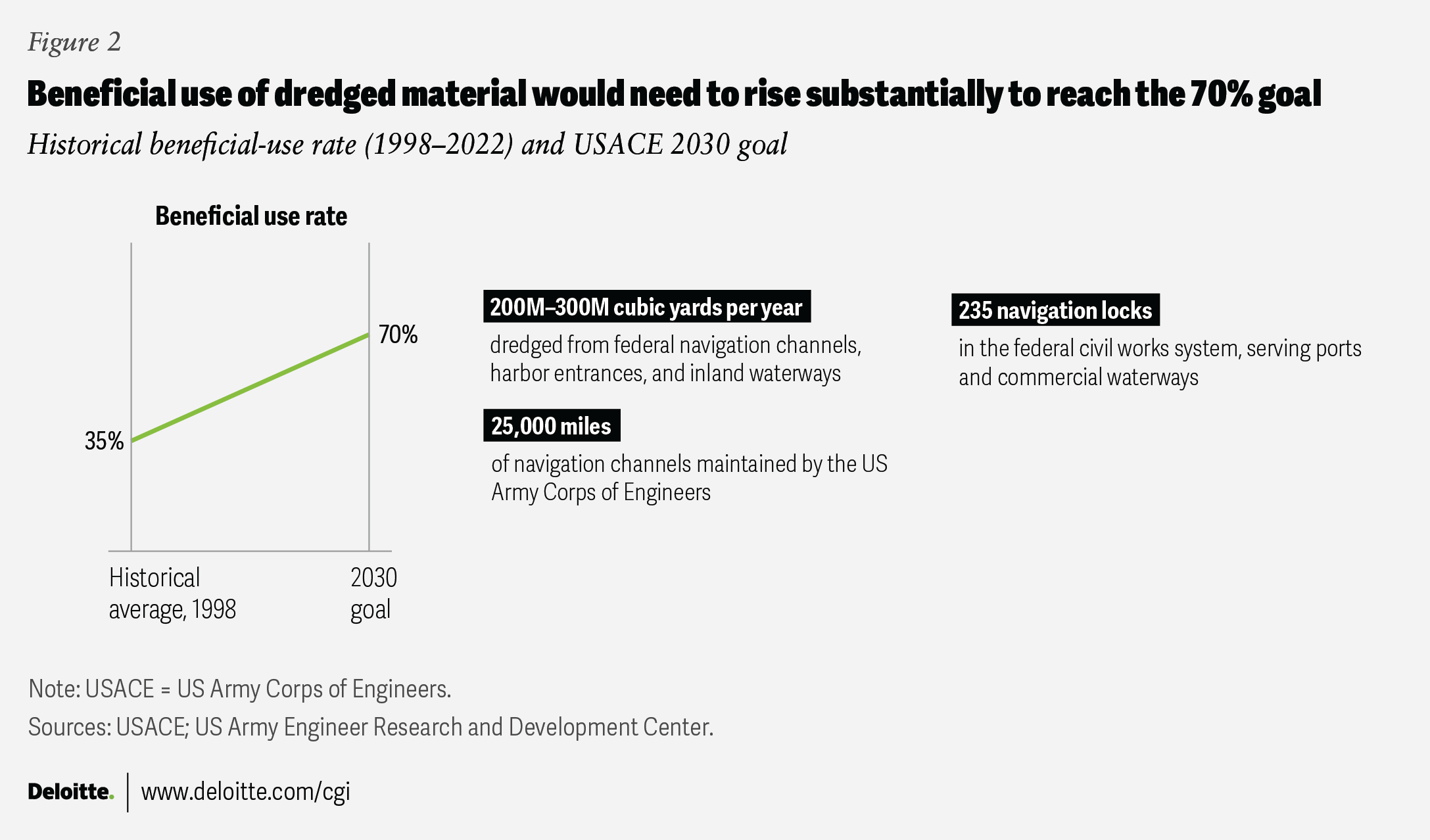
The prevailing model has prioritized moving sediment out of waterways as efficiently and cheaply as possible, through open-water placement, confined disposal facilities, or upland disposal sites. From 1998 to 2022, the US Army Corps of Engineers (USACE) estimates that roughly 30% to 40% of dredged sediment was put to beneficial use;4 the remaining 60% to 70% followed disposal or other waste-management pathways.5
Yet dredged sediment can support restoration and infrastructure projects while substituting for material that public agencies, ports, and private developers would otherwise purchase. The challenge is making these productive uses routine rather than project-specific.
Seaports are at the center of this opportunity. They generate large, recurring sediment volumes; bear substantial channel-maintenance and disposal costs; and sit adjacent to the coastal infrastructure that recovered material can protect or expand. Under the current model, sediment is treated as an end-of-project liability and disposal capacity as a finite constraint.6 In a functioning market, the same material can become a resilience input, a substitute for purchased fill, and—in some jurisdictions—a transferable asset.
The convergence of a statutory 70% beneficial use target with a pending federal standard rulemaking under the Water Resources Development Act of 2026 creates a narrow window in which the methodology for valuing dredged sediment will be codified for the coming decade. Shifting demand signals reinforce this timing: Louisiana’s pivot from river diversions to dredging-based land building, Virginia’s beneficial use requirement taking effect in December 2027, and growing offshore sand deficits along the Atlantic coast all position navigation sediment as a scarce domestic resource rather than a disposal liability.
A fragmented system keeps supply from meeting demand
USACE is responsible for the operation and maintenance of approximately 25,000 miles of navigation channels, 237 lock chambers at 192 lock sites, and the ports and harbors they serve.7 The work is carried out by a relatively small group of US-flagged dredging companies operating under long-standing domestic vessel requirements.8
Demand for suitable material already exists across several sectors. Seaports need engineered fill for expansion and other infrastructure projects, while coastal programs use material for restoration, flood mitigation, shoreline protection, and beach nourishment. Construction and manufacturing uses are also emerging, though many remain early-stage or site-specific.9
The disconnect lies in the fragmented dredging life cycle, split among federal, state, and municipal authorities managing the source; project sponsors and contractors extracting and handling material; and receiving entities using the sediment. These groups do not operate as an integrated system. Each receiving sector has different regulatory frameworks, funding mechanisms, testing standards, and timelines.10 As a result, usable sediment may go to disposal while potential users separately procure substitute material elsewhere.”
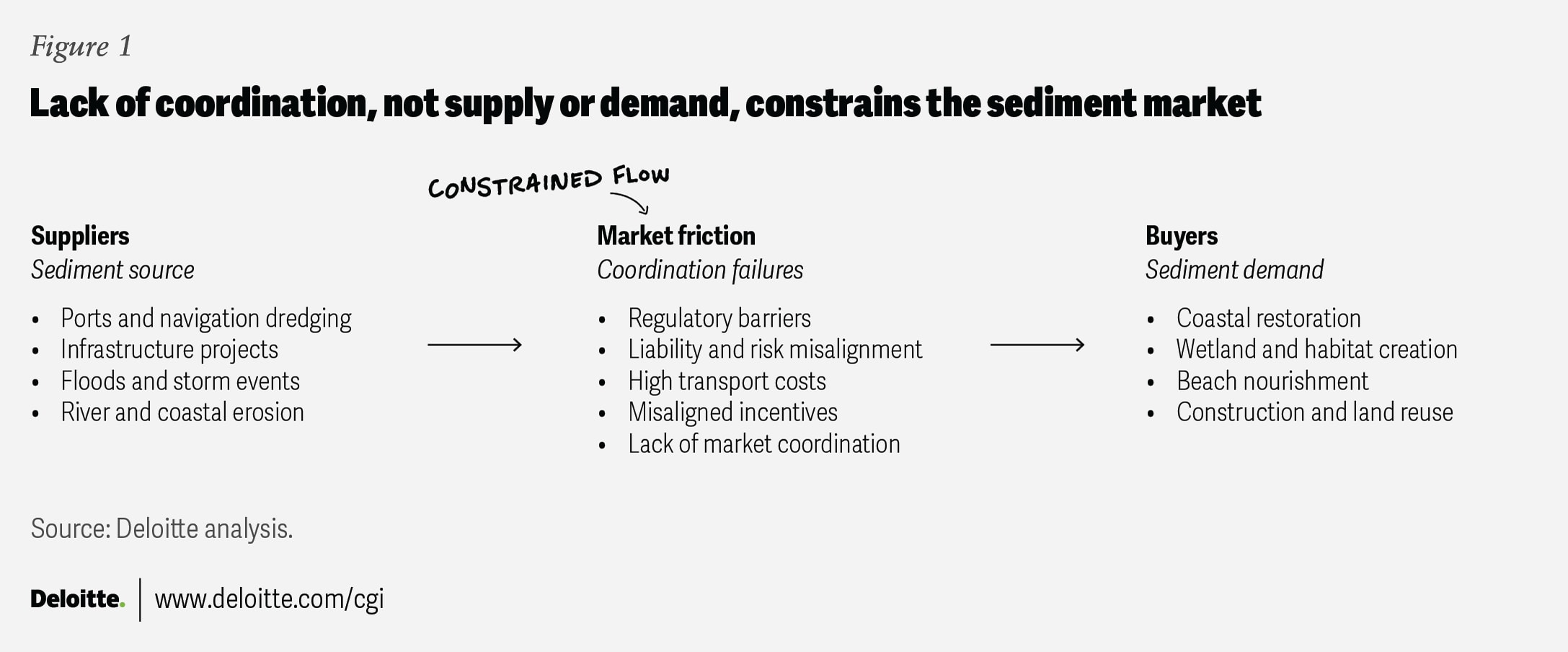
Regional programs show how sustained coordination can connect dredging with beneficial use. In San Francisco Bay, the long-term management strategy reduced in-bay sediment disposal to 1.25 million cubic yards per year while promoting uses such as wetlands restoration, levee maintenance, and beach nourishment.11 In Louisiana, the New Orleans District has beneficially used about 15.8 million cubic yards of dredged material annually.12 And at Poplar Island in Chesapeake Bay, clean dredged material has been used to rebuild habitat on an island that had eroded from 460 hectares in 1847 to just 1.5 hectares by the 1990s.13 But these examples remain geographically isolated. The United States still lacks a scalable system for connecting sediment supply with demand.14
Federal policy is creating more room for beneficial use
In January 2023, USACE’s chief of engineers established a goal to put 70% of dredged material from navigation projects to beneficial use by 2030 and limit disposal to 30% (figure 2).15 While that target is not binding, it establishes a measurable benchmark for progress.
Federal policy has also expanded beneficial use. Successive Water Resources Development Acts since 2016 have supported pilot projects and broadened the circumstances under which USACE can pursue beneficial-use options beyond the least-cost disposal baseline when environmental or risk-reduction benefits justify the added cost. 16
International experience offers similar examples. The Netherlands’ Sand Motor redistributed 21.5 million cubic meters of sand along the Delfland Coast, while Rotterdam’s Maasvlakte 2 expansion used about 240 million cubic meters of dredged sand for land reclamation. Comparable government-coordinated approaches are also used in Singapore, Belgium, the United Kingdom, and elsewhere.17
These approaches link infrastructure planning with material availability through coordinated programs, demonstrating how beneficial use can be planned at scale.
Sediment’s value depends on quality and location
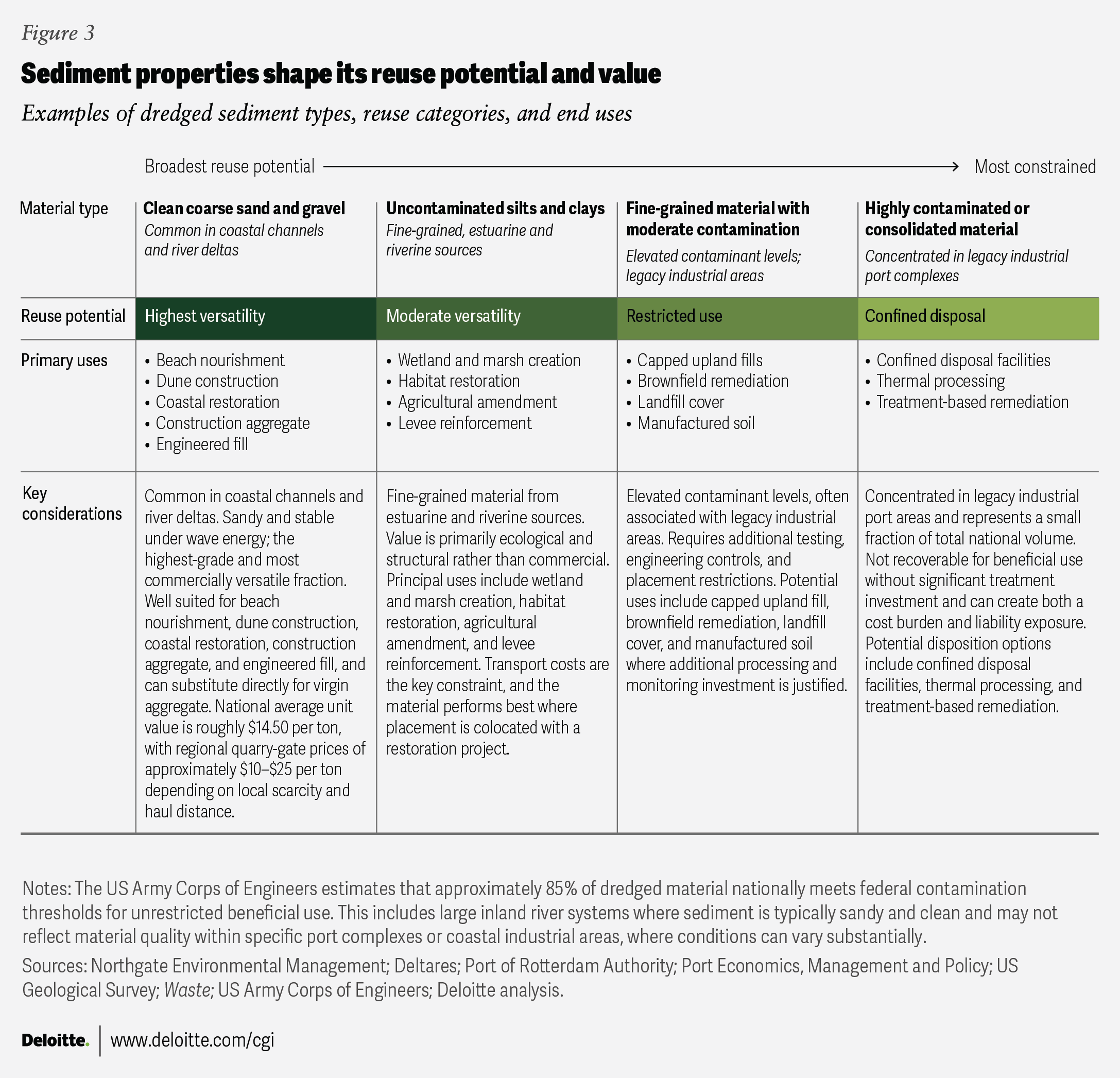
Sediment quality determines how readily it can be reused. Clean, coarse sand and gravel have the broadest range of potential applications, while uncontaminated silts and clays are more suited to ecological and structural uses.18 Contaminated material can require additional controls, processing, or disposal (figure 3).
The marketable share is, therefore, smaller than the total annual dredged volume but still economically significant. Deloitte analysis suggests that approximately 12 million cubic yards to 25 million cubic yards per year, or about 4% to 12% of annual volume, could support expanded beneficial use under current regulatory, logistical, and quality constraints.19 This subset is concentrated in cleaner, sand-dominant or otherwise reuse-feasible material streams, particularly where dredging supply and receiving demand already exist within workable transport range.
The value associated with that subset is best understood as avoided system costs rather than in a conventional commodity market. Dredged sediment can create value in two ways: by reducing disposal costs and by avoiding the cost of purchasing substitute material. Disposal costs can rise depending on transport distance, handling requirements, regulations, and whether the material requires confined or upland placement. Reusing sediment can also reduce material purchases for beach nourishment, marsh creation, habitat construction, or engineered fill. The economic opportunity emerges when one movement of material can satisfy both functions at once.
For ports, the economics are tangible: The same maintenance activity that creates a disposal burden can also produce material for nearby resilience, expansion, or fill needs. Using that material can reduce procurement needs, extend disposal capacity, and support port-adjacent infrastructure.
Some factors preventing the market from scaling
Five structural barriers continue to keep sediment supply from connecting efficiently with demand, helping explain why beneficial use remains well below the USACE’s 70% goal.
Timing mismatch: Federal dredging and receiving projects often operate on separate planning and funding cycles. When those timelines align, dredged sediment can be put to beneficial use; when they don’t, it may go to disposal by default.
Cost-allocation rules: Federal policy generally requires that dredged material be managed at the least cost to the government, commonly known as the federal standard. Beneficial use can cost more compared to disposal because it may require additional transportation, processing, testing, or placement preparation. A nonfederal sponsor is typically responsible for some or all of those additional costs, which can affect whether a project advances.
Classification and liability uncertainty: Sediment quality is another constraint because material characteristics vary, and regulatory frameworks are complex. Detecting a contaminant does not necessarily mean the sediment is classified as hazardous, but uncertainty over its regulatory classification can deter sponsors and receiving entities. That uncertainty affects project approval, insurance contracting, financing, and willingness to accept material.
Limited market visibility: Public-facing tools can help match dredged-material supply with potential users, but they do not provide the committed supply and demand, logistics pricing, or risk allocation needed for a functioning market. Sediment matching, therefore, remains largely manual, relationship-driven, and project-specific.
Physical and logistics constraints: Directing more dredged material toward productive placement can require additional vessel time, larger barge capacity, shallow-draft scows, or specialized placement equipment. A receiving project may be technically suitable and financially supported, but still infeasible if the available fleet cannot transport and place material within the required window. Although the sediment challenge is often framed as national or regional, the economics are fundamentally local. Except where material can move efficiently by barge—and even then, only within a limited range—transportation costs sharply constrain the practical radius of distribution. Over time, those costs have created a series of largely self-contained local markets, where established disposal, supply, and logistics systems shape how sediment is managed. Because these systems are generally designed to move or dispose of material rather than direct it toward its highest-value use, they can reinforce inefficient outcomes even when better uses exist nearby.
How to make the market
Because the barriers are structural, scaling beneficial use will require a coordinated system that makes supply visible, demand more predictable, quality easier to assess, logistics easier to price, and risk manageable.
Integrated regional planning: Dredging and placement decisions should be linked across multiyear horizons. Regional plans can connect federal navigation maintenance schedules with state, port, local, and private receiving projects before dredging begins, helping reduce timing mismatches and create recurring demand.
Standardized characterization: Sediment should be characterized once, with results applied across multiple approved uses within defined regulatory thresholds. More predictable classification could reduce delays, rework, destination-specific testing, and commercial risk.
Demand aggregation and offtake: The market needs to move beyond informal matching toward committed receiving capacity. Agreements to accept sediment, recurring project pipelines, and regional sediment portfolios could turn potential demand into demand that can be planned, financed, and scheduled.
Funding models that align costs and beneficiaries: Beach nourishment cost-share rules, state restoration funds, port capital plans, mitigation programs, resilience-finance tools, and public-private partnerships can help fund beneficial use where its costs exceed the least-cost disposal baseline.20 Public funding can remain part of the model, with incremental costs shared among parties that benefit from reduced disposal, avoided material purchases, and improved resilience.
Standing governance: Effective systems bring federal navigation authorities, regulatory partners, state and local sponsors, port authorities, contractors, insurers, and receiving entities together through standing coordination structures rather than project-by-project negotiations. The Beneficial Users Group concept is one potential model.21 It brings stakeholders that directly benefit from sediment use together to help fund, manage, and oversee projects. Ultimately, sediment markets need institutions that can manage risk, align timing, and keep participants engaged over time.
Regional markets may emerge first
Sediment markets may first emerge through regional clusters where clean or reusable material, recurring demand, manageable logistics, supportive governance, and available funding overlap. Federal leaders can clarify standards, strengthen data infrastructure, and align policy incentives with the 70/30 goal.22 States can integrate sediment into coastal resilience, infrastructure, and restoration portfolios. Ports can incorporate sediment into capital planning as a potential resource. Contractors and private firms can develop logistics, processing, testing, and placement capabilities. Investors and insurers can help shape risk-transfer and financing structures for repeatable projects.
The next few years will determine whether beneficial use can become a repeatable operating model. Doing so will depend on building the systems needed to connect supply with demand.
From sediment disposal to a domestic resource market
The American sediment system has operated for more than a century as an infrastructure function: quiet, technically mature, and largely invisible. Dredging will continue, and sediment will continue to move. What is changing is how that movement is understood and what is expected of the system that manages it.
Much of the infrastructure, technical expertise, and statutory foundation needed to expand beneficial use is already in place. What remains is a system that can consistently connect dredged sediment with the projects that can use it.
The system is too distributed, and the contexts too varied for a single solution. The opportunity, however, is becoming clearer. Realizing that opportunity will depend on governance and coordination that allow sediment to be organized, priced, and directed toward its highest economic and public value.
Continue the conversation
Meet the industry leaders
Crystal Upperman
By
Jerry Johnston
Crystal Upperman
The authors would like to thank the following individuals for their contributions to the research that informed this publication: Bezaleel Gebru, Devontia Williams, Matthew Taylor, Trevor Harbison, Ashish Gupta, Andrew Benson, Josephine Lee, and Hayley Rosenfeld.
They would also like to thank the following individuals for their insights, guidance, and invaluable contributions to this publication: Joe Beal, Robert de Jongh, Mike Donoghue, Mike Isman, Gibbs Lott, Brian Siegel, Avi Schwartz, Nes Parker, John Diasselliss, Ivan Kozak, Richard Longstaff, Kelly Marchese, and Tiffany Fishman.
Editorial (including production and copyediting): Kavita Majumdar, Shyamili M, Anu Augustine, and Pubali Dey
Design: Manya Kuzemchenko, Natalie Pfaff, and Alexis Werbeck
Cover image by: Manya Kuzemchenko; Adobe Stock
Knowledge services: Agni Wagh
Visit the Deloitte Center for Government Insights
Access more insights for the defense, security and justice, government health care, state and local government, transportation and infrastructure, human services, and higher education sectors.