
Beyond geology: Turning mineral endowments into investment opportunities
How finance ministries, revenue authorities, and public sector leaders can use fiscal policy to attract mineral sector investments and drive national economic growth
As governments and investors race to secure critical mineral supply chains, the countries that hold these resources face a different and more consequential challenge: whether they can convert their geological endowment into durable national wealth.
Geology determines the opportunity; fiscal policy will help determine whether that opportunity results in long-term economic benefits.
Materials once considered peripheral industrial inputs—such as lithium, cobalt, nickel, manganese, gallium, germanium, and rare earth elements—now constitute foundational inputs for clean energy systems, digital infrastructure, aerospace technologies, and advanced defense platforms.
The strategic significance of this shift has been recognized for decades. As China’s former leader Deng Xiaoping observed in the 1980s, “the Middle East has oil; China has rare earths.” Today, that observation has hardened into strategic doctrine. China controls a dominant share of global rare earth and critical mineral extraction and refining, and has begun implementing selective export restrictions, exposing vulnerabilities in the supply chains of consuming nations.1
The United States, the European Union, Australia, Japan, and a widening coalition of allied economies have responded with programs to mobilize tens of billions of dollars of public and private capital, revise trade policy, and expand development finance mandates.2 The International Energy Agency projects that meeting rising global demand for key energy transition minerals, such as copper, lithium, nickel, cobalt, graphite, and rare earth elements, will require around US$500 billion to US$600 billion in new mining capital investment by 2040. Much of this investment is needed to develop new mine capacity as declining ore grades in mature markets like copper drives up costs.3
A growing share of new investment may also be supplied by public versus private sector institutions, reflecting consuming nations’ desire to diversify their supply chains away from concentrated sources. This trend toward public sector finance is significant, but does not alter a fundamental truth for any form of finance, public or private; a host country’s fiscal design plays an important role in determining whether capital can be underwritten, deployed, and ultimately repaid.
Fiscal policy is where mineral-related value and opportunity are often won or lost. Countries’ finance ministries have the opportunity to design fiscal systems that attract investment, manage risk, and convert mineral wealth into lasting public value. Those that build these transparent and resilient fiscal systems early will capture long-term value; those that do not risk repeating the volatility and missed opportunities of past extractive cycles.
Below we outline three key structural challenges that need to be addressed to convert mineral-related opportunities into sustainable value, and discuss some practical design principles to address those issues.
Critical minerals call for a different fiscal approach
Critical minerals share many fiscal characteristics with traditional extractive industries, such as oil and gas, including long development periods, large sunk investments, revenue volatility, and substantial pre-production exposure. What distinguishes the current critical-minerals cycle is the combination of these familiar extractive risks with thin and often opaque markets, rapid technology-driven demand substitution (for example, in advanced battery chemistries), highly concentrated supply chains, and an expanding use of public finance and industrial-policy instruments by both producer and consuming countries. Project development timelines compound this uncertainty. The interval from exploration to commercial production can span a decade or more, exposing governments to pre-revenue financial commitments— including infrastructure co-investments, land access concessions, and energy cost subsidies—long before a single dollar of revenue materializes. Many of these commitments may not appear on government balance sheets, making the full scope of fiscal exposure difficult for legislators and citizens to see.
Institutional preparation needs to begin well before revenue starts to flow. Ministries that treat this period as downtime may miss their best opportunity to establish clear fiscal rules, strengthen revenue administration, and put stabilization mechanisms in place before investment and revenues arrive. Preparing during this window puts governments in a stronger position to convert mineral wealth into lasting public value.
The resurgence of industrial policy, through which governments make financial commitments that seek to influence market activities to secure supply chains, introduces another layer of fiscal complexity. Tax incentives, concessional loans, price guarantees, strategic stockpile financing, and long-term offtake agreements each carry distinct fiscal consequences. Tax holidays represent tax expenditures. Price floors create contingent liabilities. Equity participation introduces balance sheet exposure. The policy logic may be sound—supply chain resilience is a legitimate public interest—but it does not change the fiscal equation.
Increasingly, several of these instruments—particularly concessional loans, price guarantees, and long-term offtake commitments—originate with or are co-structured by external financing partners rather than the host government’s treasury alone. Their fiscal treatment must therefore be reconciled with the terms of those arrangements, which can affect the royalty base (the benchmark reference price against which royalties are assessed), the corporate tax base (through the treatment of concessional debt), and other taxes and liabilities.
Finance ministries are no longer the only stakeholders in mineral fiscal design. A growing share of the capital targeting critical mineral projects is public or publicly backed, driven by consuming nations and their allied financing institutions. Such capital is patient and strategically motivated, but it is also risk-sensitive and accountable to its own legislatures. It is underwritten against the host country’s fiscal regime—including the stability of royalty and tax rules, the integrity of ring-fencing and transfer-pricing enforcement, the transparency of contingent liabilities, and the adequacy of environmental risk management.
A well-designed fiscal regime, therefore, serves two purposes. It protects domestic public value while lowering the perceived risk that influences whether external, supply-chain-driven capital is deployed. Fiscal opacity and instability have the reverse effect, raising financing costs or deterring investment regardless of the quality of the underlying deposit.
For producer governments, fiscal architecture is therefore not only a tool to capture value, but also one of the most effective ways to attract the new forms of strategic capital now entering the market.
Governance and revenue administration are key to capturing value
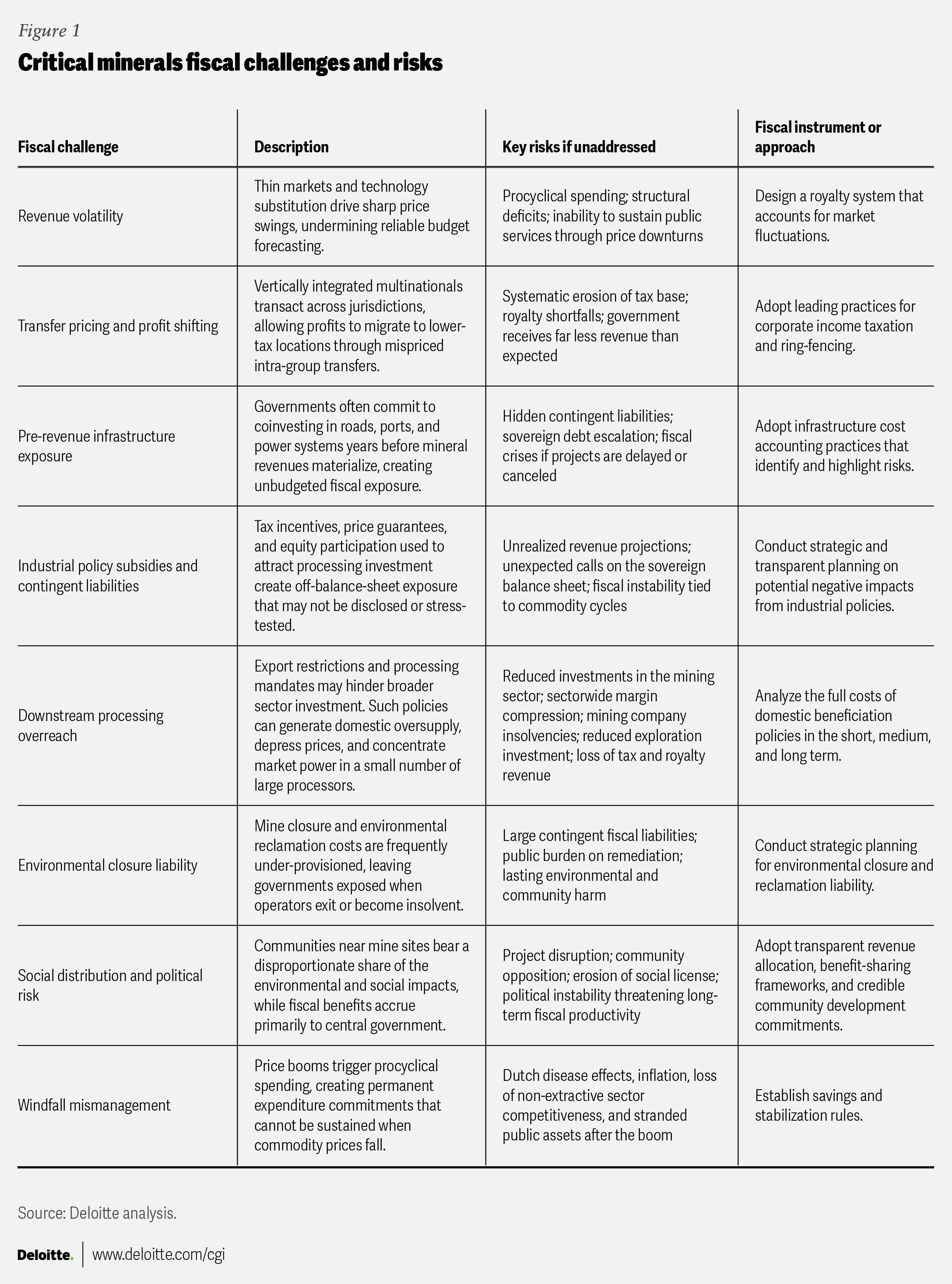
Mineral wealth does not automatically translate into public benefit. Previous resource booms have shown that realizing fiscal gains depends on the capacity of key institutions to manage fiscal administration, the quality and consistency of governance, and the transparency of public financial management. The complexity of the critical minerals sector only raises that bar further (figure 1).
Transfer pricing and profit attribution help protect public revenue
Transfer pricing risks are particularly acute when multinational firms operate across vertically integrated supply chains, as is the case for most high-value critical minerals. Because third-party reference prices are often unavailable for products traded within the same corporate groups, it can be difficult to determine whether those transactions reflect market value.
To address that risk, revenue authorities need specialized expertise to monitor and audit related-party transactions and adopt project-level ring-fencing rules that prevent companies from offsetting profits from one project against losses from another. Without those capabilities, the fiscal regime on paper may bear little relationship to the revenue governments actually collect.
To guard against this risk, related-party pricing can follow the Organisation for Economic Co-operation and Development’s (OECD) arm’s length methods, together with the extractives-specific guidance it developed with the Intergovernmental Forum on Mining. This includes reference-price (“sixth method”) approaches, which use independent market prices as a benchmark when valuing mineral sales between related companies.4
The promise and limits of downstream processing incentives
Many producer governments seek to capture greater value from their mining sectors by encouraging domestic processing through export restrictions or differential taxation. These strategies can support a long-term industrial development vision, but governments also need to weigh their full fiscal costs. They should consider how quickly demand can shift, for example, if new battery or semiconductor technologies reduce the need for a particular mineral over the next five to ten years.
Sharing mining benefits can help sustain public support
Revenue administration can often extend beyond central government institutions. Mining projects generate social and environmental impacts that are often borne disproportionately by communities near mine sites. When communities see the benefits of extraction flowing elsewhere while they bear a disproportionate share of the impact, the political sustainability of the project—and the broader fiscal regime—can be placed at risk.
In Guinea, for example, villages near bauxite mine sites in the Kindia and Télimélé regions have reported water pollution and declining crop yields. These concerns have caused project delays and eroded public trust in the government’s ability to manage the sector.6
Transparent revenue allocation, benefit-sharing frameworks, and credible community development commitments are more than social policy—they are prerequisites for long-term fiscal productivity.
Designing a strong minerals fiscal regime
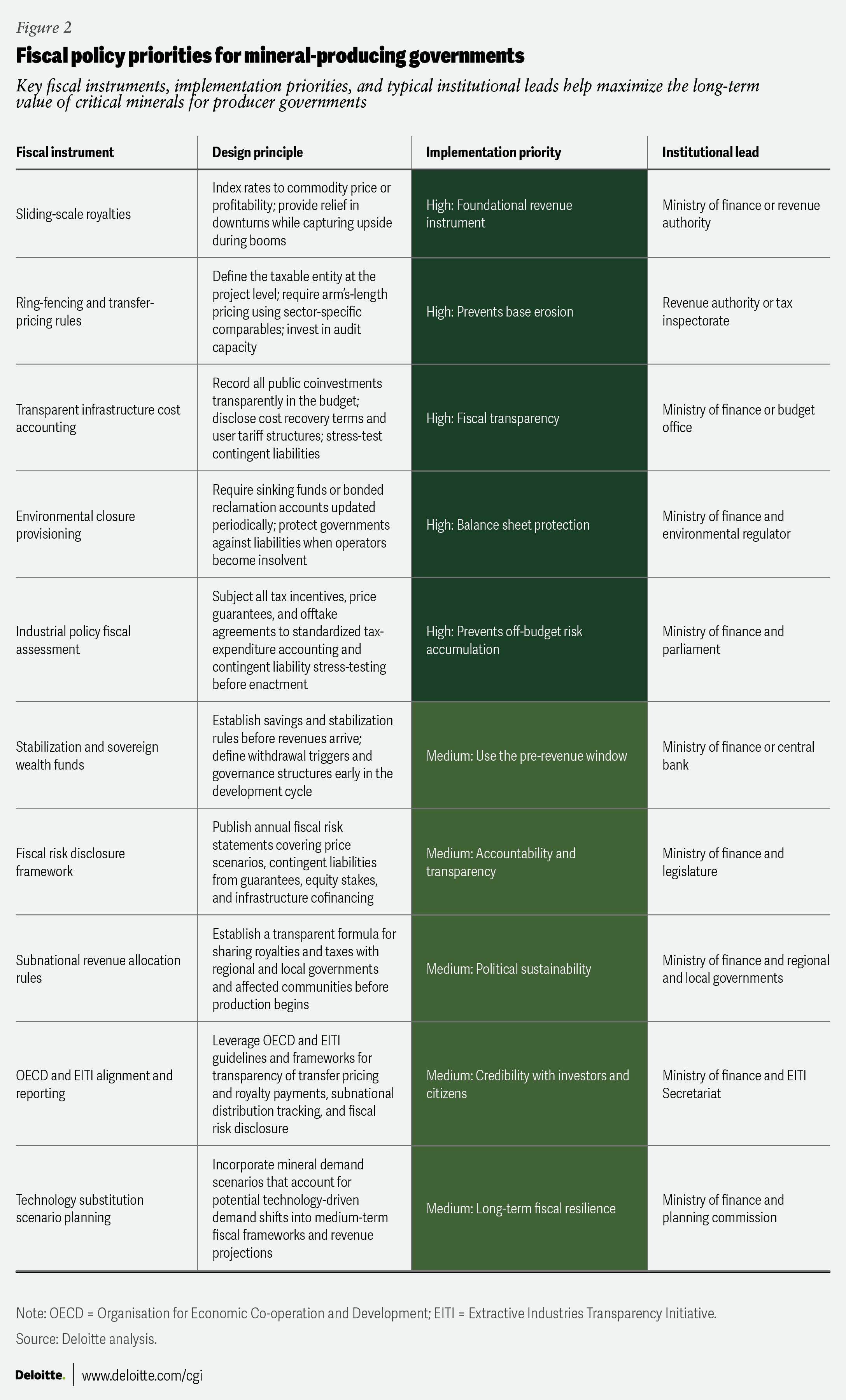
In most producer countries, mineral resources are public assets. A strong fiscal regime determines how the value they generate is shared between private investors and the state. Five components are particularly important (figure 2).
Royalty design
Royalties can provide an early and relatively predictable revenue stream when calibrated appropriately. A sliding-scale royalty structure—indexed to commodity price or a profitability metric—enables the state to capture additional revenue during price booms while providing the industry with payments relief during cyclical downturns. This approach shares risk more equitably between investors and the treasury and promotes greater stability for both project economics and public revenues over the full life cycle. It’s equally important to transparently account for how royalty revenues are distributed to subnational governments and local communities, not just how much flows to the central government.
Corporate income taxation and ring-fencing
Corporate income taxation remains a fundamental pillar of mineral revenue capture. Without project-level ring-fencing and robust transfer pricing rules, taxable profits may migrate across jurisdictions or be offset against losses from unrelated operations. Specialized audit capacity, transparent cost recovery rules, and clear definitions of the taxable entity are essential elements of effective domestic resource mobilization.
Revenue authorities require both the legal framework and the technical capability to administer these provisions effectively. The OECD and the Extractive Industries Transparency Initiative (EITI) offer complementary frameworks that finance ministries can leverage: OECD guidance governs how related-party transactions are priced and taxed, while the EITI sets the standard for transparent disclosure of what companies pay and governments receive, including subnational distributions.7
Infrastructure cost accounting
Public co-investment in mining-enabling infrastructure such as roads, ports, power systems, and water supply should also be treated transparently in fiscal accounts and risk frameworks. Clear rules governing cost recovery, user tariff structures, and equity participation are necessary to prevent subsidy leakage. Fiscal risk statements should explicitly include exposures from infrastructure guarantees and co-financing arrangements, enabling legislatures and citizens to understand the full scope of the government’s financial commitment.
Infrastructure is often co-financed by external development finance institutions or export credit institutions, particularly in emerging producer economies. Where that happens, cost-recovery rules, guarantees, and tariff structures also need to satisfy the requirements of those financiers, whose participation frequently depends on the transparent fiscal arrangements.
Environmental closure and reclamation liability
Environmental closure costs can become a significant fiscal risk if not provisioned for in advance. Sinking funds, financial assurance bonds, escrowed reclamation accounts, and periodic reassessment of closure cost estimates are essential components of prudent fiscal design. These measures also reduce the risk of government inheriting unfunded liabilities by ensuring reclamation is planned from the project design stage.
Environmental liability management is a balance sheet protection issue for the national government, not solely a regulatory matter. Where regulatory and fiscal incentives align, post-closure mine assets can be repurposed productively. Former mine workings in Australia, for example, have been converted into pumped hydropower storage sites, generating clean energy and continued employment long after ore production has ceased, as at the Kidston project in Queensland.8
Managing windfalls helps protect long-term value
A well-designed royalty and tax regime should also prepare governments for periods of high commodity prices, when revenues can increase rapidly. Without effective fiscal management, such windfalls can be just as destabilizing as revenue shortfalls, fueling procyclical spending, inflationary pressures, or exchange rate appreciation that weakens the competitiveness of non-extractive sectors. Capital expenditures made during these price booms often create long-term operating cost obligations that continue long after the windfall has passed.
Sovereign wealth funds and fiscal stabilization funds are among the most widely used tools for managing this volatility. These funds are typically established by national governments to channel surplus resource revenues into diversified assets instead of the domestic economy. This approach helps insulate the exchange rate from commodity-driven swings and builds savings for future generations. Botswana has operated a mineral-linked sovereign fund since the 1990s through the Pula Fund.9 More recently, Namibia established the Welwitschia Fund in 2022, while Mongolia launched the Chinggis Khaan Sovereign Wealth Fund in 2024, which includes a dedicated “Future Heritage” account for intergenerational savings.10
Building fiscal systems before the boom
The next decade will test whether resource-rich jurisdictions can translate rising demand for critical minerals into durable economic gains. Success will depend not only on resource endowment but also on fiscal discipline and the policy choices governments make before revenues begin to flow—not after.
Countries that build transparent, resilient fiscal systems with appropriately calibrated royalty structures, robust transfer pricing enforcement, credible stabilization funds, and clearly articulated benefit-sharing arrangements will be best positioned to turn today’s demand for critical minerals into lasting national wealth. Those that do not are likely to repeat the volatility, governance failures, and missed opportunities that characterized previous extractive cycles under new market conditions.
Continue the conversation
Meet the industry leaders
Steve Lewarne
Cole Johnson
by
Richard Longstaff
Steve Lewarne
Joe Figueiredo
Cole Johnson
Editorial (including production and copyediting): Kavita Majumdar, Cintia Cheong, Pubali Dey, and Preetha Devan
Design: Natalie Pfaff
Cover image by: Pooja Lnu
Knowledge services: Vanapalli Viswa Teja
Visit the Deloitte Center for Government Insights
Access more insights for the defense, security and justice, government health care, state and local government, transportation and infrastructure, human services, and higher education sectors.