
Adaptive by design: The next operating model for government
Many government agencies have begun to organize work around reusable platforms, mission-driven teams, and people practices that enable real agility
Government operating models were built for stability, scale, and clear lines of accountability. Today, they must also deliver adaptability. Artificial intelligence, fiscal pressure, rising citizen expectations, and complex cross-agency missions are exposing the limits of siloed hierarchies and static organizational charts.
Adaptability cannot be achieved through structure alone. It requires an operating model designed for continuous reconfiguration.
What is emerging is not simply a digital upgrade, but a redesign of how government organizes work. Instead of periodic restructures, agencies can standardize shared capabilities, assemble agile teams around outcomes, and enable talent to move fluidly where it is needed most.
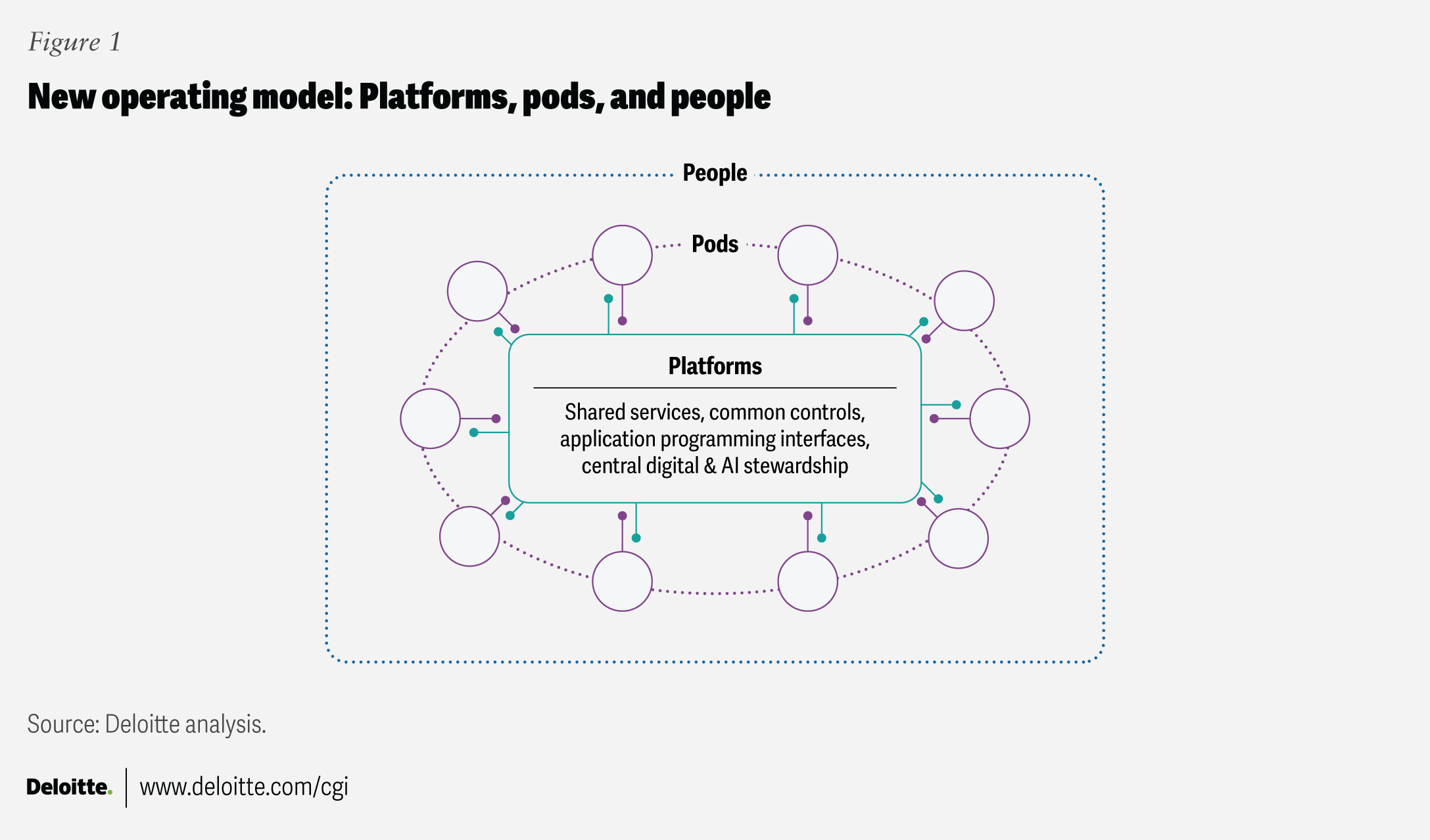
Three reinforcing elements define this model:
- Platforms provide shared, reusable capabilities—data, infrastructure, standards, and core services—that reduce duplication and enable integration.
- Pods are small, multidisciplinary, time-bound teams that assemble around specific outcomes and dissolve once their mission is complete.
- People practices support distributed decision-making, skills-based mobility, and leadership models that allow talent to move where it creates the most value.
This model complements—not replaces—stable service delivery. Government will always need reliable, standardized operations. What changes is how it adapts and evolves.
In practice, this means distinguishing between two types of work. “Run” work consists of repeatable, high-volume processes that benefit from standardization, shared data, and automation.1 “Grow” work brings cross-functional teams together around specific outcomes, often in response to emerging challenges.
By building reusable capabilities (platforms) and nimble, outcome-focused teams (pods) supported by smart workforce practices (people), agencies can create the architecture they need to thrive (figure 1). Today, only around 6% of public organizations report strong progress in breaking functional boundaries; the new operating model will take governments toward a future where significant integration is the default.2
Signals: Adaptive by design
Trend in action
Platforms: The shared foundation
Governments often respond to fragmentation by centralizing systems, conducting large-scale overhauls, or consolidating back-office functions such as human resources, finance, and information technology. Shared services can reduce duplication and generate efficiencies. But when treated primarily as technology consolidation, they rarely change how work is organized across agencies. Fragmentation often persists—just on a common system.
Shared services centralize functions. Platforms integrate capabilities. Rather than requiring every agency to use the same tool, it establishes shared, reusable capabilities—common data standards, core services, and orchestration tools—that connect existing systems while preserving flexibility. Agencies can retain their own systems but operate through a shared layer that enables integration, transparency, and performance management.
With AI and application programming interfaces, data can move securely across systems in real time, reducing manual work and enabling coordination without wholesale replacement. For example, when multiple agencies require similar software or cloud services, a shared acquisition platform can aggregate demand and recommend enterprise-wide agreements—unlocking cost savings without restructuring agencies themselves.
A mature government platform typically combines a shared data layer, workflow orchestration, user-facing services, and built-in performance tracking. These standardized capabilities are designed for reuse across agencies and pods, allowing teams to build and adapt services more quickly using common components.
These layers of standardized, shared tools are designed for reuse by multiple agencies and teams (or pods). This reusability enables teams to build new digital services quickly with common parts.
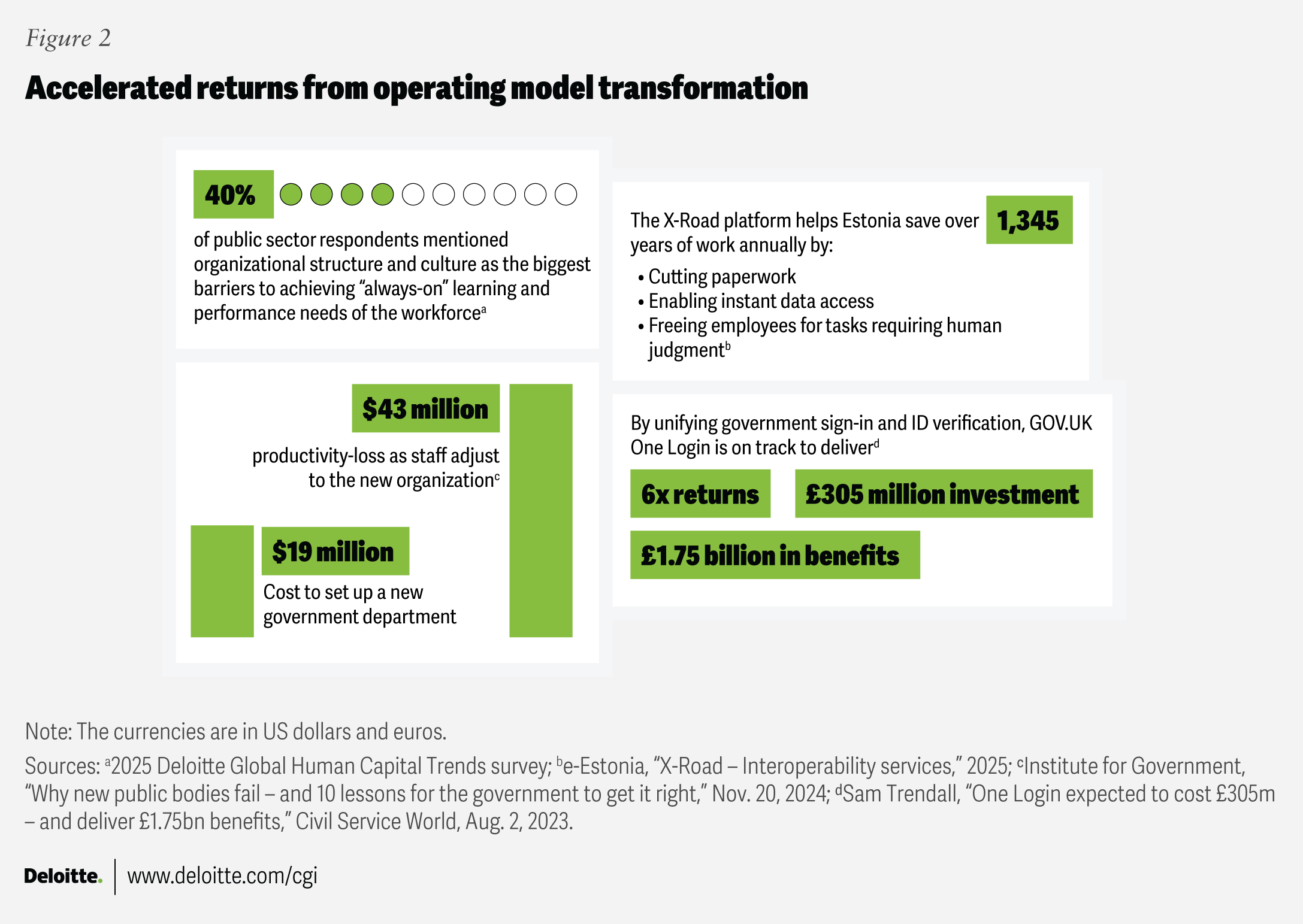
Estonia’s X-Road illustrates the platform approach. It provides a secure national data exchange layer connecting hundreds of public and private databases. Agencies retain their own systems but operate through a shared infrastructure that enables faster, safer cross-agency transactions.3
Singapore’s Government Tech Stack reflects a similar shift. As a whole-of-government platform of shared digital services and infrastructure, it provides reusable components that agencies can assemble into applications—reducing development time, improving quality, and enabling easier data exchange across government.4
Governments worldwide are beginning to pivot to a platform model by adopting some of its key features.
Moving beyond monolithic systems: Governments are moving away from monolithic, customized systems toward services built from shared infrastructure. Rather than procuring large standalone platforms for narrow functions, agencies are assembling capabilities using common data standards and standard connections.
This shift is feasible even in distributed technology environments. Workflow and orchestration tools can bridge system gaps without requiring wholesale replacement.5
A UK energy company brought its scattered finance data into a shared platform, so teams no longer had to work from separate reports. This made it possible to see up-to-date financial information in real time through a simple interface. While phasing out its old billing system—operating the old and new systems side by side—it created a single financial data model so everyone was working from the same numbers. The system could pull in data from different places without copying it, replacing 45 spreadsheet reports with one live report and making it possible to search billions of records almost instantly.6
Continuous improvement through performance data: Shared platforms can do more than integrate systems; they integrate accountability. When performance data remains trapped inside agency systems, it is difficult to compare results, improve services, or increase transparency. A platform model makes performance visible—not just internally, but across the system.
Singapore’s shared-services hub, VITAL, began as a transactional processing center for payroll and procurement.7 Today, it publishes service-level metrics openly, allowing agencies to monitor quality and drive continuous improvement. Reusable automation tools further reduce development time and complexity.8
Similarly, the United Kingdom’s National Data Library initiative is designed to make public sector data sets easier to find, curate, and connect across silos—with governance safeguards to support safe reuse and measurable public value.9
By embedding transparency and feedback loops into shared platforms, governments can move from static reporting to ongoing performance management.
Collaborative governance: Shared platforms require a different governance model. Traditional oversight emphasizes compliance and control within organizational silos. A platform approach shifts toward stewardship—where central agencies set standards, operate shared capabilities, and publish performance data, while enabling distributed execution.
In this model, the center does not micromanage delivery. It defines guardrails, maintains common building blocks, and ensures transparency across the system.
New Zealand’s Border Executive Board illustrates this shift. By pooling authority across agencies, it replaced fragmented directives with coordinated decision-making around shared priorities. During the pandemic, this structure enabled the rapid implementation of quarantine-free travel and vaccination programs because data, processes, and authority were aligned.10
Governance in a platform model becomes less about enforcing uniformity and more about enabling coherence.
Bypassing the “single system”: Australia’s modernization efforts illustrate an alternative to wholesale system replacement. Rather than pursuing a single enterprisewide platform, the government has focused on building common capabilities, such as identity verification, that agencies can integrate into their own systems.11
These shared capabilities can be adopted incrementally, simplifying modernization while enabling faster responses to changing needs. The broader principle is structural: Deconstruct work into common components, standardize what can be shared, and reconnect capabilities around outcomes rather than organizational boundaries.
Pods: Agile teams built for outcomes
If platforms create shared capacity, pods determine how quickly government can deploy it.
Traditional agencies often respond to complex challenges by creating permanent units. Over time, these structures can harden, even as priorities shift. Pods offer a different model: Small, multidisciplinary teams are formed around a specific outcome and given clear authority and timelines; they work in short cycles, and dissolve once their mission is complete.
Today, only 28% of government agencies report regularly using dynamic, on-demand teams; yet nearly 70% believe such teams will be critical within three years. This gap signals both urgency and opportunity.12
Pods can advance multiple goals.
Accelerating problem-solving: The United Arab Emirates’ Government Accelerators program assembles cross-agency teams to tackle national priorities within fixed timelines—often 100 days. With cabinet-level sponsorship and delegated authority, these teams can bypass routine processes and move from problem to measurable results quickly.13 In one case, a team reduced industrial emissions by 16% in 100 days; another increased patent filings sevenfold over the same period the prior year.14
Enabling faster, citizen-centric services: A number of Danish agencies have shifted from long, linear projects to multidisciplinary pods that iterate in short cycles. Policy experts, technologists, designers, and user representatives work together, continuously refining services based on direct feedback and significantly shortening delivery timelines.15
Cross-agency collaboration on local challenges: In Denver, “tiger teams” brought cross-functional groups together to address construction permitting delays and street homelessness.16 By aligning authority and accountability within small teams, the city reduced construction approval times by 30% and street homelessness by 45% within 18 months.17
Emerging technologies—particularly AI, automation, and low-code platforms—further increase the speed and flexibility of pods. Teams can orient quickly, test solutions safely, and convert prototypes into working features without lengthy procurement or integration cycles.
As digital agents increasingly handle administrative coordination, teams themselves become lighter and more mobile. In this model, adaptability comes not from restructuring agencies, but from continuously reconfiguring small teams around evolving missions.
People: A workforce designed for mobility
No operating model changes unless the workforce model changes with it.
If platforms provide the shared foundation and pods enable speed, people determine whether adaptability becomes routine. This model shifts authority closer to where data and delivery intersect, organizes work around skills rather than roles, and enables talent to move fluidly across missions.
Some of this is already visible in public organizations.
Distributed leadership and empowered decision-making: Traditional hierarchies can slow decisions when authority sits too far from frontline work. An adaptive model pushes ownership closer to delivery.
The UK Government Digital Service formalized single service ownership for major products such as GOV.UK, Pay, and Notify, so important decisions sit with the teams closest to users.18 Each service has a clearly accountable owner responsible for performance and outcomes, supported by multidisciplinary teams operating within shared standards. As of mid-2024, more than half of the government’s top services had designated single owners.19
HR as a capability orchestrator: In a continuously reconfiguring organization, HR shifts from managing static roles to orchestrating capabilities. Skills, not job titles, become the organizing principle.
The Australian Public Service’s Career Pathfinder platform uses AI to map transferable skills across departments, enabling faster redeployment as priorities evolve. Within months, it connected tens of thousands of roles across agencies.20
Commercial organizations are moving in a similar direction. Some have integrated HR and digital leadership and deployed AI assistants to streamline workforce management—reinforcing the link between talent mobility and operational agility. Moderna has merged HR and IT under a chief people and digital technology officer and deployed more than 3,000 tailored AI chatbots for HR tasks, streamlining performance management and employee support.21
Decoupling domain expertise from organizational structures: In many organizations, expertise remains confined within functional silos—finance knows finance, policy knows policy, and IT knows tech. The result is slower innovation and limited cross-pollination of ideas. An adaptive model allows expertise to travel.
New York City’s Office of Data Analytics operates as a shared internal consultancy, pairing data scientists with frontline agencies. Working with the fire department, it helped develop FireCast—a predictive model that integrates data across agencies to prioritize inspections.22
Professional communities, such as the UK Civil Service’s Government Professions framework, ensure that deep expertise is maintained even as individuals move across missions.23
AI can further reduce friction. New team members can rapidly gain contextual understanding, access shared knowledge, and contribute from day one.
In this model, adaptability is not achieved by restructuring departments every few years. It is achieved by enabling people, skills, and authority to move continuously within a stable shared architecture.
When talent can flow as easily as data, governments can become both more responsive and more accountable.
Enablers and accelerators
Leaders can begin designing this operating model now by:
- Requiring the reuse of shared digital capabilities, including common APIs, data standards, and workflows, to reduce duplication and accelerate delivery.
- Publishing transparent performance dashboards to enable benchmarking, shared learning, accountability, and continuous improvement across teams.
- Defining sunset criteria for pods at launch, clarifying when and how teams will dissolve or evolve once outcomes are achieved.
- Delegating decision authority clearly to pod teams, reducing bureaucratic delay while maintaining guardrails.
- Adopting AI-enabled skill-mapping platforms to assemble and reconfigure teams rapidly as priorities shift.
- Establishing a systemwide orchestration view to track capability, capacity, and cost—and rebalance resources continuously.
Toward 2030: The future this trend could unlock
Shared platforms seamlessly integrate core capabilities such as identity verification, payments, notifications, and analytics—allowing agencies to assemble services without duplicating infrastructure.
Single-window services become standard. Citizens provide information once, and agencies securely reuse it across programs, reducing friction and administrative burden.
Performance transparency is routine. Real-time dashboards allow leaders and the public to see service effectiveness, compare results, and drive continuous improvement.
Pods assemble and dissolve around clearly defined missions, reducing bureaucratic inertia and delivering measurable outcomes in months rather than years.
Workforces are organized around skills, not static roles. Talent moves fluidly across agencies and missions, supported by AI-enabled capability platforms.
AI becomes a trusted operational partner—accelerating orientation, knowledge transfer, and coordination—while human judgment remains central to complex decisions and citizen engagement.
Governments act as orchestrators of shared capabilities, deploying teams and resources quickly as priorities shift.
by
William D. Eggers
Aprajita Rathore
Alex Massey
Adithi Pandit
Amrita Datar
Ipshita Sinha
The authors would like to thank Apurba Ghosal from the Center for Government Insights for helping in the research and development of the draft. In addition, the authors would like to thank Liam A. Davies and Christopher Hamilton for their thoughtful feedback on the draft. The authors would also like to thank Sir Brian Roche, public service commissioner of New Zealand, for his valuable input in the “My take” section.
Editorial (including production and copyediting): Kavita Majumdar, Rupesh Bhat, Aparna Prusty, Anu Augustine, Cintia Cheong, and Pubali Dey
Design: Molly Piersol
Cover image by: Meena Sonar and Sonya Vasilieff
Knowledge Services: Rishitha Bichapogu
Visit the Deloitte Center for Government Insights
Access more insights for the defense, security and justice, government health care, state and local government, transportation and infrastructure, human services, and higher education sectors.