
From enabler to architect: How technology leadership now shapes mission delivery
As government agencies embrace AI, the lines between IT leaders’ strategic and tactical roles are shifting, forcing leaders to redefine those roles or be defined by them
As government agencies embrace artificial intelligence, the line between information technology strategy and execution is narrowing, pushing technology leaders to shape mission outcomes more directly.
AI and rapid technological change have transformed IT roles within agencies. Leaders still keep the fundamentals running—managing outages, updates, and security—while now also overseeing AI agents and digital platforms that can help citizens navigate services in plain language. Increasingly, they orchestrate the technology stacks and ecosystems where intelligent automation takes shape.
Technology leaders now operate at both strategic and tactical levels. They advise on technology tools to drive transformation while selecting AI models, defining guardrails, and guiding AI adoption. Striking the right balance matters: IT is evolving from a specialized department into the digital fabric that enables government performance (figure 1).
Today’s IT leaders need to define their own tomorrow—or risk having it defined for them.
Signals: From enabler to architect
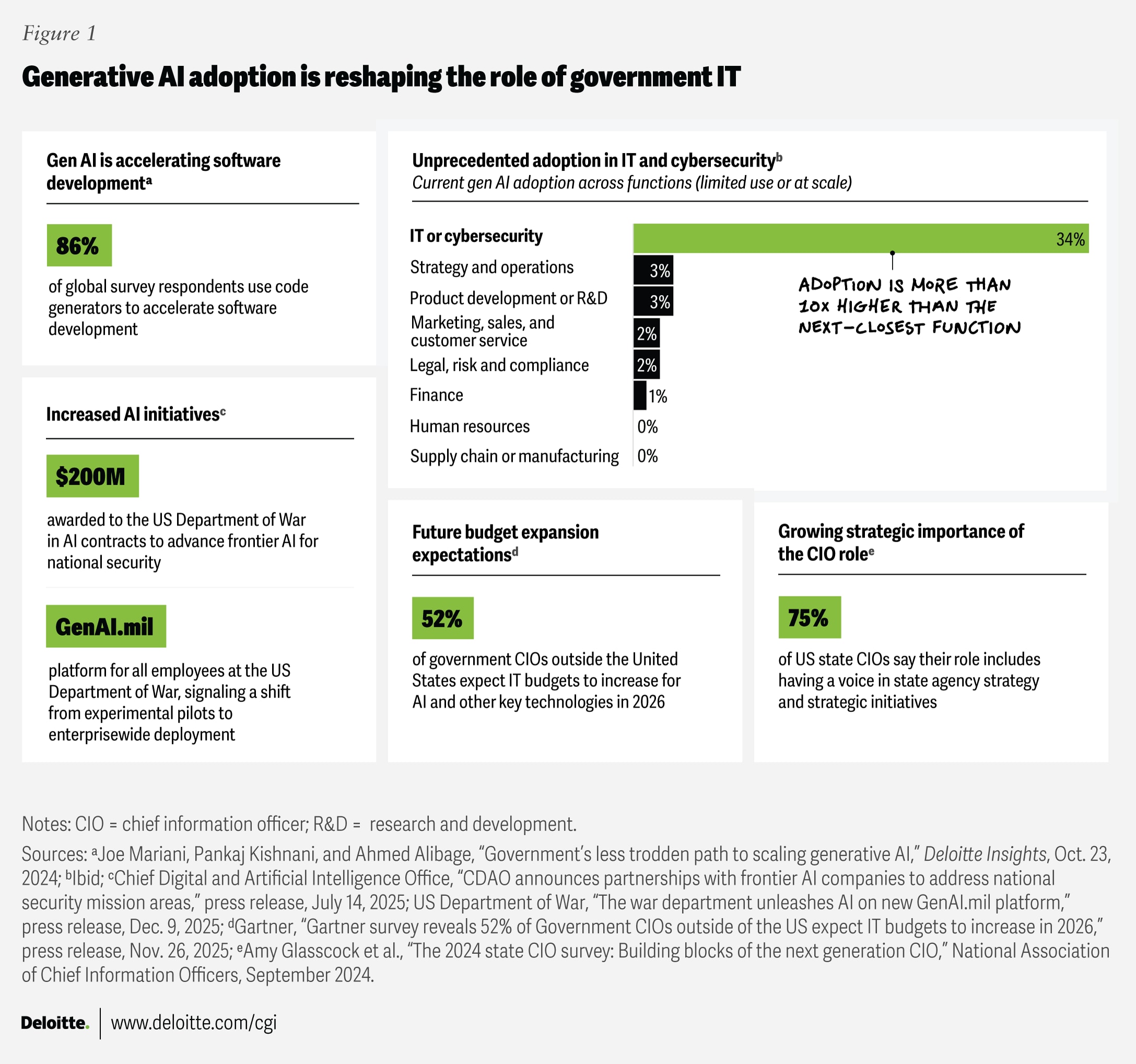
Trend in action
Government IT leaders have historically had to balance being strategic and tactical, as well as technical and mission-oriented. What has changed is that generative AI is seemingly causing strategic and tactical roles to surface in new situations and in new combinations. This shift means that the old ways of working, teaming, and finding tools may no longer fit. Government IT leaders need to actively shape what role they want—and need—to play within their agencies (figure 2).
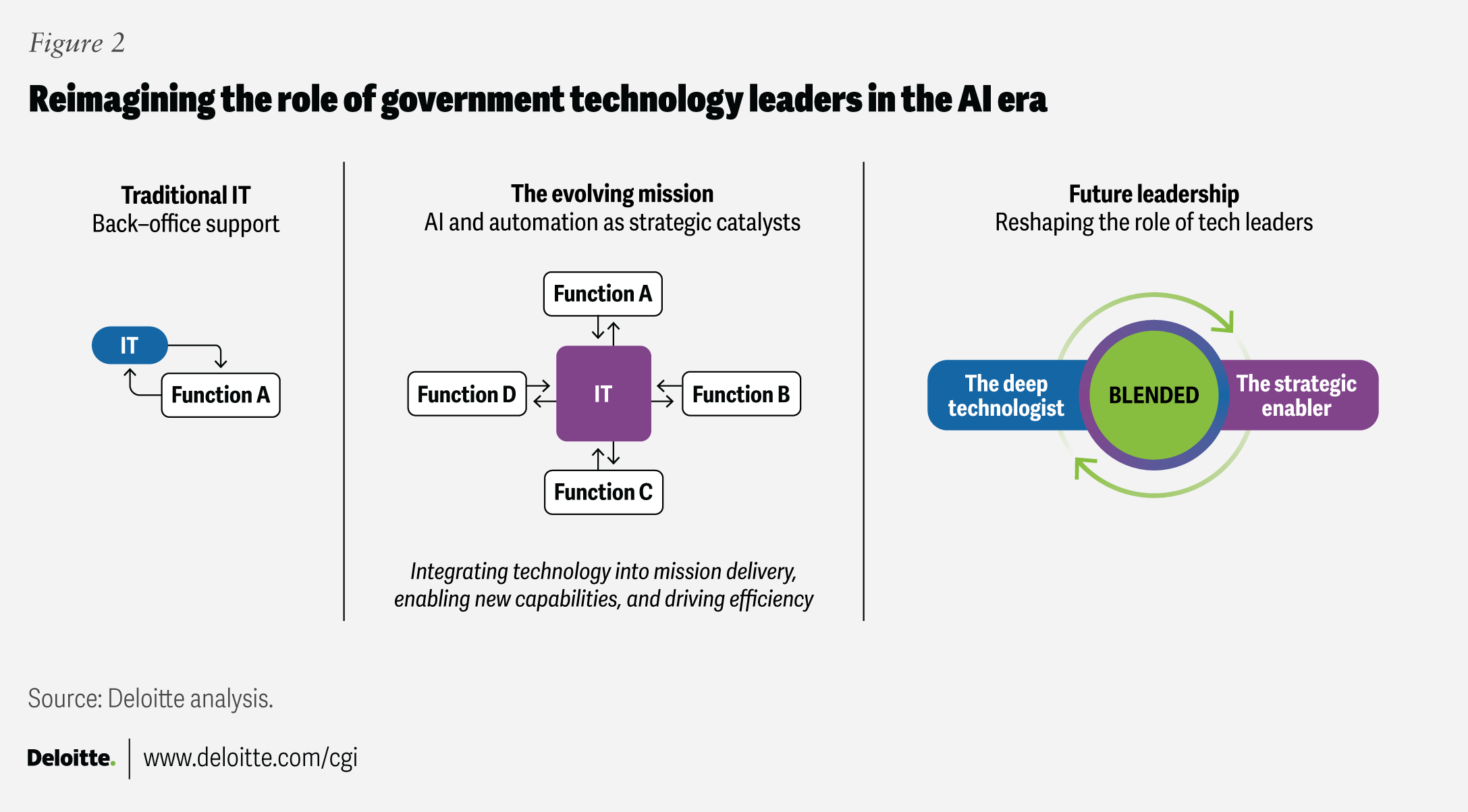
The strategic in the tactical: When tech decisions shape mission outcomes
Technology once operated largely behind the scenes. Today, it sits at the center of mission delivery.
Most citizen interactions and policy implementation now flow through digital systems that IT designs and governs. Nearly half of AI use cases in the US federal government support mission-enabling functions such as financial management and human resources.1 Cloud adoption follows a similar trajectory, with agencies investing heavily in AI-enabled infrastructure.2
IT teams are not simply enabling other departments—they increasingly deliver outcomes directly. When citizens apply for permits or access benefits, they interact with systems that IT architects and maintains. Automation now handles tasks that once required entire teams, while IT professionals coordinate intelligent systems behind the scenes.
As technology becomes mission-critical, tech leaders are shaping organizational strategy. Across government, leaders report that integrating data across systems is central to real-time decision-making. Four-fifths of leaders surveyed across government functions say that the ability to integrate data across disparate systems is the most important factor affecting real-time decision-making.3
While chatbots may get all the limelight, the underlying technologies are quietly transforming IT management itself. Many banks and other organizations that require high security and significant uptime are turning to autonomous vulnerability remediation platforms. Studies of these AI-assisted systems—which detect, diagnose, and patch vulnerabilities—find that they can reduce downtime by 87% and cut time to repair by 85%.4
The tactical in the strategic: What it really takes to make AI work at scale
AI is also reshaping IT itself. As agencies adopt gen AI, technology leaders are pulled deeper into implementation—selecting models, defining guardrails, and guiding rollout across the enterprise. The Deloitte Tech Exec Survey finds that about 80% of chief information officers say their roles have significantly expanded to meet business objectives—evidence that leadership is becoming more hands-on and mission-driven.5
In many governments, CIO roles have expanded significantly. AI coding assistants, for example, have reduced development time and improved productivity in cross-government pilots in the United Kingdom and elsewhere.6 In the US Department of the Air Force, gen AI has helped refactor millions of lines of legacy code, accelerating modernization.7 Using gen AI to refactor old code isn’t just a time-saving exercise—it’s a fundamental shift in how IT work is done. It shows how smart technology can help reconstruct decades-old, undocumented systems while accelerating modernization.
AI is also helping address chronic cybersecurity talent shortages, estimated at 4.8 million unfilled positions in 2024.8 Intelligent systems can detect vulnerabilities, automate remediation, and analyze large volumes of threat data, allowing resource-constrained cybersecurity teams to focus on higher-risk issues. The state of Utah uses an AI-powered cybersecurity program for threat detection. With two terabytes of data scanned daily, the technology helps the state sift through the noise and enables proactive mitigation by providing more actionable alerts.9
Across agencies, tasks that once required weeks now take minutes. Documentation, code review, and system analysis increasingly occur at machine speed.10 The result is not simply greater efficiency, but a redefinition of how IT work is performed.
Tech leaders must choose their own adventure in redesigning the modern CIO role
Technology leaders cannot simply inherit yesterday’s role. As AI becomes embedded in mission delivery, they must deliberately shape how authority, accountability, and execution are distributed.
In some agencies, that means embedding technical leaders directly within mission teams. The US General Services Administration, for example, has centralized procurement of certain AI models to reduce costs and improve buying power, while simultaneously enabling agencies to deploy those capabilities within their own mission environments.11 This blend of central control and distributed application reflects a broader pattern: shared foundations paired with mission-level autonomy.
In other cases, IT leaders are stepping into strategic transformation roles. At the US Department of Transportation, CIO Pavan Pidugu has described building an internal culture that goes beyond maintaining systems to building products—reframing the CIO function as a creator of mission capabilities rather than simply a provider of infrastructure. "Everybody always thought the CIO’s job is [to be] responsible for network security ... and then maybe desktop support," says Pidugu. “I want the OCIO within Transportation to be a technology shop where we build technology.”12
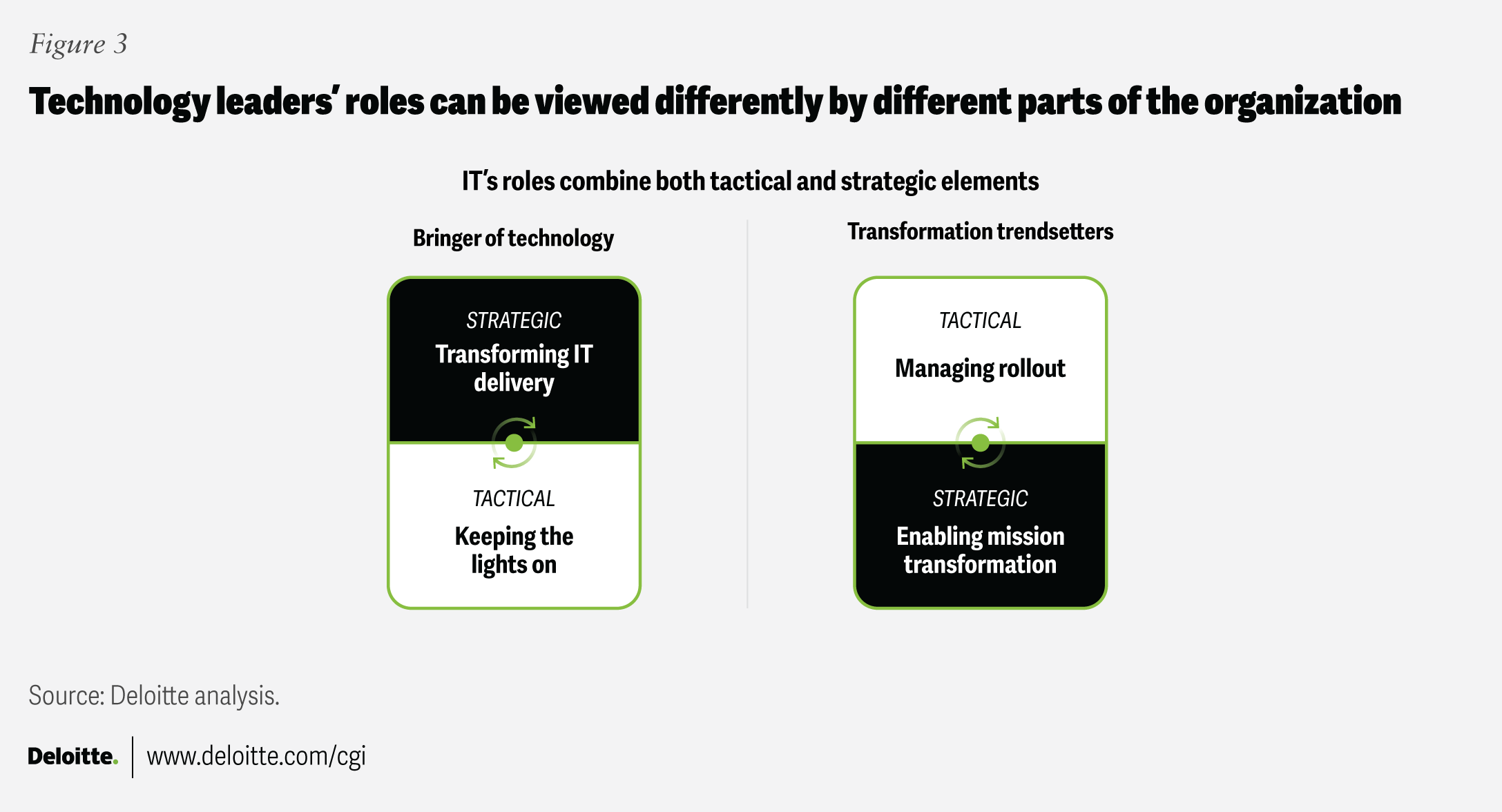
IT leaders have always balanced being strategic and tactical. What’s different now is that AI has positioned IT not just as a provider of the tools of change, but as a leader in shaping how work itself gets done. This is shifting the mix of strategic and tactical responsibilities within each role (figure 3).
The challenge is not choosing between strategic and tactical influence but intentionally blending both. Overcentralize, and innovation slows. Delegate too far, and coherence erodes. The most effective technology leaders are actively defining the balance rather than letting organizational history define it for them.
Enablers and accelerators
The AI transformation is underway whether agencies are ready or not. Success increasingly hinges on two capabilities that have historically challenged public-sector organizations: agility and talent. Several practical levers can help.
- Innovation exchanges. Tour-of-duty programs and industry rotations bring external AI expertise into government while embedding technologists within mission teams. This cross-pollination accelerates adoption and builds internal capability.
- Smarter acquisition. AI-assisted procurement tools can help agencies evaluate vendors, pricing, and performance more quickly. Centralized buying models—such as the US General Services Administration’s bulk purchasing of AI models—can lower costs while preserving mission-level flexibility.
- Financial and operational transparency. FinOps and similar tools make cloud and AI spending visible, linking technology investments to measurable outcomes rather than abstract budgets.
- Mission-aligned metrics. Beyond uptime and system availability, IT leaders need metrics that demonstrate mission impact—time saved, services improved, risks reduced.
- Cross-functional convening. Structured forums that bring together IT, finance, human capital, and mission leaders create shared accountability for execution and AI adoption.
These tools and approaches are not theoretical. Many agencies are already deploying them. The challenge is choosing the right mix for each agency’s context and maturity.
Toward 2030: The future this trend could unlock
By 2030, the traditional IT department will look very different—not because it disappears, but because it becomes embedded throughout mission delivery.
Technology leadership blends technical depth with strategic authority. Some tech leaders embed within mission teams, bringing expertise directly to frontline delivery and leveraging tools such as low-code platforms and automated code review. Others operate at the executive level, identifying emerging technologies and aligning them with agency priorities.
Strategic foresight and operational execution converge. Technology leaders orchestrate shared platforms, data standards, and AI guardrails while partnering across finance, human capital, and mission units. Authority is defined less by system ownership and more by the ability to integrate technology, governance, and delivery into a unified operating model.
Success depends not on controlling technology but on shaping how work is redesigned around it.
My take
From tech support to transformation architect
Vince Kellen, PhD, chief information officer, The Texas A&M University System
For most of my career, the role of IT has been framed around reliability, keeping systems up, secure, and compliant. That work still matters, but it no longer defines the role. Today, one of the most important changes facing IT leaders is philosophical, not technological. We are shifting from optimizing systems to accelerating the flow of knowledge across the organization.
AI is the catalyst for this shift. It fundamentally changes how knowledge is created, accessed, and applied. Large language models make expertise available everywhere, all the time, and enable institutions to convert their internal knowledge into an explicit, usable form almost instantly.
But right now, CIOs should be far more concerned about the rate of adoption than the rate of implementation. It’s not enough to just implement AI and leave it there; users need to adopt it—and adapt their processes—to see the benefits. But people need to want to adopt AI, which means that CIOs should think about designing what I call an architecture of desire. That means aligning leadership goals, user motivations, and mission outcomes so people genuinely want to use these tools. Without engagement, there is no transformation.
Enterprise resource planning implementations were like picking grapefruits: large, consolidated processes with quick returns. AI is more like picking olives, requiring hours of effort across many smaller knowledge tasks before value emerges.
When organizations rush into adopting technology without making comparable investments in people, they shouldn’t be surprised when value falls short. Technology-induced change can be effective, but it is rarely desirable without thoughtful human investment. The public sector is mission-driven, not margin-driven. But fulfilling the mission involves efficiency in administration, and that demands honest measurement of productivity gains.
There are practical implications for CIOs navigating this moment. CIOs must stay ahead of the organization on the AI journey, helping others cross the bridge from the past to the future. This is one of the few times when meaningful long-term planning is possible, given the inertia around current AI platforms. CIOs should also use AI personally, starting from a place of curiosity, asking questions, and diving back into the details. They should shift from facing business partners across the table to standing beside them, cocreating vision at the whiteboard rather than simply responding to requests.
Ultimately, IT is evolving from a specialized function into the digital fabric of the organization. CIOs who succeed will likely be those who define their role proactively, bridge past and future thoughtfully, and give equal attention to technology, people, and strategic clarity.
In an AI-shaped world, the real differentiator will not be the tools we deploy. It will be the leaders who know how to unlock their full potential.
By
Scott Buchholz
Sam Park
Miguel Eiras Antunes
Joe Mariani
Glynis Rodrigues
Thirumalai Kannan
The authors would like to thank William D. Eggers and Sushumna Agarwal from the Center for Government Insights for their feedback on the draft. The authors would also like to thank Vince Kellen, chief information officer, The Texas A&M University System, for his valuable input in the “My take” section.
Editorial (including production and copyediting): Kavita Majumdar, Rupesh Bhat, Aparna Prusty, Anu Augustine, Cintia Cheong, and Pubali Dey
Design: Molly Piersol
Cover image by: Meena Sonar and Sonya Vasilieff
Knowledge Services: Agni Wagh
Visit the Deloitte Center for Government Insights
Access more insights for the defense, security and justice, government health care, state and local government, transportation and infrastructure, human services, and higher education sectors.