
The procurement reset: Adopting a simplicity-first mindset
A simplicity-first reset can help government leaders clear procurement bottlenecks, open markets, and use technology to accelerate speed, access, and results
For many governments, procurement reform has followed a familiar pattern: Invest in new digital tools, promise faster buying, and expect automation to fix long-standing delays. Too often, the result is disappointing. Technology faithfully replicates complex, layered processes—only now behind new interfaces. Cycle times barely move. Suppliers see little difference. Confidence in modernization erodes.
A growing number of governments are taking a different path. Instead of starting with technology, they begin by simplifying the underlying system. They strip out low-value reviews, clarify decision rights, standardize common documents, and focus on what truly matters: how quickly credible suppliers can deliver, how widely markets can participate, and whether spending achieves meaningful outcomes.
Only after the process is simplified do they apply digital tools—selectively and strategically. Automation supports clearer pathways rather than reinforcing clutter. Marketplaces stay open all year round. Dashboards track time to award, supplier access, and delivery against results. Technology becomes an enabler of simplicity, not a substitute for reform.
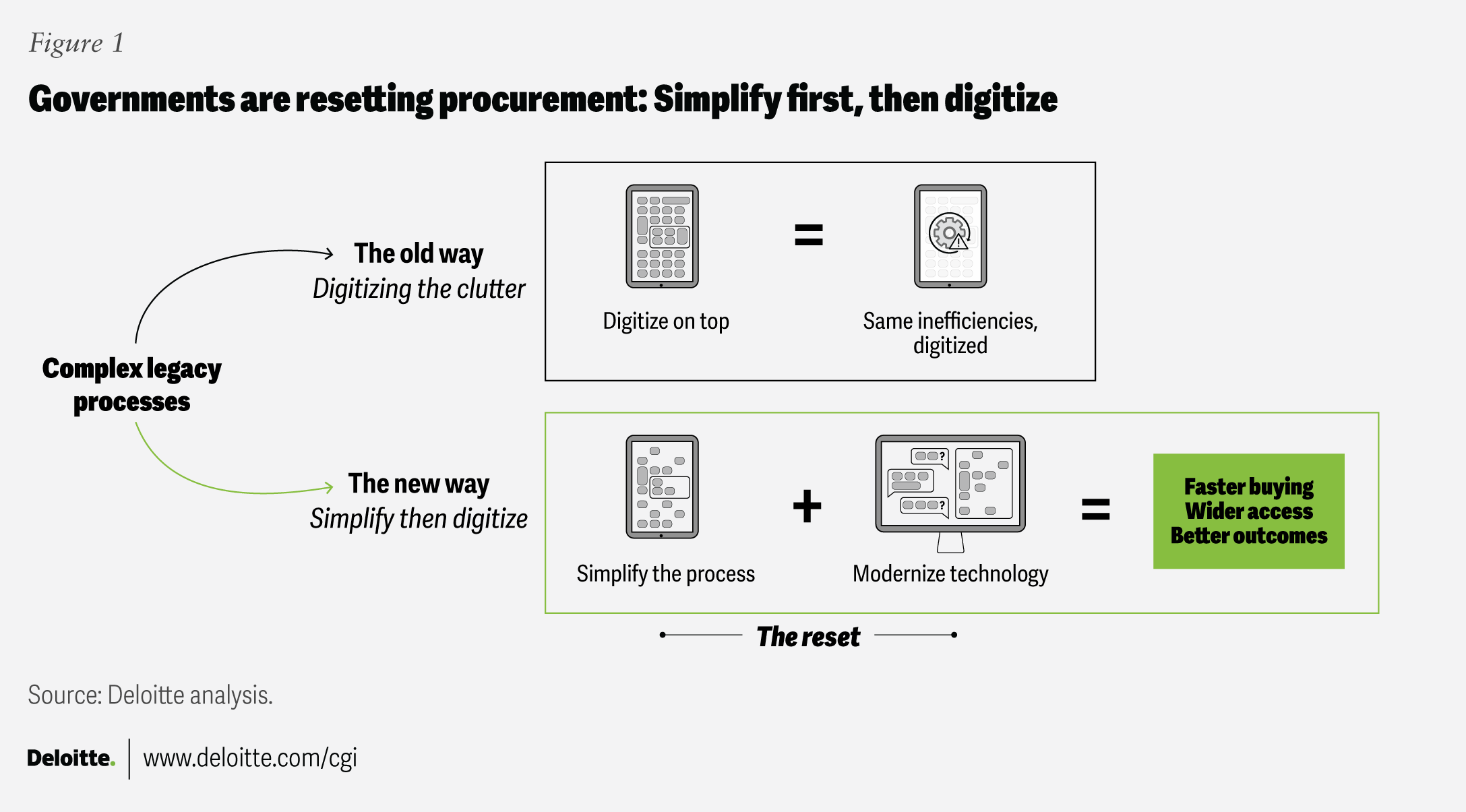
When procurement is reset this way, it feels different (figure 1). Workers see steps disappear rather than multiply. Suppliers find it easier to engage. Leaders can point to visible gains in speed, access, and impact. Modernization shifts from digitizing the old system to redesigning it.
Signals: The procurement reset
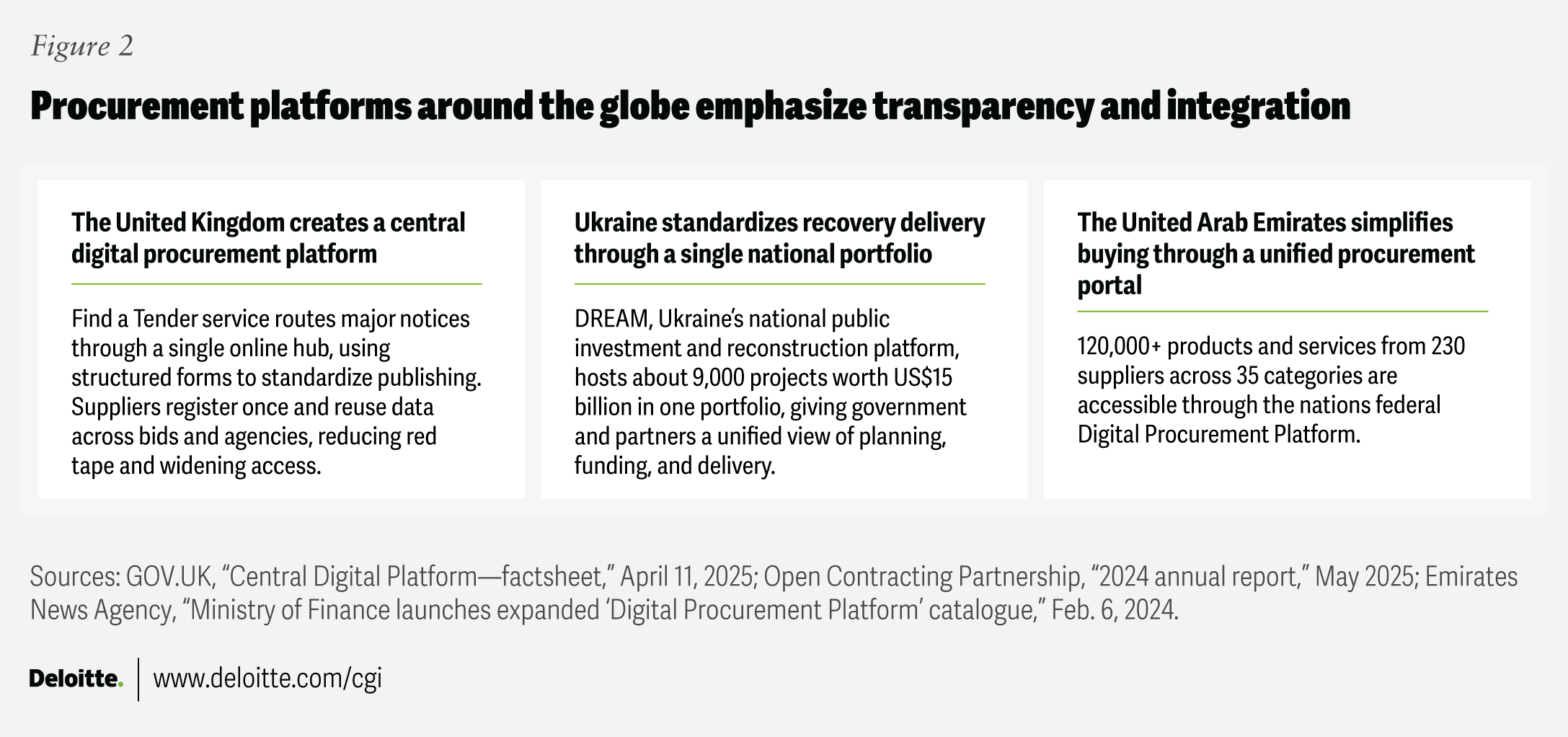
Trend in action
Improving speed: Buying more quickly and effectively
Procurement rules are built to protect the public interest—to ensure fairness, manage risk, and safeguard taxpayer funds. Over time, however, layers of well-intentioned safeguards can accumulate. Reviews multiply. Documentation expands. Approvals overlap. What was designed to reduce risk can begin to slow delivery.
Many governments are now stepping back and asking a basic question: Which steps genuinely protect the public, and which simply persist out of habit?
In 2025, the US federal government began a major effort to rewrite its core procurement rules in plain language and remove duplicative requirements.1 By cutting back unnecessary clauses and raising thresholds for streamlined purchases, the reform aimed to clarify decision rights and significantly shorten buying cycles.2 The emphasis shifted from procedural compliance to responsible, outcome-focused purchasing.3
It is only after simplifying the rules do targeted digital tools typically make a meaningful difference. At the US Internal Revenue Service, for example, an automated review tool scans draft contracts to ensure required terms are included and applied correctly. After the agency simplified its internal rules, review times dropped from hours to minutes.4 The technology worked because the underlying process had already been clarified.
India’s Government e-Marketplace shows a similar pattern. By standardizing common goods and services and creating a shared digital marketplace, the government reduced purchase cycle times by more than 30%.5 The speed came not just from the platform itself, but also from simplifying how routine purchases were structured.
The US Department of Defense’s Software Acquisition Pathway reflects this same logic. Designed for rapid software delivery, it replaces hardware-centric timelines with shorter, iterative cycles. Digital marketplaces then help buyers identify solutions that fit those faster pathways.6
Across these examples, speed does not come from more automation alone. It comes from simplifying the path first, then using technology to reinforce that simplicity. When teams see steps removed rather than added, trust grows. Leaders can track time to award and time to delivery as core performance measures. Buying becomes lighter, faster, and more transparent—without compromising accountability.
Greater access: Working with more companies and suppliers
Procurement systems can unintentionally exclude capable suppliers—especially smaller firms and new entrants—when requirements are complex, opportunities are infrequent, or participation feels unpredictable. When only experienced incumbents can navigate the system, governments limit competition and innovation.
Expanding access begins with lowering unnecessary barriers. Governments are simplifying bid documents, standardizing common requirements, and creating clearer, more predictable qualification pathways. Instead of one-off tenders with shifting rules, suppliers increasingly see stable criteria and opportunities that remain visible throughout the year.
Public Services and Procurement Canada’s Better Buying initiative, for example, focuses on rewriting contracts in clearer language and removing outdated provisions to make bidding less burdensome.7 In the United Kingdom, reforms under the Procurement Act 2023 include prompt payment requirements that improve cash flow for smaller suppliers.8 ChileCompra connects thousands of public bodies with more than 110,000 suppliers through a centralized platform, increasing visibility and participation in public markets.9
New Zealand’s Pae Hokohoko Marketplace offers an always-open catalog of pre-qualified suppliers. Rather than waiting for narrow windows of opportunity, firms can qualify when ready and compete for work through a shared digital entry point.10
What matters most is whether suppliers genuinely find it easier to do business with government. That may mean a single registration process, reusable credentials, clear communication, and consistent expectations across agencies. Technology supports this shift—but access expands only when procurement teams are prepared to manage a broader, more dynamic supplier base.
Greater access is not just about inclusion. It strengthens resilience, increases competition, and brings fresh ideas into public programs—ultimately improving outcomes for citizens.
More outcomes: Buying results, not just products
Most public contracts are still written around activities—such as hours worked, units delivered, and features specified—rather than the results that matter for people and programs.11 An outcomes-first approach starts from a different question: What change are we trying to achieve?
Instead of tightly prescribing how work must be done, governments define a small number of meaningful results and align contracts, payments, and performance tracking to those outcomes. In practice, outcomes-based contracting typically falls into three buckets: citizen or population outcomes, the effectiveness of a public service or program, and the reliability of a technology system (figure 3).
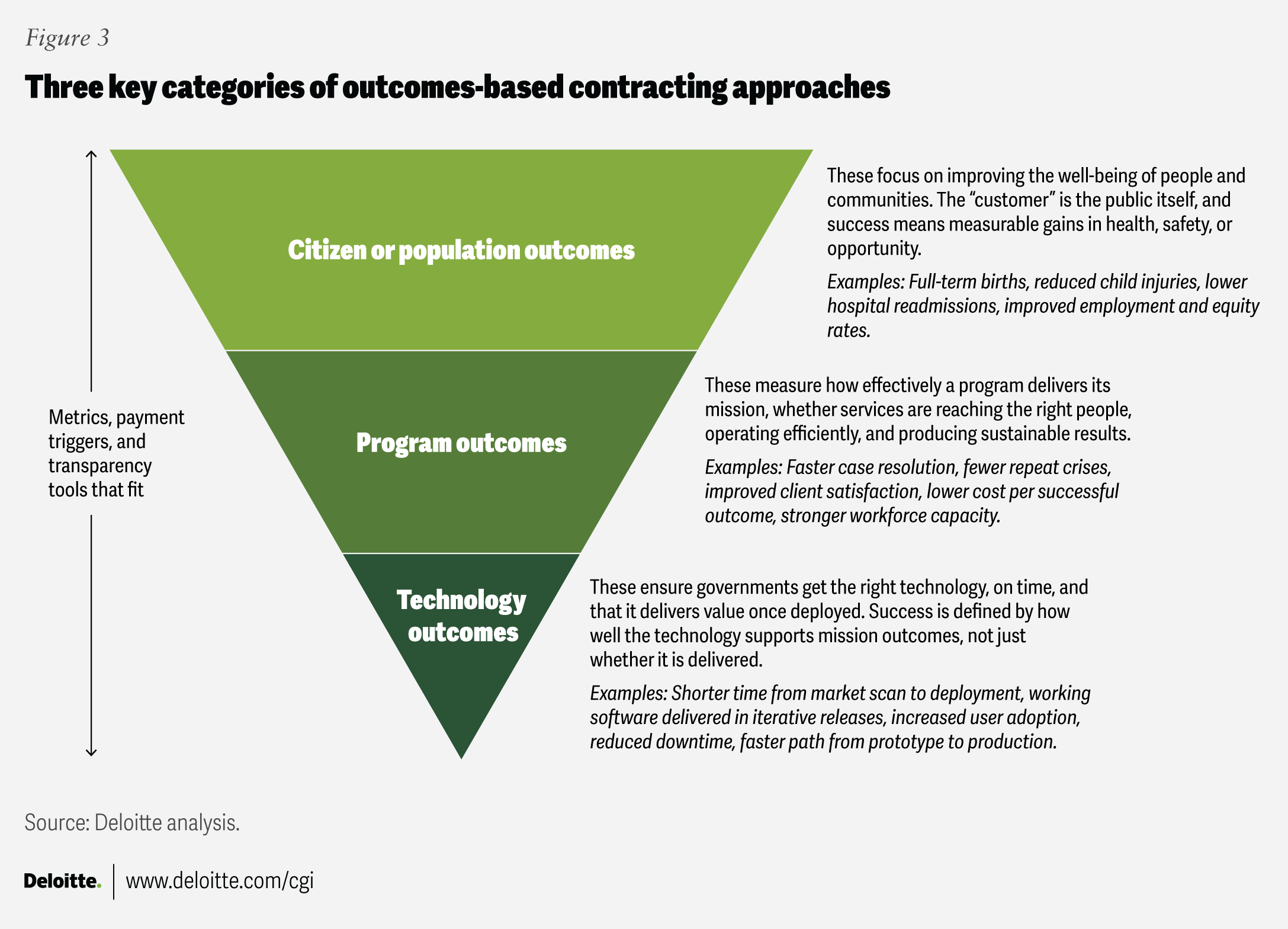
At the citizen level, some governments are tying a portion of funding to verified outcomes. Missouri’s Children’s Trust Fund, for example, developed a statewide “rate card” that pays providers additional incentives when specific results are achieved, such as healthier births or safer home practices.12 Connecticut piloted a similar model in its maternal and early childhood programs, linking bonus payments to measurable health and stability outcomes, such as early prenatal enrollment, economic stability, and prenatal and postnatal health.13
At the service and technology level, governments are increasingly paying for delivered capability rather than effort alone. The United Kingdom’s Digital Outcomes and Specialists framework evaluates progress through short development cycles tied to working software.14 The US Department of Defense’s Software Acquisition Pathway aligns payments to functional delivery milestones, enabling earlier fielding of capability.15
Buying for outcomes is not simple. Proving that a bid complies with formatting rules is easier than proving it will deliver real value. To shift toward outcomes, agencies should loosen overly rigid specifications, invite diverse approaches, and apply clear, transparent evaluation criteria focused on impact.
The governments making the most progress define a handful of meaningful results, design contracts around them, and use straightforward dashboards to make performance visible. When spending is tied to outcomes rather than activities, procurement becomes a lever for measurable public value—not just a transaction process.
Enablers and accelerators
Governments can accelerate a procurement reset by focusing on a few practical shifts.
Speed
- Start with simplicity. Map the typical path for common purchases and ask why each step exists. Remove redundant reviews, collapse overlapping approvals, and standardize a small set of reusable templates before introducing new technology.
- Create clear, fast lanes. Define streamlined routes for routine purchases and digital services, with clear decision rights and thresholds. Teams should know how to move quickly without needing special permission.
- Embed checks into the workflow. Once pathways are simplified, use digital tools to automatically apply standard clauses, approvals, and validations. Track time to award and time to delivery as visible performance measures.
Access
- Build one front door. Move toward a single supplier registration, reusable credentials, and consistent notice formats so firms don’t have to relearn the system each time they bid.
- Keep markets open year-round. Allow rolling qualification and maintain active catalogs where appropriate. Monitor participation data to identify gaps and adjust outreach.
- Communicate clearly. Provide straightforward feedback to bidders so they understand decisions and can compete more effectively next time.
Outcomes
- Define a small number of meaningful results. Decide what success looks like—for citizens, services, or technology—and focus contracts on those outcomes rather than detailed inputs.
- Link payment to performance in simple ways. Use milestone payments or outcome-based incentives where appropriate, without overly complex formulas.
- Make performance visible. Create simple dashboards showing outcomes, cost, and equity impacts. Review them regularly and retire metrics or processes that no longer add value.
Toward 2030: The future this trend could unlock
By 2030, procurement should function less as a compliance checkpoint and more as a strategic delivery engine. Simplicity becomes the default, and complexity is treated as a cost.
- Clear, simplified pathways: Most purchases flow through a small number of streamlined routes built on shared digital standards. Policy checks and standard terms are embedded directly into these pathways, allowing routine buys to move quickly while reserving deeper scrutiny for higher-risk or novel procurements. Teams use these pathways confidently, without needing constant specialist intervention.
- Open, accessible markets: Supplier access is consistent and visible year-round. Firms register once, reuse credentials across agencies, and compete through unified digital entry points. Always-open catalogs and rolling qualification lower barriers for smaller firms and new entrants. Governments measure market access with the same rigor they apply to speed and cost.
- Outcomes as the organizing principle: Major contracts define a small set of meaningful results tied to mission impact. Payments align to verified performance rather than activity alone. Simple, live dashboards make progress visible to program leaders, procurement teams, and oversight bodies alike.
- Oversight matched to risk: Review intensity is calibrated to actual risk rather than precedent. Routine, low-risk purchases move through fast lanes with embedded safeguards, while complex or sensitive buys trigger deeper analysis. Effort is focused where it adds value.
In this future, technology supports clarity rather than compensating for complexity. Procurement becomes lighter, more transparent, and more accountable—accelerating delivery while strengthening public trust.
BY
William D. Eggers
James Gordon
Karen Harvey
Lauren Dailey
Adam Routh
Akash Keyal
The authors would like to thank Ipshita Sinha from the Deloitte Center for Government Insights for helping in the research and development of the draft. They would also like to thank Jaimie Boyd, Tom Pickthorn, Shanley Vetter, Phoebe Baker, Mason Chin, and Duke Wu for providing feedback and suggestions at critical junctures. In addition, they would also like to extend their gratitude to Daniel J. Finkenstadt, vice president of research and senior fellow, Commerce & Contract Management Institute, for his valuable input in the “My take” section.
Editorial (including production and copyediting): Kavita Majumdar, Rupesh Bhat, Aparna Prusty, Anu Augustine, Cintia Cheong, and Pubali Dey
Design: Molly Piersol
Cover image by: Meena Sonar and Sonya Vasilieff
Knowledge Services: Rohan Singh
Visit the Deloitte Center for Government Insights
Access more insights for the defense, security and justice, government health care, state and local government, transportation and infrastructure, human services, and higher education sectors.