
Moving from capital availability to capital fit
Greater capital availability can finance more infrastructure projects, but governments still need to align capital, risk, and delivery models with each asset’s economics
Deloitte’s 2026 Future of Infrastructure Survey shows that the investment needs are expanding across digital networks, energy systems, water utilities, mobility infrastructure, health facilities, and other critical assets (see “About the survey”). Infrastructure needs have never been greater, and government budgets alone can no longer cover them.1 The record levels of private capital sitting in infrastructure and other private market funds—largely supplied by pension funds and insurers—could be an obvious answer.2
Yet, shortfalls are rarely about money alone: Too many projects are not yet investable due to their unclear revenue models, misallocated or contested risk, and—underlying both—insufficient governance. That is, the institutional capacity to prepare a credible project, run transparent procurement, and hold delivery to account. These challenges intensify as projects increasingly cross traditional asset and sector lines.
While many projects with predictable revenues can attract private debt and equity on commercial terms, others may create substantial public value but require government funding, guarantees, concessions, or incentives to attract private sector capital. Survey respondents reinforce this by expressing greater expectations for the use of public funding, debt instruments, vendor financing, user-fee mechanisms, and public-private partnerships.
The challenge also varies between building new infrastructure (greenfield) and modernizing existing assets (brownfield). Greenfield projects commonly face development, construction, approval, and demand risks.3 Brownfield upgrades may offer stronger life-cycle benefits but in some cases, struggle to secure upfront investment.4 Additionally, many public projects are too small or fragmented to attract large institutional funds individually and may need more innovative ways to pool projects to unlock capital flows.5
For many governments, the objective is not to maximize private sector involvement. It is to build an investable pipeline, aggregate projects where scale is a constraint, allocate risk more deliberately, and use public and private capital to meet project needs.
Infrastructure investment priorities are broadening, and consequently, financing needs are diverging
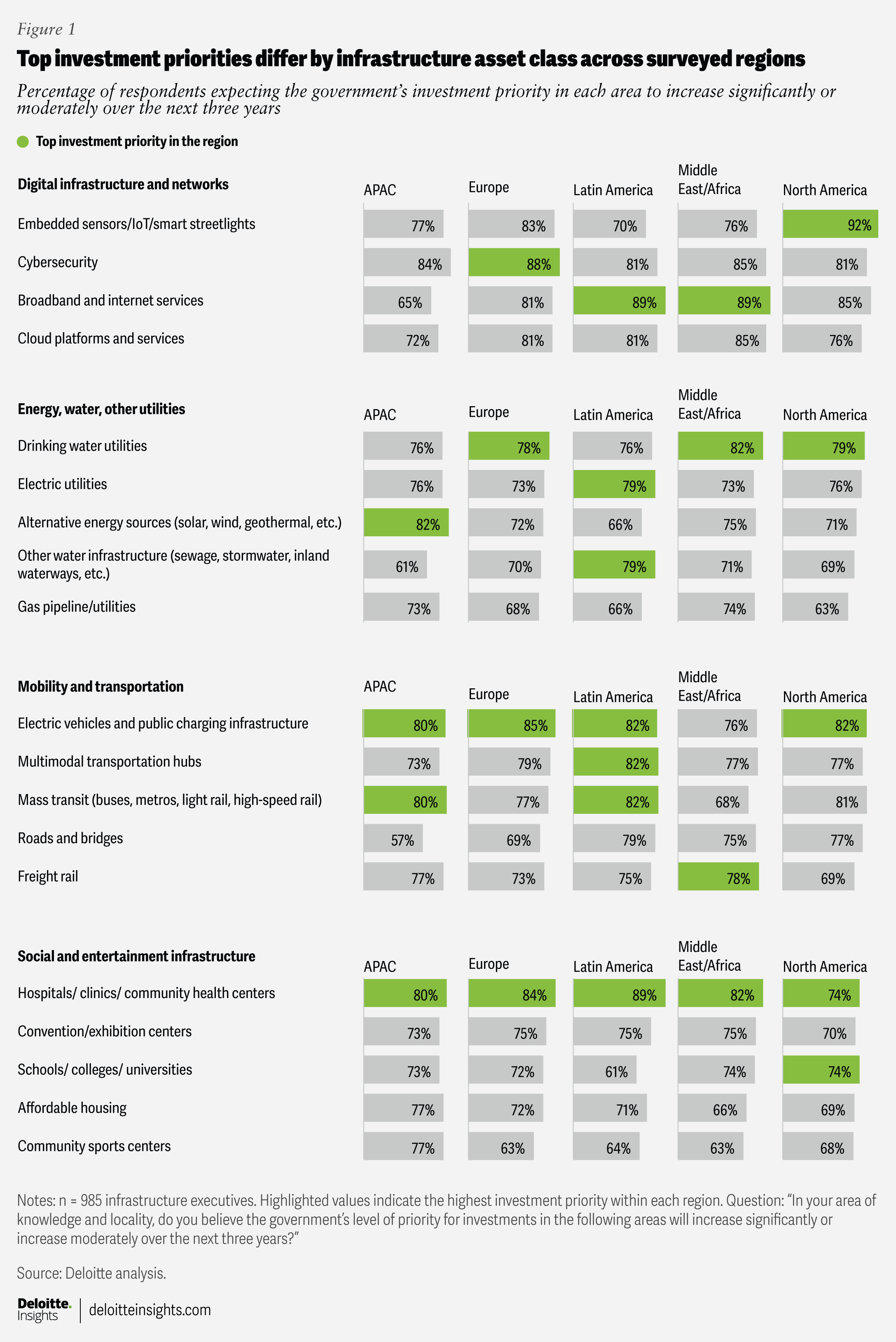
Governments are preparing for increased investment across a wide range of infrastructure categories. Respondents to our survey cited digital infrastructure, energy systems, transportation networks, water utilities, and social infrastructure as investment priorities for their organizations over the next three years (figure 1).
But broader investment means a more complex financing challenge. Projects across these sectors differ significantly by their revenue potential, risk profile, scale, and public value, and as a result, will require different approaches to financing. Most notably, a revenue-generating asset will require a different financing approach than assets that generate substantial public value without producing a direct or predictable financial return.
What the survey tells us:
- Digital infrastructure: Cybersecurity, broadband, and internet services rank as the top global digital priorities. North American respondents identify embedded sensors, Internet of Things, or smart streetlights (92%) as their highest investment priority, far outpacing respondents in all other regions. Importantly, financing needs may differ between new digital capacity and upgrades to existing assets that improve security, connectivity, or operational performance.
- Energy and water infrastructure: In many regions, drinking water utilities emerged as the most significant investment priority. Asia-Pacific respondents prioritize alternative energy more significantly than those in other regions.
- Mobility and transportation: Most regions anticipate the highest investment increases in electric vehicles and public charging infrastructure. Freight rail ranks highest in the Middle East at 78%, suggesting a stronger emphasis on trade corridors and logistics connectivity.
- Social infrastructure: Within social investments, essential services take clear precedence. Hospitals, clinics, or community health are the overwhelming global priorities across regions. North American respondents place equal emphasis on schools, colleges, and universities.
The financing challenge extends beyond capital availability
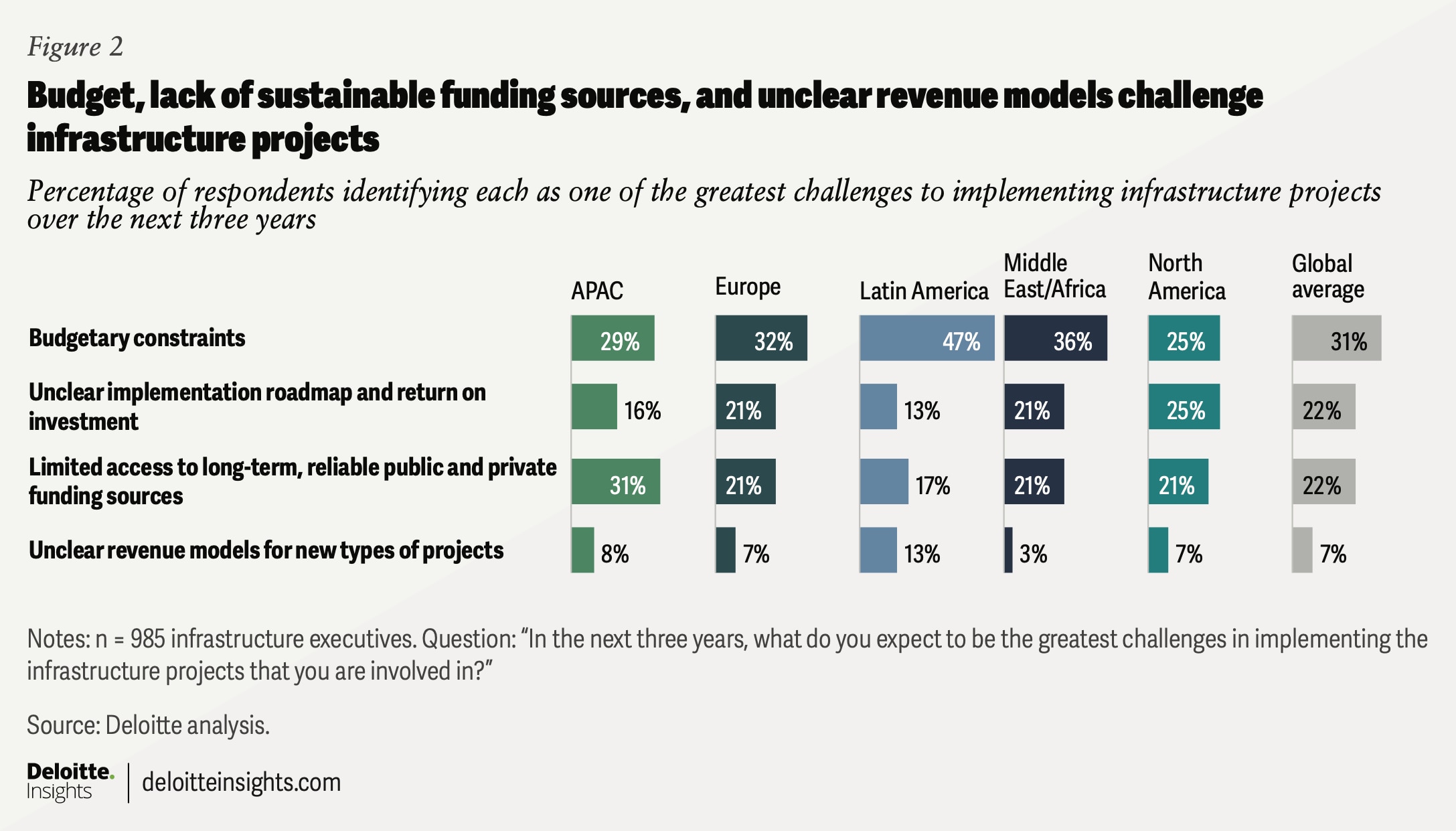
Infrastructure pipelines are expanding, but not every priority can, or should, be financed the same way. Respondents continue to cite budget constraints, unclear implementation road maps, limited long-term funding, and uncertain revenue models as barriers to delivery. For some projects, the constraint is insufficient public funding; for others, it is the absence of a viable revenue model, sufficient scale, or confidence in delivery (figure 2).
What the survey tells us:
- Globally, budget constraints rank as the greatest financing challenge at 31%, with Latin American respondents reporting the strongest pressure at 47%.
- In addition to budget constraints, North American respondents report the greatest concern about unclear implementation road maps and return on investment at 25%, suggesting that access to capital alone is insufficient when project economics, approval, or delivery pathways remain uncertain.
- Asia-Pacific respondents report the highest level of difficulty accessing long-term, reliable public and private funding, illustrating that capital availability and accessibility can differ significantly by region.
Infrastructure financing is becoming more layered, but priorities differ
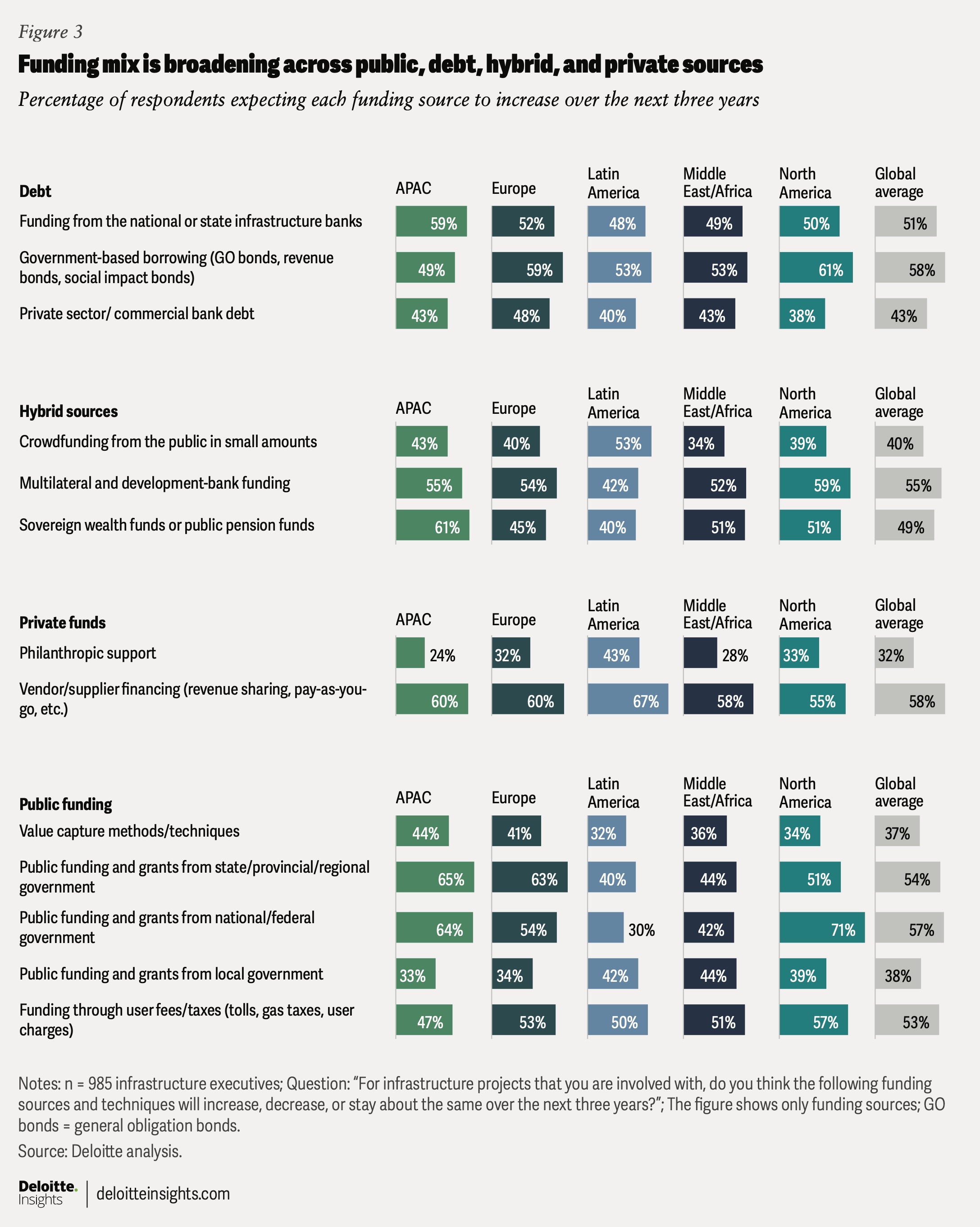
Respondents expect funding to increase across public, private, debt, and hybrid sources, suggesting that no single capital source will dominate infrastructure financing. Instead, funding structures will become more layered.
Public investment may anchor projects, while debt instruments, user fees, development bank lending, and private capital help close the funding gaps (figure 3). Public capital can also play several roles: directly funding essential services, absorbing risks the market cannot efficiently manage, financing enabling infrastructure, or improving the viability of projects that generate substantial public value but insufficient commercial returns.
India’s highway construction effort since 2016 illustrates how governments can plug the viability gap in projects. To attract private capital, the National Highways Authority of India launched the hybrid annuity model in 2016, a public-private partnership structure that rebalances risk between government and developers. The government funds 40% of the project cost during the construction phase via milestone-based installments (typically five equal payments), retains toll revenue and the risk of revenue shortfalls, and pays inflation-indexed annuities for construction, operation, and maintenance. The hybrid annuity model’s success has prompted the government to apply the model to attract private players to develop infrastructure projects in additional areas, such as water and sanitation.6
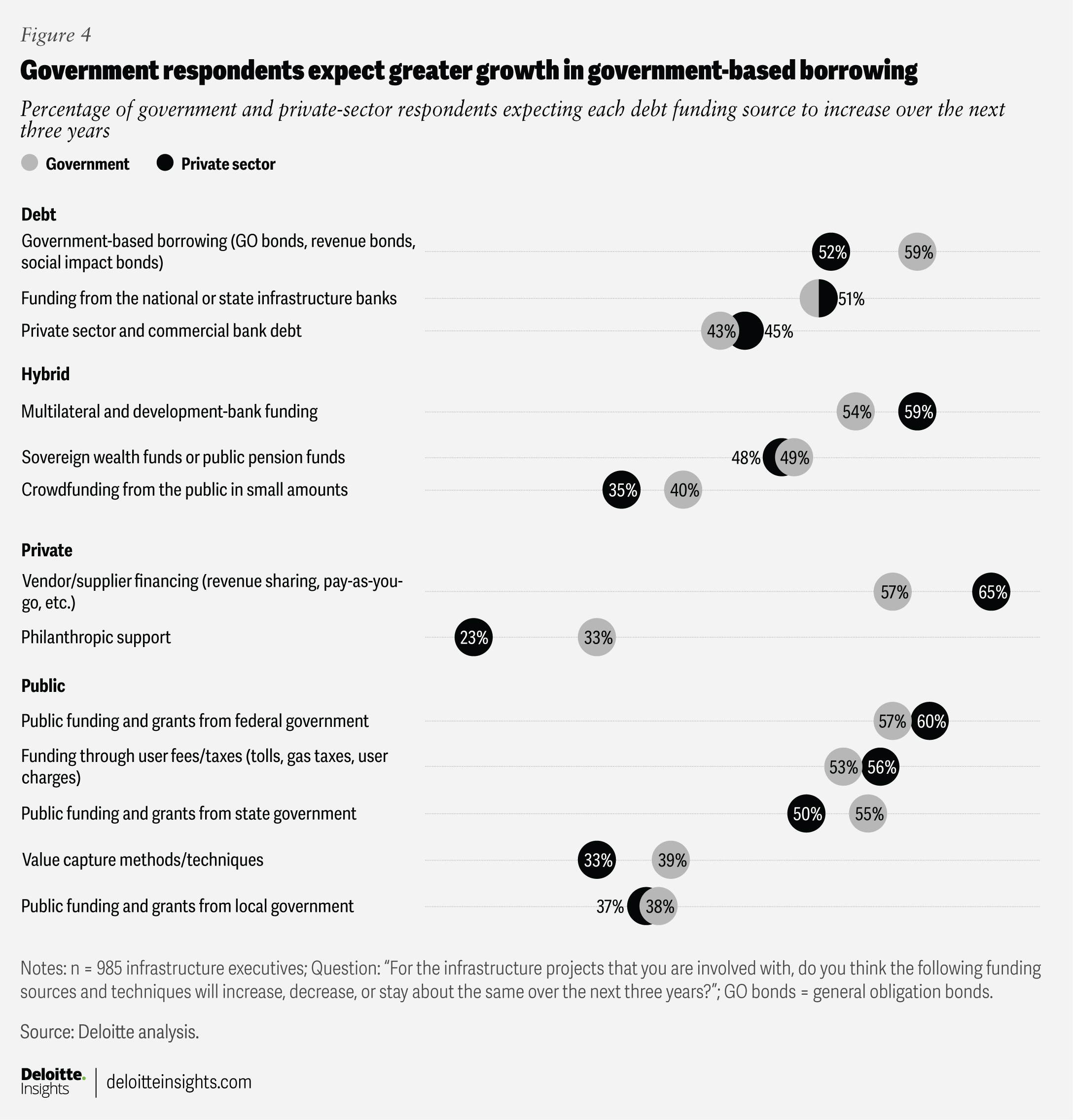
Government respondents tend to favor traditional debt instruments, such as general obligation and revenue bonds. Private-sector respondents show stronger interest in vendor financing, revenue-sharing models, pay-as-you-go structures, and partnership-based approaches—suggesting that private capital is more likely to flow to projects with a clear return on investment and sustainable revenue streams (figure 4). The challenge is not to favor one side’s preferred instrument, but to combine funding sources in ways that fit each project’s economics and risk profile.
Combining capital sources is just one part of the solution. Governments can also select a delivery and partnership model that aligns incentives, protects public value, and matches each party’s risk tolerance.
Partnership models should balance project economics and public value
Public-private partnerships are expected to grow, but the more important shift is in how they are selected and structured. Traditional public-private partnerships remain prominent, yet private-sector respondents show stronger interest in outcome-based contracts and performance-linked approaches that tie returns more directly to service delivery and project results (figure 5).
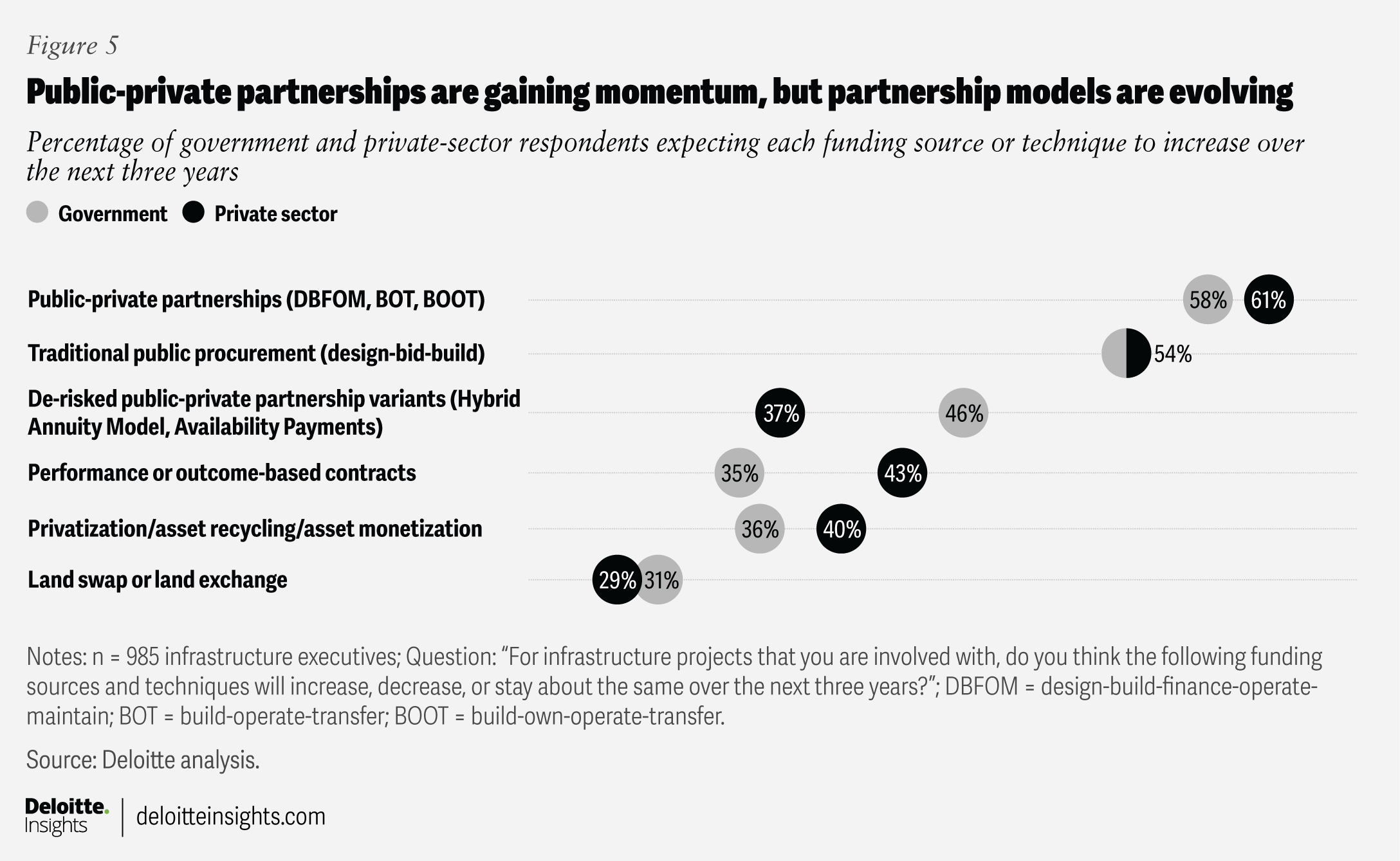
Sydney Metro illustrates how private participation can be structured without transferring every risk to the private sector.7 The New South Wales government retains fare and revenue risk, while private partners assume defined construction, availability, interface, and performance obligations (see “From risk transfer to risk management”).
Governments need a portfolio of models. Beyond the availability-payment and viability-gap approaches illustrated by Sydney Metro and India’s hybrid annuity model, governments are also testing minimum revenue guarantees to de-risk demand uncertainty and regulated asset base structures that give investors a regulated return tied to allowed revenues rather than market demand—both of which are ways of matching government support to the specific risk profile of the asset in question.
In the United States, the San Diego County Water Authority’s 30-year purchase agreement for the Carlsbad Desalination Plant operates on a revenue-or-demand guarantee. The Authority is committed to purchasing a minimum volume of water each year, regardless of actual demand, thereby giving the private developer the revenue certainty needed to finance the plant.9
Capital fit, and not capital volume, will determine what gets built
Capital is available, and funding sources are diversifying. But capital alone does not deliver infrastructure, and not every project should be financed in the same way. It is important to distinguish between commercially financeable projects and projects that require targeted public support, as well as essential public-service investments whose value extends beyond direct financial returns.
The future of infrastructure financing is not about choosing between public and private capital. It is about assembling the right mix of funding sources and financing mechanisms (such as blended finance or public‑private partnerships) and allocating risk to the best-positioned partner to manage it. The objective is not to maximize private capital participation, but to use each form of capital where it can deliver the greatest public value.
By
Craig Walter
Avi Schwartz
Frederique Deau Blanchet
Mahesh Kelkar
Vishal Rander
Editorial (including production and copyediting): Kavita Majumdar, Pubali Dey, Aparna Prusty, and Anu Augustine
Design: Natalie Pfaff and Harry Wedel
Cover image by: Natalie Pfaff and Jim Slatton
Knowledge services: Agni Wagh
Visit the Deloitte Center for Government Insights
Access more insights for the defense, security and justice, government health care, state and local government, transportation and infrastructure, human services, and higher education sectors.