
More autonomous trucks are hitting the road. How should insurers be changing lanes on coverage?
Get ready for disruption! As premiums shift across multiple lines of business, traditional products and processes may not cover it. It’s time for carriers to start experimenting
Deloitte estimates advancements in self-driving technology may eliminate the need for around 380,000 long-haul truck drivers in the next five years.1 This alone could have a major impact on workers’ compensation insurers, with a potential loss of around US$3 billion in premiums.2 But widespread adoption of autonomous vehicles could also result in a shift in premiums across multiple insurance lines, including commercial auto, product and professional liability, and cyber coverage.
Imagine an insurance underwriter driving on an interstate highway, overtaking a convoy of three long-haul trucks. While passing the first truck, he glances to his right, anticipating a cursory smile from the driver—only there isn’t one! He speeds up, but to his bewilderment, there is no one driving the second truck, either. He exhales in relief when the driver on the lead truck sees him staring wide-eyed, giving him a wave. The underwriter spends the rest of his trip thinking about the insurance implications of how to cover such “ghost” trucks, a challenge that insurance executives should be pondering now, rather than later.
A growing number of driverless vehicles are already on the roads in some states, and they are only going to get more visible with time.3 The challenge facing insurers is how to underwrite risks that may emerge with driverless commercial fleets, and which lines might be tapped for coverage—with traditional policy lines likely to lose premiums while others benefit from shifts in exposure.
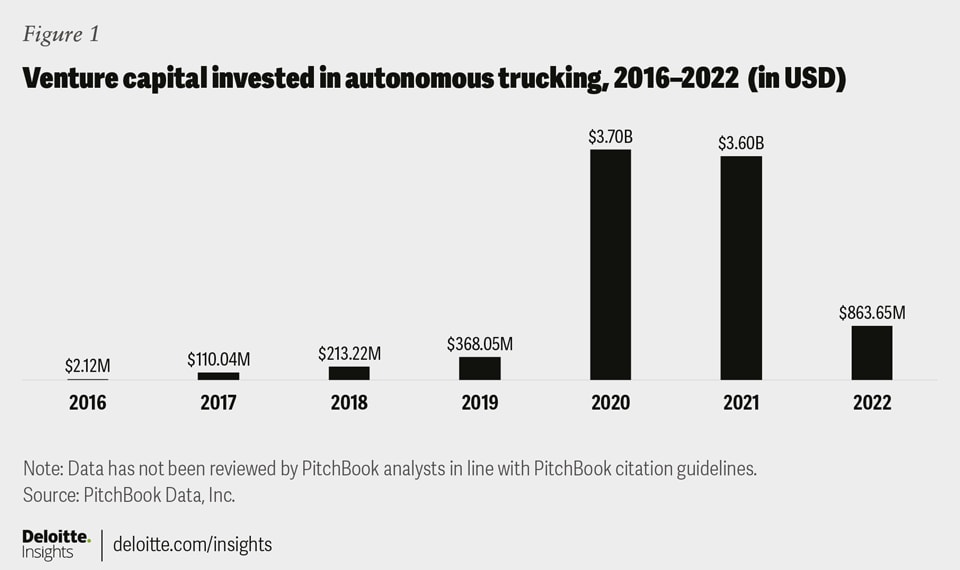
Self-driven trucks may improve performance for commercial auto insurance
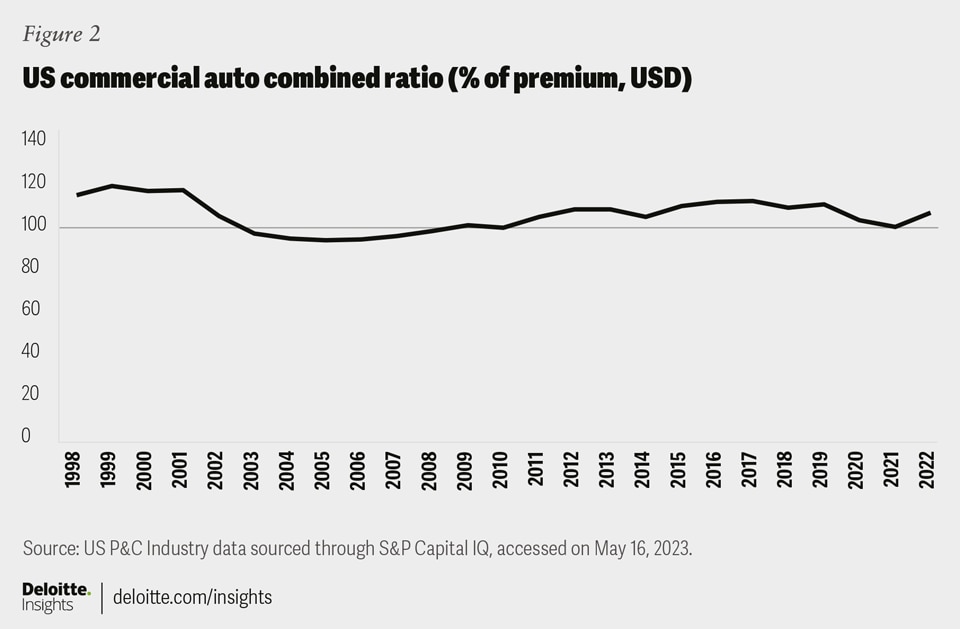
Commercial auto, which generated an average of US$34.9 billion in annual premiums over the past decade, has consistently been one of the US insurance industry’s worst performing business segments.12 Starting in 2011, the segment posted underwriting losses for 10 straight years, until a pandemic-related decline in accident frequency (thanks to having fewer passenger vehicles on the road) helped it generate an underwriting profit in 2021 (figure 2). This turned out to be an anomaly; the commercial auto industry will likely continue reporting negative underwriting returns unless there is a strong catalyst for change. Widespread adoption of autonomous trucks could be that game changer, as well as being a major disruptor of the commercial auto insurance market.
A 2015 study by the United States National Highway Traffic Safety Administration revealed that 94% of all motor vehicle accidents were caused by driver-related factors such as impaired driving, distraction, or illegal maneuvers.13 While there has yet to be sufficient data gathered to show that autonomous trucks may be less likely to be in accidents than those steered by human drivers, it could seem intuitive that eliminating live drivers may also remove many of the human causes of accidents, which could lower loss frequency.
However, autonomous driving could also create an entirely new set of risk exposures—many of which wouldn’t be covered by most of current commercial auto insurance plans.
Shifting liabilities may result in premiums changing lines
As more autonomous vehicles hit the road, new causes of loss will emerge that would have major implications for traditional commercial auto insurers. Even in vehicles with human drivers aided by assisted driving technologies, assessing causality may become quite challenging. Accidents in tech-driven vehicles could be caused by software errors, manufacturing defects, network outages, GPS flaws, failing sensors, or cyberattacks.14
Such occurrences would likely fall in the purview of product liability coverage, or even professional liability insuring those whose code or algorithms malfunction. Or would it? What if a self-driven truck hits a pothole or an icy patch and veers off the road, which would likely still be covered by traditional commercial auto policies? Incidents like this could lead to some complicated claim adjustments, and even increased litigation over who or what is responsible for an accident. As self-driving technology prompts changes in the underlying exposure, it can be hard to predict how much premium dollars might shift from payments to traditional commercial auto insurers to other types of policies. But even if only 20% of such premiums move into these other coverage lines, that would represent a loss of US$7 billion annually from commercial auto coffers.
Rising technological complexity and interconnectedness could vastly increase the cyber vulnerability of autonomous trucks and fleet operators. Industry data shows modern vehicles contain about 100 million lines of code.15 The amount of code will only increase rapidly with increasing autonomy of vehicles. As the cyberattack surface would rise exponentially with multiple targets and points of access, cyber insurance would assume a much larger proportion of insurance costs for autonomous truck owners/operators than what it is now.
One almost certain net loser, however, would be workers’ compensation insurers. Driving-related injuries account for approximately 25% of all workers’ compensation claims.16 Thus, any reduction in accident frequency due to assisted driving technology could directly benefit the profitability for this line. But even though autonomous vehicles could lessen the impact of the anticipated shortage in truck drivers (see sidebar, “The case for growth of autonomous trucks”), full-fledged autonomous vehicles, estimated to eliminate the need for 380,000 jobs, would also eliminate the need for workers’ comp coverage for those self-driven trucks. This could result in a loss of around US$3 billion in potential workers’ comp premiums.
What worked for human-driven trucks likely won’t work for driverless trucks
Insurers have decades of data on human-driven vehicles to help ascertain the type of products the market needs and determine pricing. But for autonomous trucks, insurers do not have any historical data to work with. Akin to the evolution of cyber insurance, carriers may take years to figure out what works for the market; they may sometimes burn their hands in the process.
Still, first movers will likely have an advantage. They may be well-positioned to understand the lay of the land and craft unique coverages for the emerging commercial trucking industry. One possible avenue could be to form relationships with autonomous truck manufacturers to embed multiple coverages with the sale of the vehicles. Liberty Mutual, for example, has taken a head start with multiple partnerships to assess the safety of autonomous vehicles and better understand the risks.17 AXA XL has launched a single customizable policy for autonomous vehicles, covering vehicle and component manufacturers, fleet owners, operators, and software developers.18
Exploring with new coverages and relationships early can also prove to be a good sandbox, helping carriers prepare for a larger disruption from widespread adoption of consumer autonomous vehicles down the road.
BY
Matthew Carrier
Dishank Jain
The authors would like to thank Shreeparna Sarkar of the M&A and Restructuring Services (MARS) for helping with the venture capital investment data.