
2027 Aerospace and Defense Industry Outlook
The industry has the budgets, buyers, and private capital. But, in 2027, it has to prove it can turn all three into delivered capability.
Heading into 2027, the aerospace and defense industry carries more demand, acquisition authority, and private capital than at almost any point in the last decade. Industry-specific signals are strong: a US$1.5 trillion fiscal 2027 defense budget request (not yet enacted),1 a rebuilt acquisition system, a record commercial order book, and surging demand to replenish interceptors and munitions, as well as tax code incentives for domestic research and development and production across industries. All of these could collectively drive venture capital toward “neo prime” defense tech entrants. While each lends its own growth story, together, they raise a question: Can the industrial base convert demand into delivered aircraft, accepted interceptors, and maintained and repaired fleets within the promised timelines?
This question is the common thread running through the five trends of this outlook.
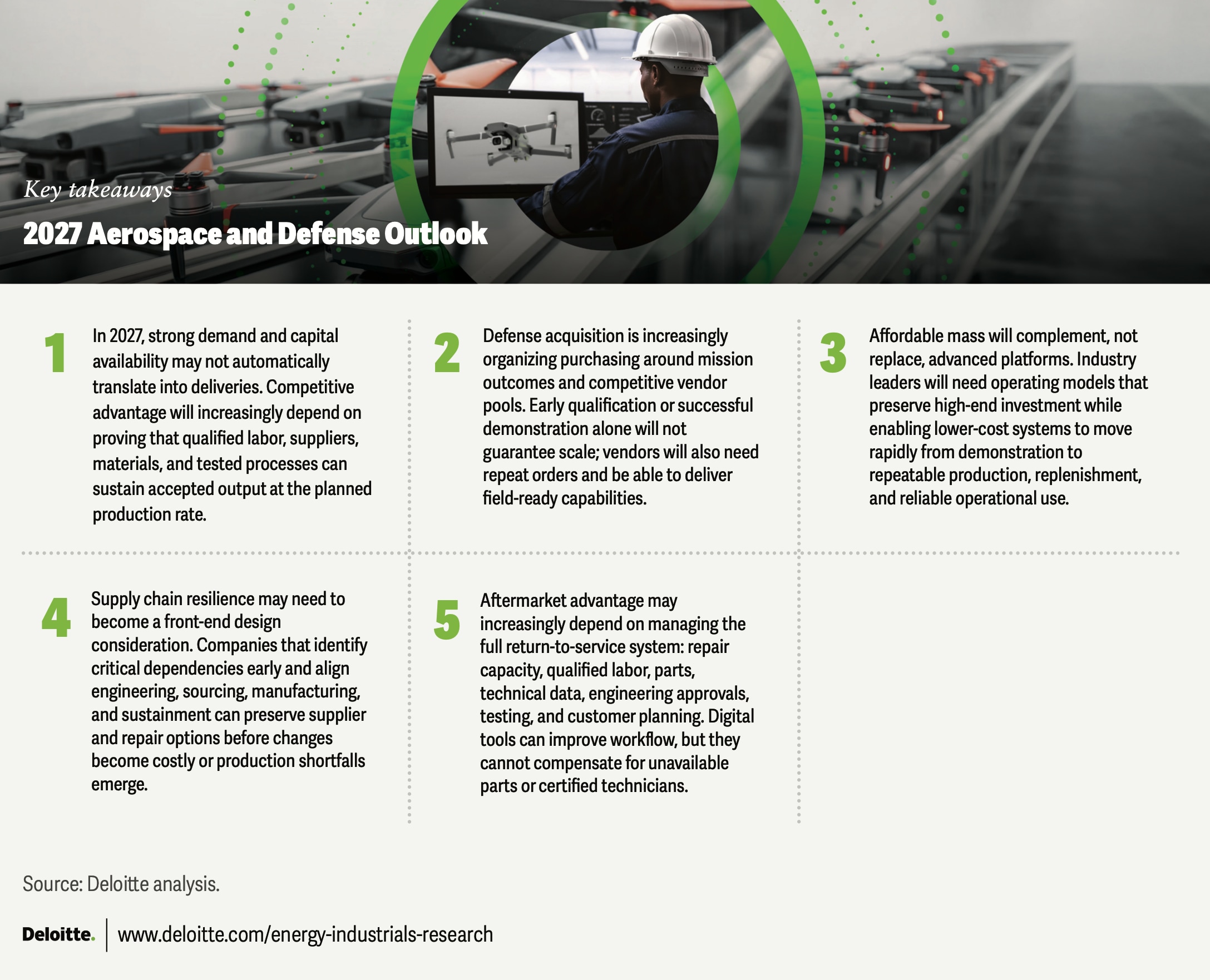
1. Throughput: From backlog to delivered capability
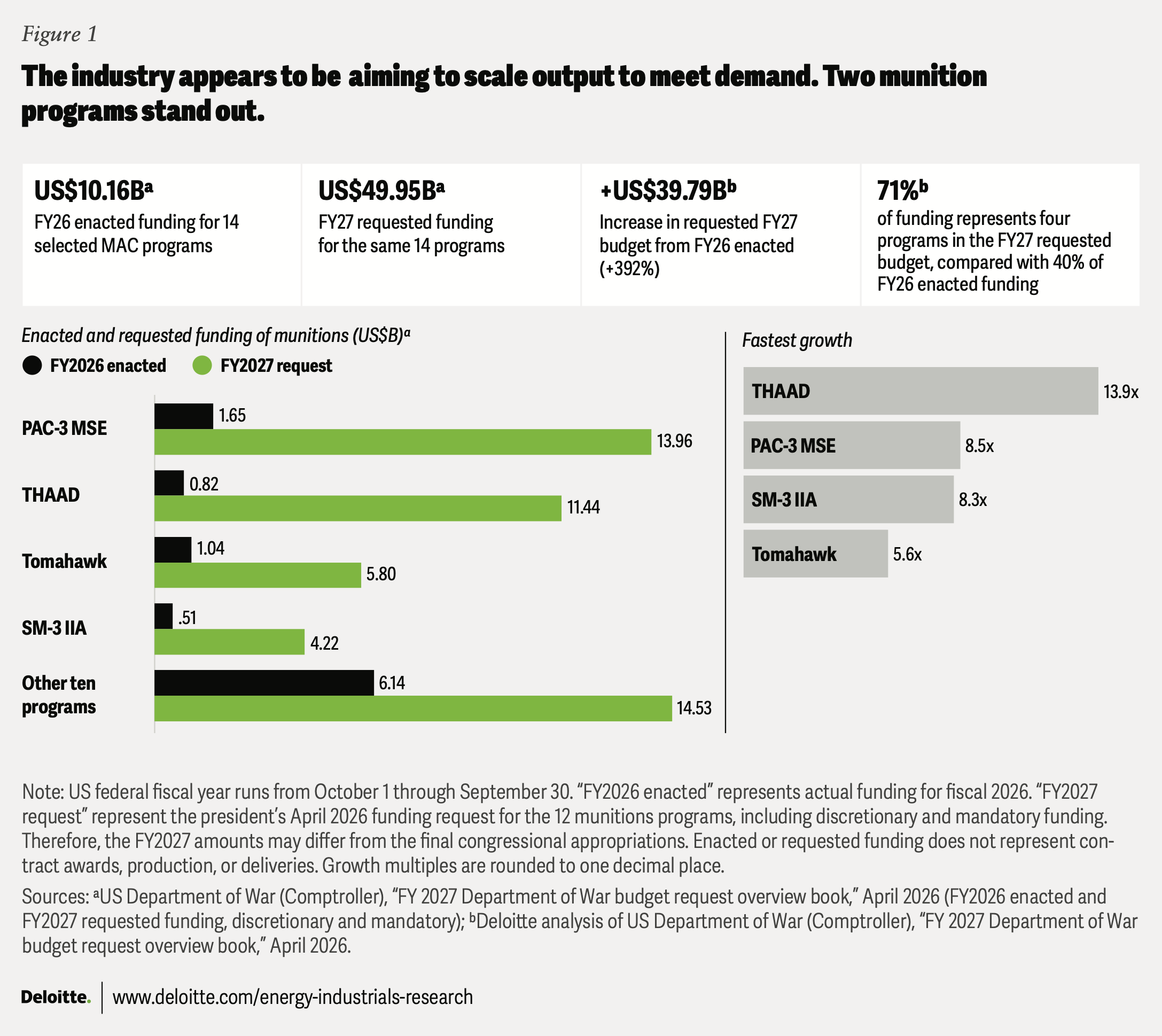
Order books and backlogs reached historic highs in 2026,2 so demand is no longer the question. Companies should now assess whether they have the capacity to deliver. Public filings show that the three largest US defense primes together hold a combined backlog of $624 billion, of which $454 billion is pure defense work—equivalent to three times these companies’ 2025 current annual sales.3 Production scale expectations have risen sharply, too. Where organizations once planned for incremental output gains, many are now scaling programs to rapidly and drastically increase output.4 Multiyear framework agreements illustrate that ambition. Several call for roughly tripling interceptor output and quadrupling another. Four munition programs account for 71% of the requested fiscal 2027 funding across the 14 selected Munitions Acceleration Council programs (figure 1).5
The past two years have shown that announced, installed, qualified, and demonstrated capacity are four different things. Capacity has to be proven to specification, fed the right inputs, and demonstrated as repeatable and sustained at the planned rate, with a high share of units passing inspection the first time. Many companies already track this kind of data internally to check whether they can actually hit their own production targets. In this new landscape, sharing production data externally in a standardized way could give companies an edge. This can help customers verify capacity claims the way they verify deliveries, allowing buyers to estimate production readiness before awarding a contract, and suppliers and lenders to plan and invest based on real production rates.
The real test is whether companies can turn their planned production rates into tested, accepted, and operationally usable products. In 2027, companies will likely be measured by what’s actually been built, tested, and accepted—all of which impact the real output rate.6
Secondary research suggests that delivered capacity is not necessarily limited by capital availability.7 Companies need to be able to deploy capital into repeatable, at-rate production, quickly enough to meet customer expectations. Established primes appear largely focused on extracting additional output from their existing facilities, while newer entrants are building manufacturing and supply capabilities from a relatively blank slate.
Two structural constraints could limit growth in 2027. The first is supplier readiness: Smaller suppliers downstream (tier 2 and lower) may lack the capital or appetite to adopt the digital and quality systems required to deliver for original equipment manufacturers and primes. The second, possibly harder constraint on growth, is skilled labor shortfall. While automation and AI can meaningfully improve productivity, they cannot substitute a trained workforce working within a well-designed process. Technology layered onto an immature process tends to add complexity rather than enhance output.
In 2027, rising budgets and capital availability won’t convert to delivered capability on their own. Production rate plans, procurement mechanisms, and workforce initiatives are important to prove that companies can turn commitment into output.8 But expect results to be selective, not uniform, across platforms and supplier tiers.
2. Redesigning the defense buyer: From platform programs to mission portfolios
For decades, the US defense acquisition system has organized spending around individual platforms and programs. That model still makes sense for complex aircraft, ships, vehicles, missiles, and strategic systems. But long development cycles and tightly integrated designs make it hard to introduce new technology, change suppliers, upgrade systems quickly, or swap in a cheaper alternative. The Government Accountability Office (GAO) reported in July 2026 that the average time needed to deliver capability through major defense acquisition programs has grown to more than 12 years.9 This is causing a shift in the defense buyer’s basic unit of decision-making, from individual platform programs to mission portfolios.
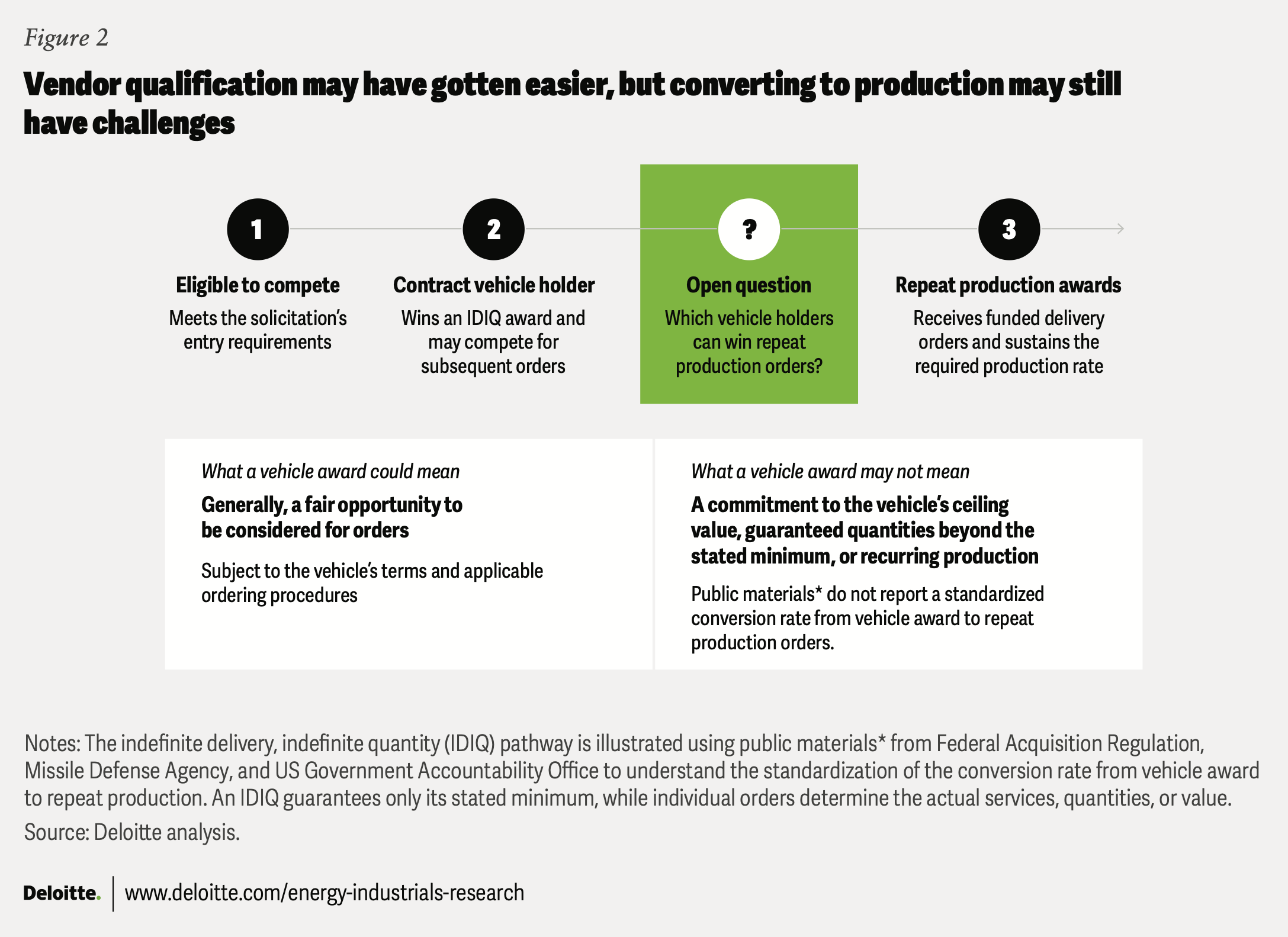
Contracts signed since late 2025 show the US Department of War is increasingly building vendor pools around a mission outcome.10 These vendors then compete for individual task orders. For instance, one recent initiative qualified around 2,400 vendors, spanning established primes, mid-tier suppliers, and newer entrants under a single contract ceiling.11 Most vendors in these pools still start with smaller initial design orders, while larger task orders, which determine real production volume, are competed for later.
This shift appears to be rewarding a different kind of readiness. Some newer entrants are investing in product and manufacturing capabilities ahead of funded contracts, betting that demonstrated speed and scalability will help them win mission portfolios. Multiyear frameworks are not appropriations, but they act as a demand signal that provides the industry confidence to invest ahead of confirmed government orders.
For the buyer, acquisition rules generally built around large, discrete hardware platforms now also have to adapt to software-centric capabilities, which evolve on a much faster cycle than hardware programs. How quickly they can adapt is likely to shape how much of the portfolio-buying model becomes a funded reality (see “Rethinking vendor readiness in a portfolio buying model”). That flexibility matters most at the handoff point. Faster access to demonstration doesn’t necessarily produce repeat orders, scaled fielding, or operational capability. The real test is whether early speed carries through to a fielded system (figure 2).
In 2027, a meaningful signal will be whether buyers start rewarding demonstrated production scalability as early and visibly as they reward technical performance, rather than discovering only after an award that a preferred vendor can’t deliver.
3. Affordable mass: Scaling without losing the high end
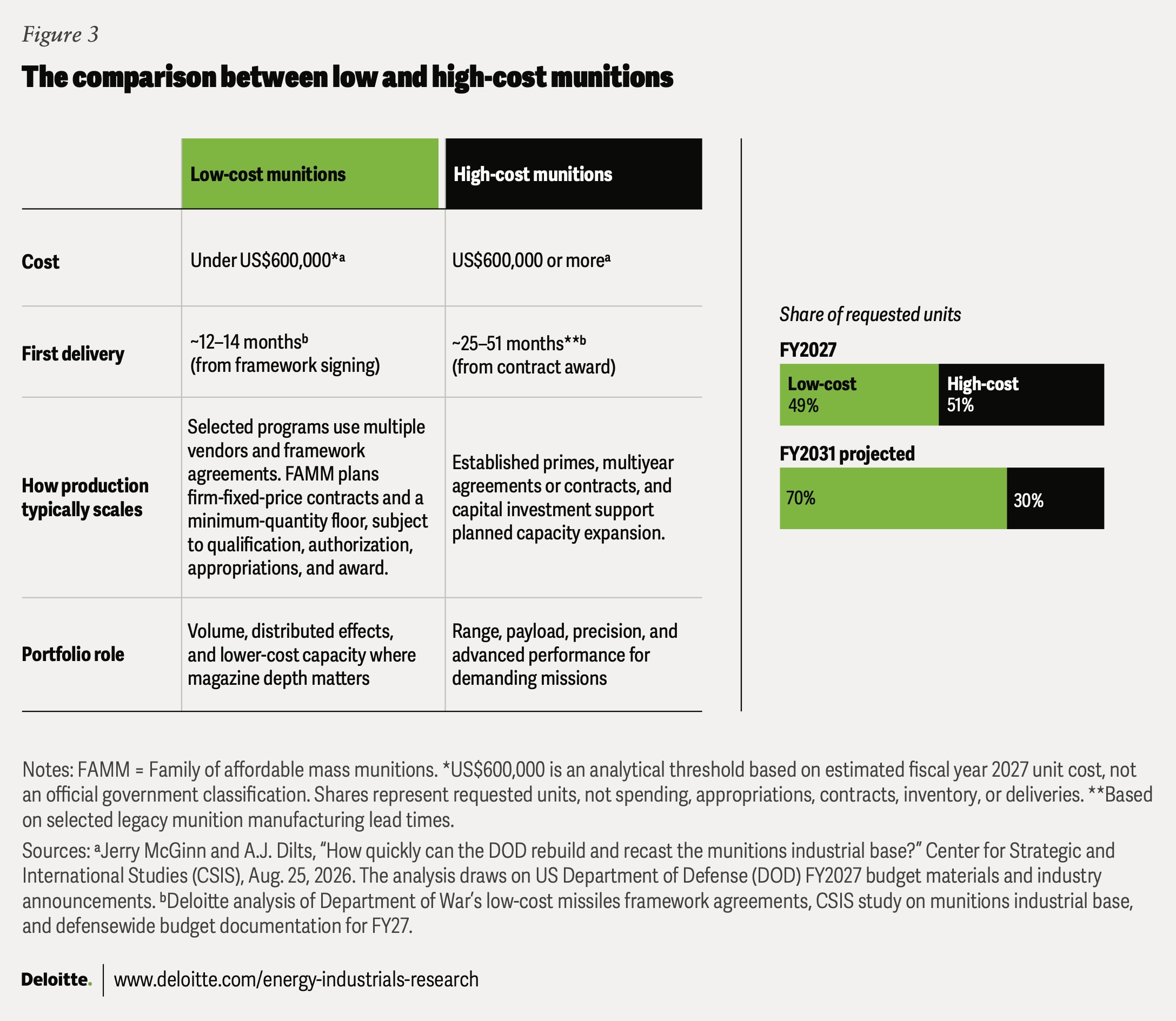
The US defense industrial base is increasingly supporting two different capability models (figure 3). One centers on exquisite platforms designed to remain operational for decades. The other is lower cost, rapidly scalable, autonomous, and drone based. And this model is growing rapidly. US procurement plans alone call for roughly 28,910 units of one family of affordable mass missiles between fiscal 2026 and 2031, backed by a budget of about US$13 billion.12 Primes may need dedicated business units, or in some cases separate entities, to compete credibly in affordable mass, since legacy overhead and rate structures can make an established organization uncompetitive on unit cost almost by design. Current dynamics suggest neo-primes are looking to own manufacturing end-to-end. But strategic partnerships between primes and neo-primes can work too, with primes bringing scale and market access and neo-primes bringing the underlying innovation.
The two models are not substitutes. Advanced defense systems are essential for missions that demand range, survivability, payload, and high-end performance. Lower-cost systems can add capacity, distribute risk, extend the reach of these platforms, or perform missions where the loss of an expensive asset would be difficult to accept. Affordable mass is therefore about choosing the right mix of capability, quantity, performance, and risk for each mission, not simply buying cheaper equipment.
Capital markets seem to reflect this bifurcation, although investment remains concentrated. The five largest transactions accounted for roughly 44% of global defense technology venture capital in the second quarter of 2026, with the largest single deal comprising nearly 30% of that quarter’s total.13 This indicates that investors are placing large bets on the few companies they expect to scale, sometimes even before government orders are confirmed, which could increase the pressure on those companies to convert prototypes into production.
In 2027, the test may be whether affordable mass programs can move beyond demonstration into repeatable production and operational use. Companies may need to preserve investment in advanced platforms while developing faster design cycles, more flexible production, and different sustainment models for lower-cost systems. Repeat orders, production rate, field availability, replenishment speed, and cost per successful mission could be better measures of progress than prototype count or unit price.
4. Supply chain: Moving control upstream into design
Many companies have traditionally addressed supply chain resilience after a product design is largely complete. They qualify suppliers, negotiate inventory agreements, and address shortages or obsolescence as they emerge. This reactive approach is becoming unsustainable. Supply chain disruptions across the aerospace and defense industry continued to constrain output in 2026, with stretched lead times, shortages of parts and materials, and limited alternatives for single-sourced components.14
Moving supply chain control into the design process can help address such challenges. The objective is to identify critical dependencies early in design and preserve alternatives before changes become expensive, while also ensuring the supply chain supports the target scale. Under this framework, availability, repairability, material choice, supplier options, and data rights are increasingly considered alongside cost, schedule, and performance during early engineering (figure 4).
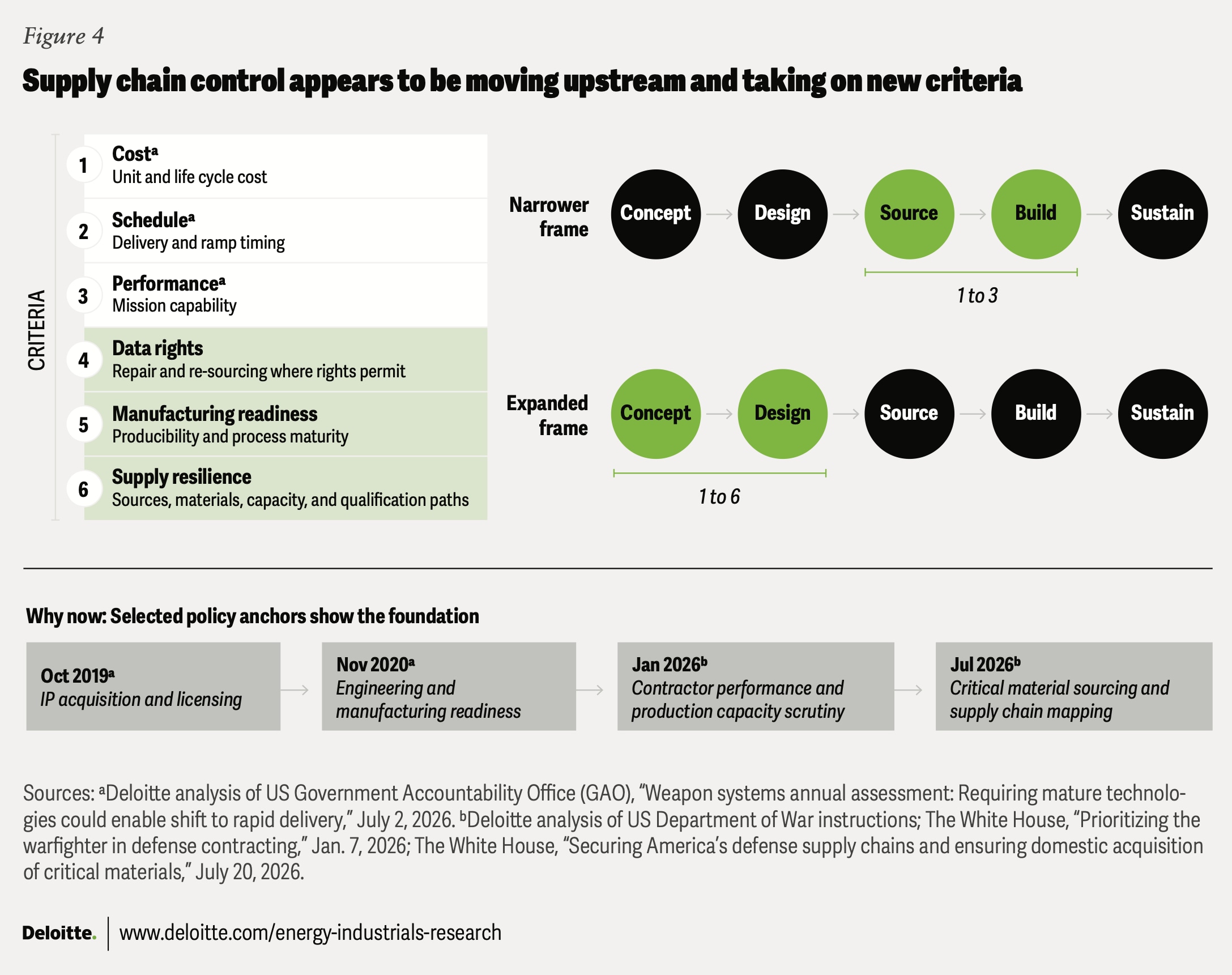
The GAO found that major defense acquisition programs continue to face delayed milestones, while some rapid acquisition programs began with immature technologies and leading product development practices are not consistently followed.15 Digital models, prototypes, and early supplier involvement can help teams identify related risks before they engage in large production investments.
Pending provisions in the National Defense Authorization Act for fiscal year 2027 could reinforce this shift. The House passed and the Senate committee reported bills establishing government purpose rights as the default, unless the contractor establishes entitlement to more restrictive rights through “clear and convincing evidence.”16
Company culture could present an obstacle to redesigning the necessary processes. For instance, neo-primes often default to solving manufacturing scale-up internally and may be cautious about sharing intellectual property or partnering during the innovation stage.
In 2027, companies should consider treating supply chain resilience as a formal design parameter, not an afterthought. Companies that coordinate engineering, sourcing, manufacturing, and sustainment together early can be at an advantageous position, not those that wait for a production crisis.
5. Aftermarket: Capacity becomes the competitive edge
Aftermarket is an area of opportunity for the industry in 2027. Meanwhile, the next year’s challenge looks different from last year’s. Aircraft, ships, and vehicles are staying in service longer, which makes maintenance, repair, and overhaul (MRO), spare parts, and sustainment critical, since equipment availability now determines mission success as much as new production does. One leading fighter program shows the gap: Sustainment costs kept rising while the program’s mission-capable rate fell from 67% to 44% between fiscal 2021 and 2025.17
Commercial aviation faces the same pressure. Engine shop turnaround times remained above pre-pandemic levels, against a global aircraft backlog already exceeding 17,000 units.18 An IATA study found that annual shop visits for some newer engine types could rise from the current 600 to 800 range to more than 5,000 by 2040.19 That combination suggests engine MRO demand could outrun available capacity even as industry spending on capacity continues to increase.
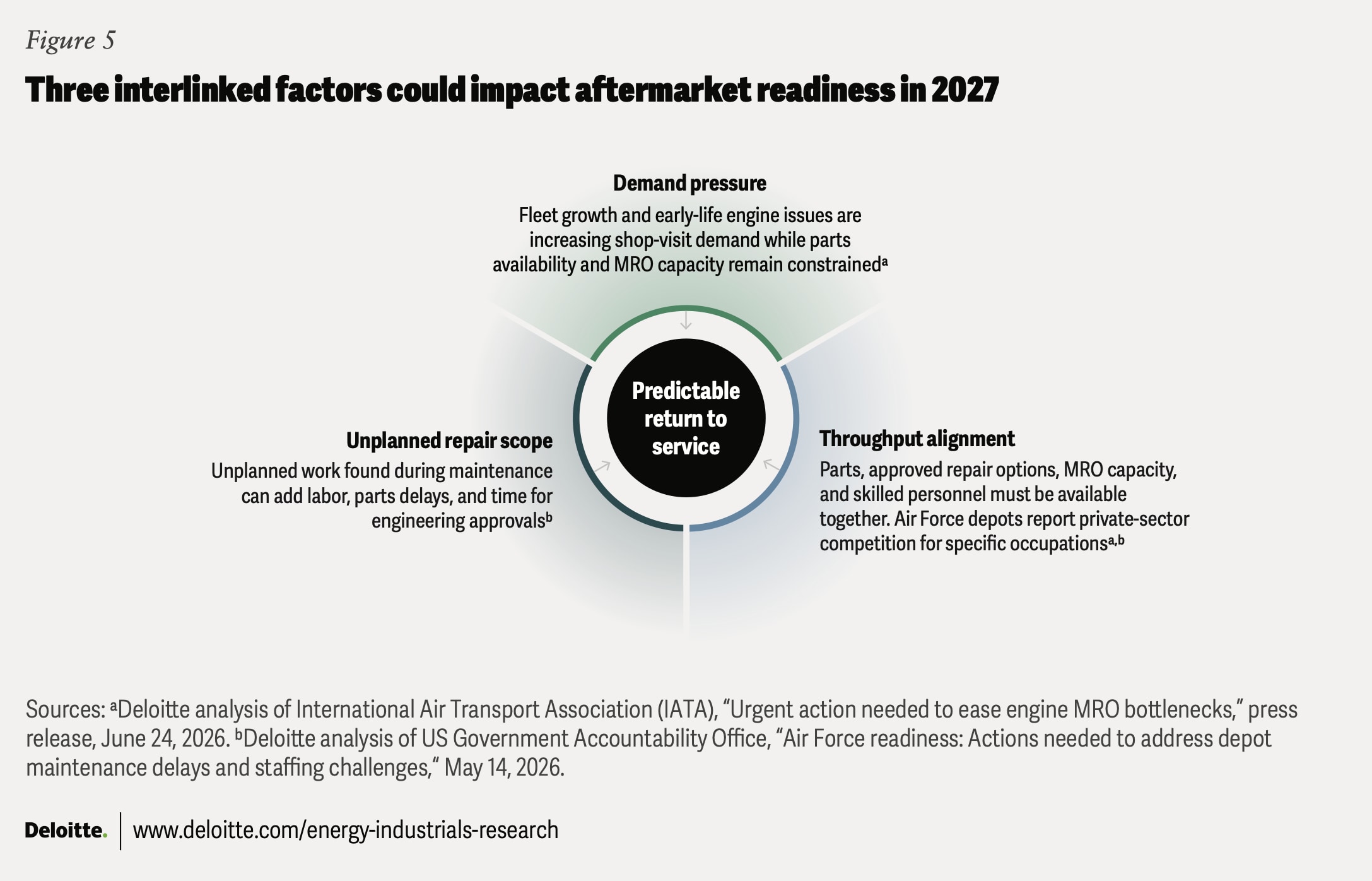
This constraint mirrors the industrialization challenge discussed in the previous trends, and it can be broken down into three interlinked factors (figure 5). Military maintenance depots are increasingly competing directly with the commercial sector for the same skilled talent, and that competition is a direct driver of rising maintenance delays. The MRO segment is likely to require a sustained, multiyear talent pipeline, alongside near-term compensation increases.
Digital technologies may ease these limits, but only partly. Many MRO providers still need to efficiently collect consistent data and work across fragmented systems. Additionally, repair findings often do not flow back from the repair floor to engineering teams, making it harder for each repair to inform the next. Three moves may help: using AI—still mostly experimental—to augment technicians; building an ecosystem of manufacturers, suppliers, repair shops, governments, and operators that share data and coordinate decisions; and capturing and reusing knowledge so each repair improves the next.
In 2027, aftermarket leaders may need to manage the full return-to-service system, from repair slots and qualified labor to parts, technical data, engineering approvals, testing, and customer planning. Digital tools can improve forecasting and workflow, but they cannot replace missing parts or certified technicians.
The 2027 test: From promised capacity to delivered capability
Across all five trends, 2027 poses the same test: Can promised capacity translate into delivered capability? Whether it’s commitment to a conversion ratio between promised and accepted output, demonstrated production scalability, repeatable production from affordable mass programs, building supply chain resilience into design at the onset, or aftermarket providers meeting real-world turnaround times, the question holds.
The industry’s center of gravity is shifting from securing demand to proving it has the capacity to meet it. Budgets, backlogs, and framework agreements give contractors, primes, and neo-primes the right to attempt delivery within a timeline. But none of these guarantees delivered capability. That only holds if qualified labor, tested processes, available materials, and negotiated data rights all come through.
That difference between securing work and delivering it creates real opportunities: for suppliers that can prove capacity rather than merely announce it; for MRO providers that offer guaranteed turnaround in a scarce market; and for nontraditional entrants that provide modular, software-defined products that bring strategic advantage for portfolio competition.
Continue the conversation
Meet the industry leaders
Steve Shepley
Kate Hardin
By
Lindsey Berckman
Kerry Millar
Kate Hardin
Scott Welch
Tarun Dronamraju
Deloitte Advisory Board:
The authors would like to thank Michael Schlotterbeck, Kevin Brannon, Ajay Chavali, and Pete Robertson for their subject matter input and review.
The authors would like to acknowledge the support of Clayton Wilkerson for orchestrating resources related to the report; Kimberly Prauda and Neelu Rajput who drove the marketing strategy and related assets to bring the story to life; Mariel Balaban for her leadership in public relations; and Pubali Dey and Aparna Prusty from the Deloitte Insights team who supported the report’s publication.
Editorial (including production and copyediting): Pubali Dey, Aparna Prusty, and Cintia Cheong
Design: Harry Wedel
Cover image by: Sanaa Saifi and Alexis Werbeck; Adobe Stock
Knowledge services: Viswa Teja Vanapalli