

If we have selected the wrong experience for you, please change it above.

Skills-based organisations: Looking back to move ahead
Read our latest perspective: How skills-based organizations are facing the future (and winning the talent race)
It’s been several years since Deloitte first started exploring the potential that transitioning to a skills-based organisation (SBO) can offer. Since then, we’ve consistently highlighted the SBO model’s ability to foster agility, resilience, growth, and innovation; improve the workforce experience; and champion talent development and internal mobility.
The SBO model today is ever more relevant, as pressures mount from shifting operating models, technological impact on skills, evolving economics and demographics, and a general need to upskill for relevance in this volatile, uncertain, complex, ambiguous world – especially as competitors see SBO gains.
In this first article of three, we’ll review lessons learned as pioneer organisations began to bring the SBO concept into practice. Subsequent articles will move forward to the present state of SBOs and on to a future of ensuring impact and resilience with proven SBO strategies.
First steps toward SBO
In 2020–21, we started to see triggers for a new view of work, mainly the post-pandemic “great resignation” and talent war. Back then, organisations were realising the need to build more resilience, become more flexible and focus more on skills, but steps were slow. And they lacked a clear vision strategy that would make use of skills as a data point. Deloitte stepped in to begin supporting organisations in transitioning to skills-focused operational frameworks, such as introducing common taxonomies.
In 2022, we introduced our SBO “hub and spokes” framework, also urging clients to treat skills as a “red thread” connecting talent practices to business impact.
-image?$Responsive$&wid=1024&fmt=webp&fit=stretch,1&dpr=on)
More companies began experimenting, at least with the first phase of an SBO approach. One of the largest technology companies in the Netherlands became an early SBO pioneer, followed by multiple Dutch banks as interest spread across other sectors. But many organisations focused too heavily on building skills libraries and used them only sporadically for select talent processes, again without a clear vision or strategy. Back then, they still lacked an understanding of how skills can be used as a data point and integrated across all their talent processes.
Scrolling forward to 2023, we saw many more SBO adopters – inspired by others’ success stories – beginning their own journeys by preparing to build the required foundation. We mined client feedback and experiences to continuously inform and fine-tune their approaches.
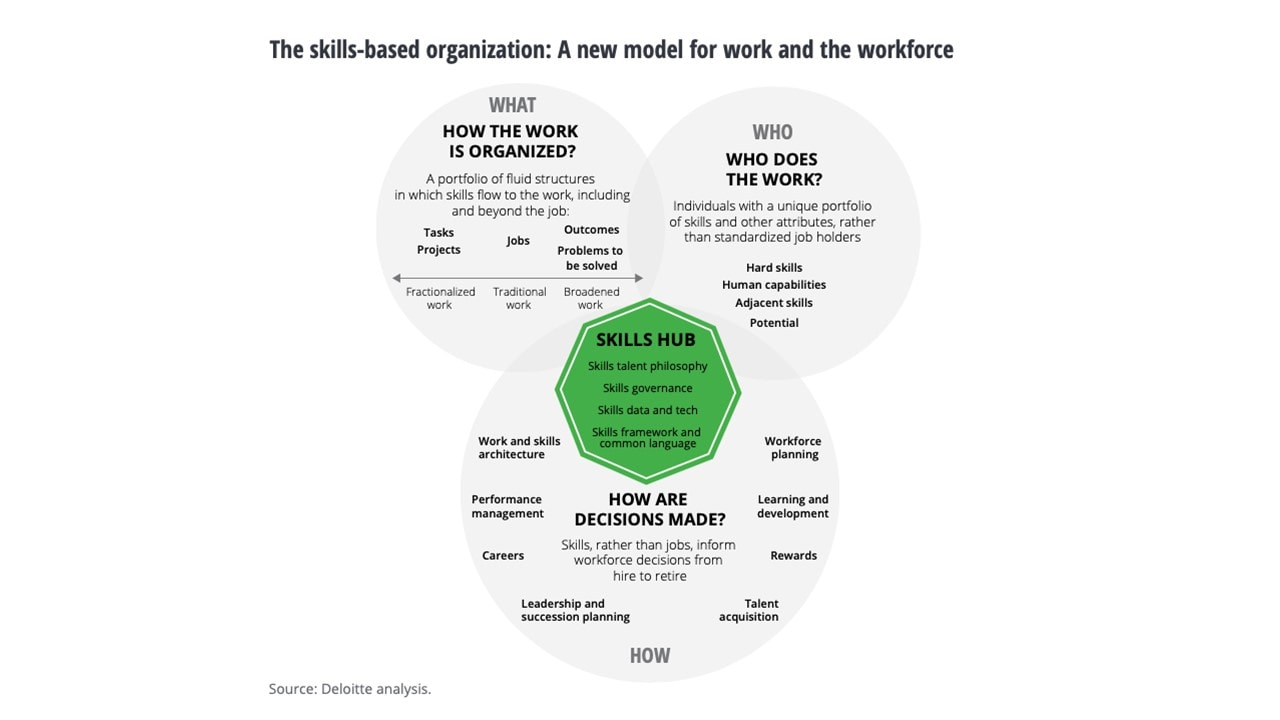
But some companies continued to fixate on the individual spokes of our SBO framework (talent acquisition, for example), rather than building a holistic, streamlined, disruption-resistant framework for an SBO. And sometimes departments and practices would turn their focus to skills while others continued to focus on competencies and jobs; that kind of discord makes it impossible to realise the SBO model’s maximum potential.
Assessing past steps, recommitting to the goal
Now it’s 2025, and many businesses are in a state of limbo: wanting to prioritise skills and new talent management processes, but struggling to clean up the “mess” of legacy or competing systems in other business units. To double down on an SBO future that breeds agility, a resilient workforce and a competitive edge, let’s drill down into what’s worked and what hasn’t, keeping a close eye on your own approach.
Skills defined
We broadly define “skills” as encompassing:
- “Hard” or technical skills, such as coding, data analysis, and accounting
- Human capabilities or human skills, such as critical thinking and emotional intelligence
- Potential skills, including latent qualities, abilities, or adjacent skills that may be developed and lead to future success
But "skills" might also encompass interests, passions, motivators, work or cultural styles.
What are the weaknesses?
The following common points of vulnerability have hindered certain organisations’ SBO efforts:
Immature skills and SBO foundations: Efforts stop at skills libraries or early pilots, without connecting skills to business outcomes.
Unclear vision and operating model: SBO initiatives lack: direction and buy-in without a shared narrative, clarity on taxonomy, a framework, defined governance or a roadmap for change.
Insufficient use cases: Organisations have applied a skills focus randomly, without identifying the right use cases.
Over-focus on individual talent processes: Skills are applied narrowly (e.g., just for learning or recruiting) instead of being embedded across the talent lifecycle and linked to talent strategy.
Fragmented or misaligned technology: Organisations adopt multiple tools without integration or clear ownership, creating overlap, complexity and limited ROI.
Recognising these “blind spots” in your own organisation may end up exposing others. Are there skills you ignored as you defined and championed others? Have you developed complex skills libraries with competing definitions? Are you missing a solid view of your skills data that lets you see where gains can be made?
If you’re finding more weaknesses than strengths in your SBO strategy, you’re in good company; many organisations have not moved beyond a basic level of SBO maturity.
What are the strengths?
If you’re lucky, examining your SBO efforts may also highlight that, for all the gaps needing filling, your organisation has also seen some wins. There have certainly been some in the SBO landscape as a whole. Leadership buy-in is one – there’s little argument from executives that SBO is an evolutionary concept to refocus perspective, not a revolutionary model that will disrupt every aspect of the business.
We’ve also seen organisations reap substantial benefits when they’ve shown agility and applied an iterative approach – such as defining skills vision, strategy and use cases rather than just identifying key skills needed to deliver required capabilities. These are companies that didn’t rush to become SBOs overnight (by implementing only a skills platform, for example), but took careful, measured steps in that direction.
And – recognizing that tendency of the past few years to use skills libraries in an ad hoc way – we’ve helped clients pivot to building a holistic SBO approach. That’s led to organisation-wide implementation and success, rather than just a quick fix in a certain area.
Finally, there’s a whole host of vendors offering SBO-specific solutions; it’s encouraging that you can now implement a common and integrated suite of tools to spotlight where new skills are needed, monitor existing skills, match skill supply to demand, and develop organisational and talent capabilities. (Although navigating through this vendor landscape can be challenging, as some leaders will already have found.) What’s more, many organisations are finding AI a useful companion to SBO-specific tools – a point we’ll explore further in the next article.
Where does this leave us?
Probably the biggest lesson learned since the beginning of this decade is how crucial it is, before implementation, to foster an SBO mindset and lay out a change management strategy based on specific goals, considered use cases and careful technology choices.
Ignore your impulses to prioritise smaller choices… you might start by building a skills library, but without planning how you’ll use it or how it will stay relevant, you just won’t see the full benefits. Focus on the problems you want to solve by implementing SBO components, not a single (technology) solution. And once you’ve got your plan in place, consult it at every stage of implementation to keep you on track.
Every effort should be a step to build a future-proof SBO business model that holds up in the face of any disruption. Because they will keep coming, whether it’s AI, a global recession or the fluid working styles of Generation Z. Why wait until the next disruptive event adds sudden pressure to abandon the traditional “job” construct?
Moving on, with clarity and purpose
With Deloitte’s help, our clients across industries have been transitioning to an SBO model with thoughtfulness and purpose. They’re seeing gains by making data-driven interventions in hiring processes, upskilling, redeployment and planning for the future. As SBOs, they’ll stay competitive by solving talent retention challenges, ensuring a future fit workforce and a way to fill gaps arising from shifts and disruptions. With the right strategy and guidance, they’re taking the best course of action to build resilience and move with the changing tide of hiring, using and retaining talent.
In the next article we’ll drill down into the current state of SBOs, such as maturity, trends and successful case studies. The last article will look to the future, offering strategic SBO direction for HR and business leaders.


