
Are organizations ready for personalized AI agents in the workplace?
Personal AI agents could give workers more control over how they work and accelerate innovation and adoption. But they also raise new questions around governance and trust.
Imagine a job interview where the candidate brings not only a résumé but also their personal AI agent. Rather than completing an assessment independently, they work alongside an agent they’ve trained over months or years. The interview is no longer evaluating only the individual. It’s also revealing how they collaborate with artificial intelligence.
But the more interesting questions might come after they’re hired. Can they bring that agent into their new role? Does the organization need to review or onboard it? Can it connect to company systems or data? Or does the human worker need to recreate what they’ve built using whatever tools the organization already has at its disposal? Organizations may not be confronting these questions at scale yet, but several trends suggest they might need to start thinking about them.
To begin with, some organizations are making ambitious plans to scale agents in the next several years. It is predicted that by 2028, the average Fortune 500 company will have 150,000 digital agents deployed across its operations, up from fewer than 15 in 2025.1 At the same time, creating customized AI tools is becoming easier for nontechnical users. OpenAI reported that from August 2025 to June 2026, weekly usage of Codex (an AI-coding assistant) among non-developers increased 137-fold for individual users and 189-fold for organizational users.2
And even as organizations have begun providing more sanctioned AI tools, workers continue to use unsanctioned alternatives of their own. A May 2026 Deloitte Trust ID study reported that among workers using AI at work, 49% of respondents reported using unapproved AI solutions, with senior leaders 32% more likely than staff to use unapproved AI tools.3
As these forces converge, they could create a world in which workers augment traditional enterprise tools with personal agents to improve their own productivity and team output. They could also create a new set of questions around security, intellectual property, cost, trust, and governance. While there isn’t a single answer for how organizations should respond, leaders can begin by considering where the organization should standardize AI and where it might benefit from giving individuals more room to shape their own tools.
Personal agents: Opportunities and trade-offs
Enterprise agents offer an important advantage: scale. Because they are designed to operate across workflows, their value depends less on individual workers and teams deciding whether or how to use them.
But that breadth can also be a limitation. Enterprise agents may not account for the specific work individuals and teams do, or for the different ways people approach that work. Personal agents, developed by individual workers and deployed primarily on their local desktop to enhance individual productivity, could help fill that gap by allowing workers to tailor AI more closely to their own tasks and ways of working.
Not only could encouraging the use of personal agents help organizations move faster toward integrating agentic technology into workflows, but enabling individual workers to create and manage their own tools could help attract and retain differentiated talent in an AI era. As individuals develop preferences around AI tools in their own lives, being able to develop and use personal agents could also enable workers to perform better on behalf of the organization. Workers on the ground may be best positioned to develop agentic solutions to augment work they are already doing.
But giving workers more latitude to develop and use personal agents also introduces new challenges to governance. An agent used by one employee for a limited task raises different issues from one that can connect to enterprise systems and access an organization’s data or interact with customers. And an agent built entirely within an organization’s approved technology environment poses different risks from one a worker brings with them from outside the organization.
Governing agents is already proving to be a challenge for many organizations. According to Deloitte’s 2026 State of AI in the Enterprise, only one in five surveyed companies has a mature governance model for autonomous AI agents, despite three-quarters planning to deploy them within two years.4 Additionally, a separate Deloitte survey of 500 senior managers and above found that 70% of respondents viewed the inability to trust and govern agents as a barrier to adopting agentic technology.5
To understand the opportunities and trade-offs, organizations can first consider whether a particular use case is better suited to an enterprise agent or a personal agent. If a use case can’t be addressed by enterprise-level agents, organizations can consider two approaches to personal agents. Workers might bring their own external agentic to address the use case or, if they need to, build an agent within enterprise frameworks (figure 1).
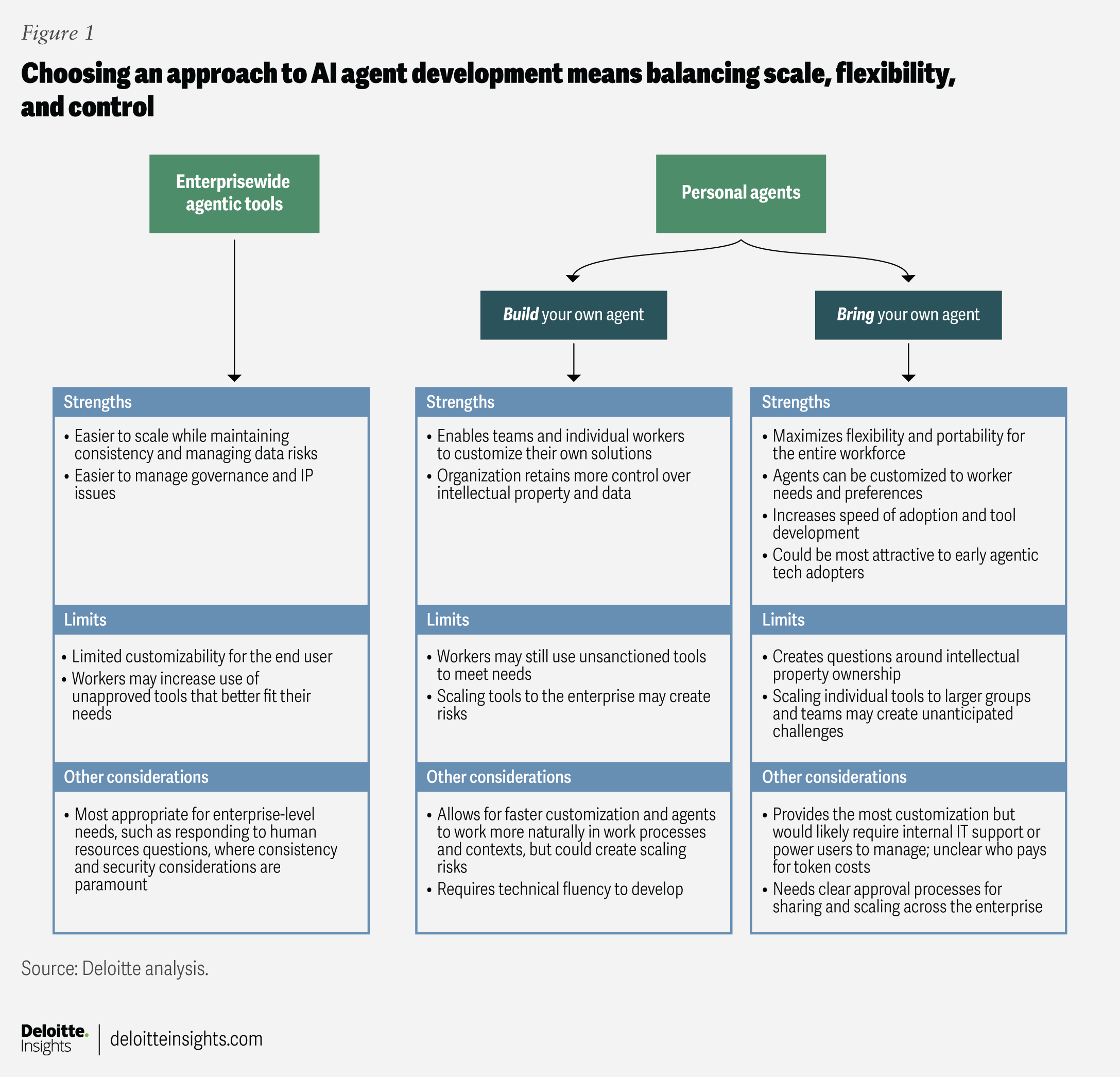
Key considerations for governing personal agents
If people increasingly turn to personal agents to help them perform better in their professional roles, the era of one-size-fits all enterprise software might be giving way to something much more fluid: Workers who use AI to build the exact tools they need can make a localized impact within their role. To begin to integrate these personal agentic tools into enterprise agentic strategies, organizations might need to rethink how much flexibility they can allow in developing and using them. The questions are not only technical. They also touch strategy, trust, cost, and the balance between enterprise control and individual autonomy.
Strategy: How do personal agents fit into a broader human x machine strategy?
Human x machine strategies intentionally design work to leverage the unique strengths of both humans and machines to create sustained value and growth. Recent Deloitte research suggests that companies that lead in developing human x machine strategy—particularly on the people and organizational sides—are nearly 2.5 times as likely to report better financial results.6 Personal agents could become another way to put that strategy into practice by giving workers more scope to shape AI around the work they actually do. They may also provide opportunities for individuals to harness their own creativity and unique ways of thinking to accelerate the development of agentic tools as well as the pace with which work processes can be rearchitected around human-machine collaboration.7
Trustworthy AI: How can organizations enable experimentation without creating unacceptable risks?
While personal agents may help accelerate adoption, they could carry risks related to the reliability of agentic outputs, especially at scale. Organizations may need to restrict those agents to individual or small team use and avoid higher stakes use cases such as those that involve sensitive data or customer-facing interactions. Despite the potential risks around trust and reliability at scale, enabling workers to pilot the use of personal agents may actually alleviate the use of unapproved agentic tools.
Cost and value: Who pays, and how do we assess the value personal agents bring?
As organizations become more mindful of the token costs related to scaling agentic technology,8 personal agents could add an additional wrinkle to those calculations. Workers might be more efficient as well as innovative when they have the opportunity to use personal agents to support their efforts, but decentralized experimentation could also create duplicative efforts and additional token costs. Walmart recently made the decision to limit token use in an effort to avoid duplicative requests and vibe-coded projects,9 and other companies could follow next. Bring-your-own approaches also raise another question: If a worker uses a personally developed agent for work, who bears the cost—the organization, or the individual?
Personal AI agents could require organizations to rethink not only how AI is governed, but also where to draw the line between enterprise standardization and individual autonomy. The challenge may be less about choosing one over the other than deciding where greater individual flexibility creates value, and where the risks may require tighter organizational control.
Continue the conversation
Meet the industry leaders
Kyle Forrest
by
Gregory Vert
Brad Kreit
Abha Kulkarni
The authors would like to thank Corrie Commisso, Brenna Sniderman, Siri Anderson, and Susan Cantrell for their ongoing feedback and support throughout the writing and development process. They also thank Saurabh Rijhwani and Akshay Poojari for their marketing support, as well as Mario Passera for his support in the development of this article.
Editorial (including production and copyediting): Corrie Commisso, Shyamili M, Anu Augustine, and Cintia Cheong
Design: Molly Piersol
Cover image by: Manya Kuzemchenko and Sonya Vasilieff
Knowledge services: Viswa Teja Vanapalli