
Maternal health inequities persist. Can digital tools be part of the solution?
Digital tools can empower the maternal health ecosystem, but there is a need for better cultural tailoring and increased ease of use.
Maternal health is a worldwide issue, and the United States is no exception. In fact, it has the highest maternal mortality rate of all developed countries.1 Racial disparities exist across all US income and education levels, with maternal mortality among Black women occurring three times more often than among White women,2 due to inequities in access and care.3 The maternal health ecosystem can do more than just ensuring that women survive pregnancy.4 However, substantial challenges remain in identifying and addressing patient needs efficiently and equitably. While not a silver bullet, digitally enabled care and tools could help increase access to and utilization of timely and tailored care.5
To understand how digital tools can be helpful and how maternal health–focused organizations are using technology and digital tools to improve health care disparities and access for people across the pregnancy journey, the Deloitte Center for Health Solutions conducted a survey in the United States in July and August 2023 of 2,000 people who were pregnant in the previous two years and interviewed a wide range of stakeholders (see “Appendix: Study methodology, respondent profiles, and data analysis” for more information). We found that digital tools could boost maternal health empowerment, with more than 70% of respondents using digital tools to manage specific health needs, going beyond accessing health care and receiving or sending communication.
However, Black, mixed-race, and Hispanic respondents were twice as likely as White respondents to say that digital tools for maternal health did not meet their personal needs or align with their cultural backgrounds. This indicates that, as US health care providers work to activate a maternal health ecosystem that improves pregnancy and child health outcomes, it’s important to understand people’s unique experiences and needs when using digital tools to support maternal health and equity.
Digital tools could improve access to care and help manage maternal health needs
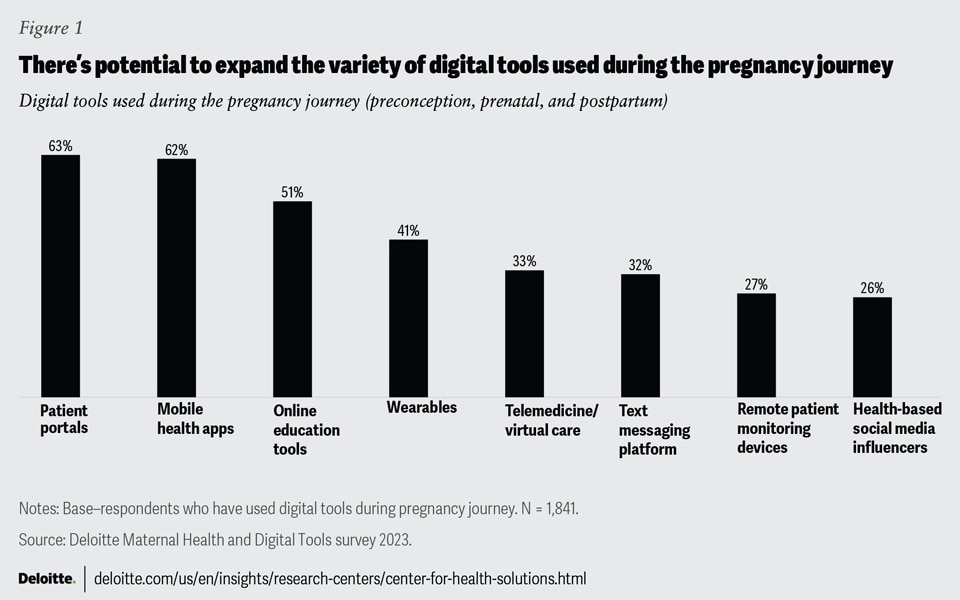
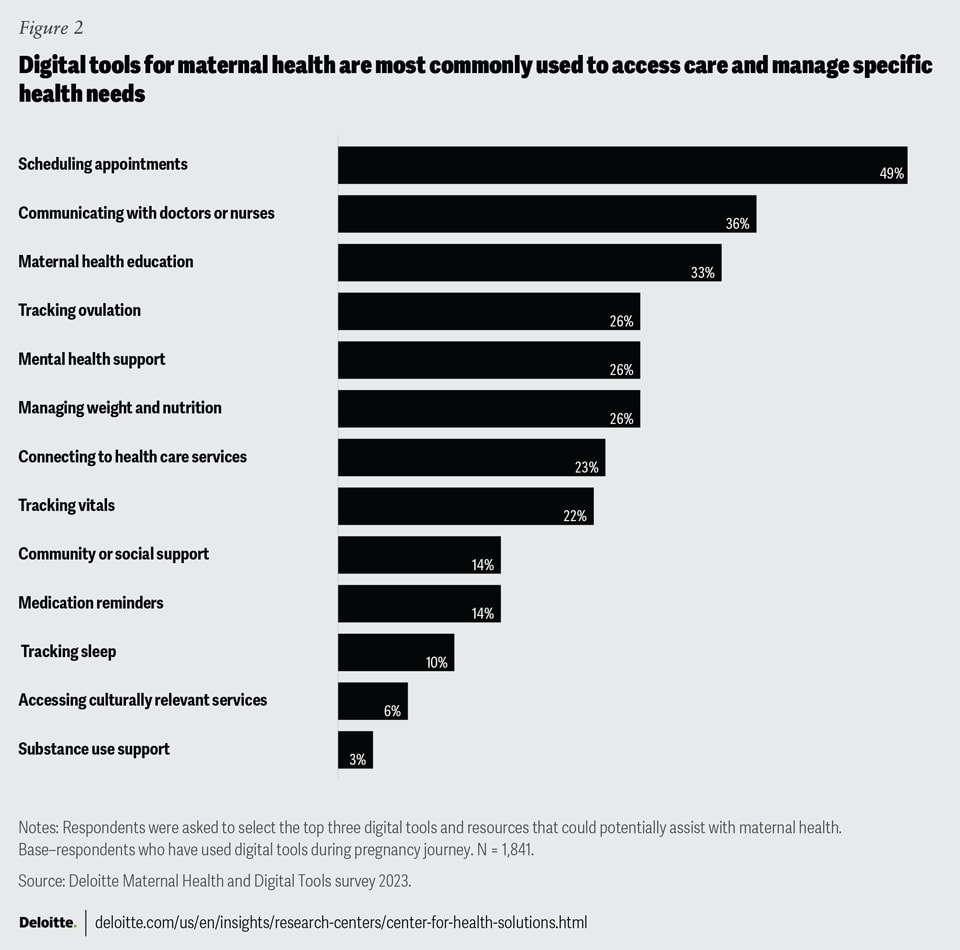
Digital tools for maternal health can act as a gateway to enhance accessibility to care teams and health services, and to aid patients in addressing specific needs. According to the survey findings, patients of all racial groups are using patient portals and mobile health apps most frequently across the pregnancy journey (figure 1). Nearly half of the respondents use digital tools to access care, with 49% using the tools to schedule appointments and 36% using them to communicate with their care team (figure 2).
Patient portals, online scheduling platforms, and communication tools are the bare minimum that should be provided to patients to access care. However, a deeper look shows that using digital tools can help patients meet more specific needs when it comes to getting the care they need. According to the survey, 77% of respondents are using digital tools to monitor reproductive cycles, manage weight and nutrition, support mental health, and educate themselves on maternal health.
Through our focus group and interviews, we found that, overall, health care providers are already using some digital tools like telehealth but are interested in venturing further. Advancements like virtual doula care have been shown to educate patients on maternal warning signs, help manage mental health, provide emotional support during pregnancy, and ultimately reduce the need for a cesarean delivery.6 Boosting health systems’ proficiency in using digital tools for maternal health is important to effectively address patients’ unique needs. One large health system is using an artificial intelligence–enabled pregnancy chatbot that provides a virtual safety net by sending alerts to the care management team depending on patient responses and data.7
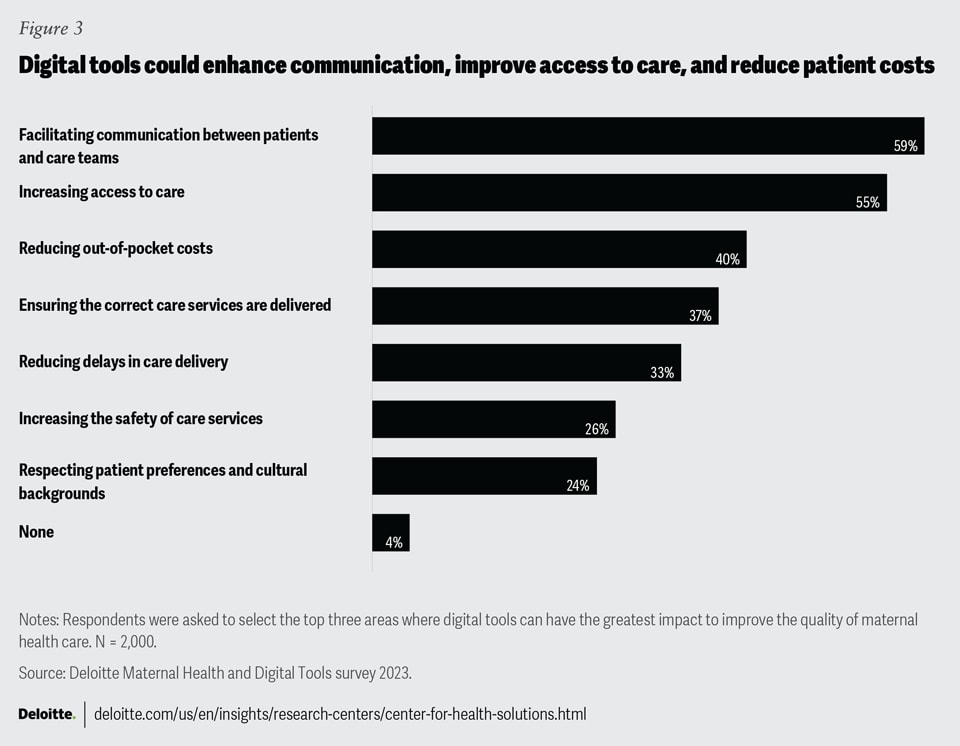
While the survey responses suggest that digital tools could significantly enhance access to maternal health services, there's broader potential for these tools. In fact, nearly 60% of respondents report that digital tools can improve communication with care teams, 55% believe they can increase access to care, and 40% think they can help reduce out-of-pocket costs (figure 3). Some interviewees also noted that digital tools can contribute to a more empowered ecosystem by reinforcing patient voices and experiences with actionable data.
Using data collected from digital tools to amplify patient voices
Digital tools can give patients more agency during interactions with their providers by supporting their concerns with trending data points—thereby empowering them at a deeper level. According to the leaders we interviewed, when patients express their concerns about pain, headaches, lack of fetal movement, or other symptoms, for example, providers don’t always know what to do with the information. Instead, when patients can share data that shows their blood pressure changed or that the fetal movement pattern wasn’t consistent during the previous few days (see “Empowering patients with data to prevent stillbirth” for more information), providers can be better equipped to act.
Making digital tools more equitable and better aligned to consumers’ needs
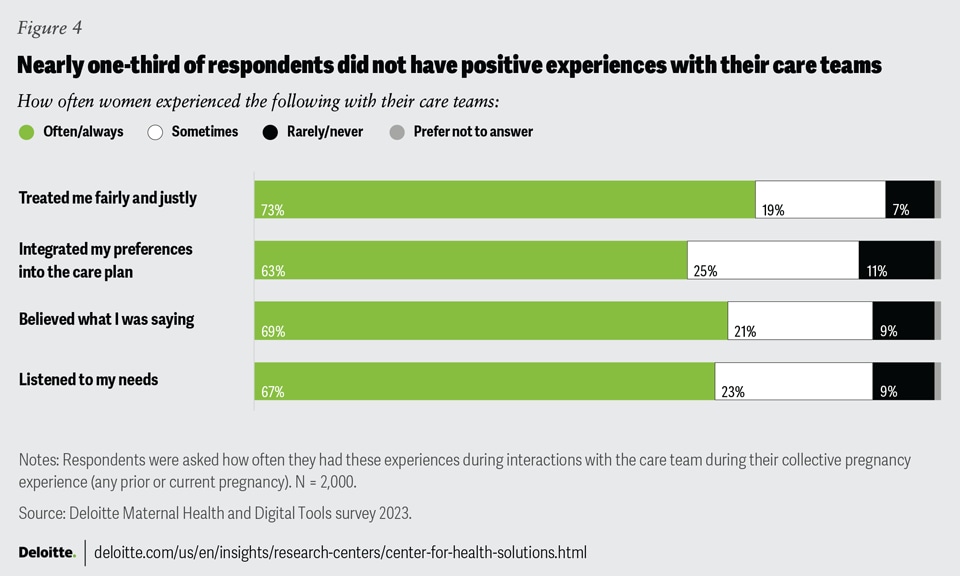
In analyzing the survey results, we examined different dimensions of the pregnancy experience to understand how supported the respondents felt. We looked at whether during the pregnancy journey, respondents felt their health care teams listened to their needs, believed what they were saying, integrated their preferences into their care plan, and treated them fairly and justly. Sixty-three percent to 73% of respondents reported that these aspects happened often or always during their pregnancy journey (figure 4).
However, 27% to 37% of respondents said that these aspects of care did not frequently occur on their patient journey. Those with negative pregnancy experiences were more likely to be Black or African American, and to say that digital tools were not designed to address their personal needs or align with their cultural background.
In our survey, Black (30%), mixed-race (24%), and Hispanic (23%) respondents were nearly twice as likely as White (13%) respondents to say that digital tools for maternal health need to be more culturally informed. This could mean providing the information in different languages for comprehension, showing what conditions or risk factors might look like on different skin tones,13 or accounting for cultural stigma related to certain topics like mental health.14 Cultural tailoring is important for uptake and effectiveness and is likely to continue to be important in light of persistent maternal health inequities.
We interviewed a few leaders from remote care startups who noted that depending on patient needs, they may offer services in different languages and account for cultural concordance of the care team (see “Providing culturally informed care to patients” for more information). Culturally concordant care—in which the care team or provider leverages shared cultural similarities or lived experiences, particularly for patients from marginalized backgrounds—has been found to enhance patient care experiences, improve communication between patients and providers, encourage more frequent use of recommended health care services like screenings and checkups, and decrease overall costs through more efficient care use.15
According to Deloitte research, survey respondents, particularly Black respondents, say it is important to receive care from clinicians who can understand their background.16 Interviewees, particularly those providing direct patient care either virtually or in person, noted the importance of hiring clinicians from diverse backgrounds that either share similar life experiences as patients with marginalized identities, or who can provide culturally informed care. A startup leader we interviewed noted that a virtual platform allows for more personalization and tailoring, as certain populations that may be difficult to reach in person can be helped in greater numbers online. For example, this approach could help clinicians customize care for patients with limited mobility, certain religious affiliations, or intersectional identities more efficiently and effectively.
Digital maternal health offerings should be designed for equity. Equity-centered design is a process that purposefully and continuously incorporates the real-life experiences of the end users. In this process, end users are valued as co-designers and their input is considered important throughout the entire design journey.21 Over 80% of our survey respondents indicated that people with relevant lived experience should be involved before a digital resource for maternal health is created, while it’s being developed, and after it’s launched. Furthermore, respondents also said that they would be willing to participate in each of these stages, with 87% of respondents willing to inform before development, 91% during development, and 92% after a tool is in market. These findings were consistent across racial groups.
Equity-centered design isn’t merely about ticking boxes on a static checklist. Instead, it should be an ongoing process that emphasizes active involvement and inclusion. When designing a tool or offering to address a specific issue, it is generally beneficial to bring in the experiences of those most impacted. For example, if the goal of a resource is to improve patient education on preeclampsia, then those at greatest risk of preeclampsia and with lived experience relative to the issues should inform the process.
Certain tools are specifically designed to prioritize and amplify community voices and involvement (see “Amplifying community voices to promote transparency and accountability” for more information). By bringing in community voices, digital tools can connect parents and families with similar or different experiences to provide helpful insight and support to navigate the maternal health journey. Community perspectives can also offer greater transparency into care systems, not only helping families, but also advancing accountability and improvements for organizations and hospitals across the health system.
Digital tools can be difficult for people to access and use
Survey participants expressed a strong need for consumer-friendly and accessible digital resources. In particular, the respondents highlighted the need for better access, improved integration and interoperability, and less information overload.
- Increase access by reducing costs: Nearly half of the respondents (49%) noted reducing the cost of tools and related digital services as a key improvement going forward. Access to tools is merely the starting point. The economic impact of poor maternal health is already substantial, and economic challenges to solutions may also compound the problem.
- Improve integration and interoperability: Nearly a quarter of the survey respondents noted the lack of interoperability as a challenge when using digital tools. Interoperable tools allow multiple users to access data from different systems and use that data to coordinate care.24 Across all subgroups, over half of respondents indicated a need to develop a unified platform for maternal health information in the future. Structural factors like integration (within an organization) and interoperability (between organizations) can be important to translate data in a timely manner to deliver better informed care.
- Limit information overload: Across all subgroups, nearly 30% of the respondents stated that they had difficulty deciding which tool to use because there were so many options, and that too much information was causing stress. Relatedly, 44% of respondents highlighted a need to make it easier to understand how to use tools. Digital offerings should consider the information load and its impact on users’ ability to use tools effectively and make decisions for their health. While digital tools can bridge gaps in access and resolve specific needs, they should not compound maternal health burdens.
Overcoming governance challenges and leveraging regulatory momentum
Prior Deloitte research shows that governance and organizational ownership of digital health initiatives are a challenge. Various departments from strategy, clinical, innovation, and marketing to security have a vested interest, leading to fragmentation. The leaders we interviewed noted a discrepancy in that consumer-facing tools are generally managed under marketing, while hospital-centric tools are often managed under IT, with confusing navigation between the two. Leveraging various departments and roles to account for applicable intersections is important, however, organizations should break siloes and clarify roles and shared ownership.
Beyond governance within the health system, the regulatory landscape across the health ecosystem can play an important role in generating momentum for equitable digital transformation in maternal health. Released in 2022, the White House Blueprint for Addressing the Maternal Health Crisis provides support for innovation in maternal health and increasing access to digital tools to advance maternal health equity.
Another challenge we heard from our interviewees is how the lack of reimbursement impedes the adoption of digital health options and add-on services. In our survey, 40% of respondents highlighted the need to cover digital tools and technologies under an insurance plan. Looking ahead, overcoming these challenges and leveraging supportive policies can help pave the way for a more accessible and equitable digital health landscape.
Digital tools are not a cure-all
In story after story, women with lived experiences have called attention to how their questions and concerns have been met with skepticism and disregard. From a former professional athlete detailing postpartum care concerns,26 to Black health professionals, including a pediatrician and an epidemiologist who died from postpartum complications,27 to a fatal outcome after a routine cesarean section,28 the list is long.
We conducted multivariable regression analyses of our survey data (a technique that allows us to account for more than one factor at a time) to understand the relationship between digital tools and pregnancy experiences. We accounted for digital tool use and utility, as well as personal factors like age, insurance status, education, and race. We found that Black respondents were significantly less likely to report a positive pregnancy experience, and digital tools did not account for the entire association with pregnancy experience (see “Appendix” for more information).
Despite their potential, digital tools are not a cure-all for the pervasive gaps across the maternal health ecosystem. Instead, the focus should be on how digital tools can be used alongside and to enhance other interventions, including in-person interactions. As one interviewee said, “We can’t deliver a baby through a screen.” Some startups have developed tools that help ensure consumers have in-person touch points, so that the human aspect of care is not lost. Equity- and patient-centered care across in-person delivery and interactions remains paramount, and the impact and resolution of this work should not fall on one sector or one setting.
Addressing maternal health inequities requires coordination across the ecosystem
The need to advance equitable maternal health goes beyond the traditional health care system. The economic impacts of poor maternal health extend to the workforce. Nearly 1.5 million mothers left the workforce in 2021 due to lack of maternal and child support, with Black, Hispanic, and Asian mothers hit hardest.29 Having fewer women in the workforce costs the US economy $650 billion annually, with $237 billion in lost wages alone.30 With an increasingly diverse national population and workforce,31 sectors within and outside of the health system should leverage their respective strengths to support patient-centered and equitable care, in person and remotely.
Health systems, tech developers, employers, and regulatory bodies alike can impact the design and implementation of digital tools as a supplement to better hybrid care. Providing access to digital tools or positioning the tools to increase access to care is just the starting point. Here are a few potential actions that stakeholders across the ecosystem could take to help improve maternal health:
- Define where and how equity, data, privacy, and trust intersect with product or service development and deployment.
- Tailor resources to meet specific personal and cultural health needs and make them easier to use.
- Diversify the data that informs the development of resources to not only include patient experiences, but also pair clinical information with the social, economic, and environmental drivers of health relevant to the broader health ecosystem.
- Collaborate with other sectors to address maternal health needs and meet patients and families where they are.
- Engage equitably by listening to those most impacted and incorporating voices into the development of product and services. Also, provide a clear feedback loop for communities, families, and patients to have a meaningful voice in the process.32
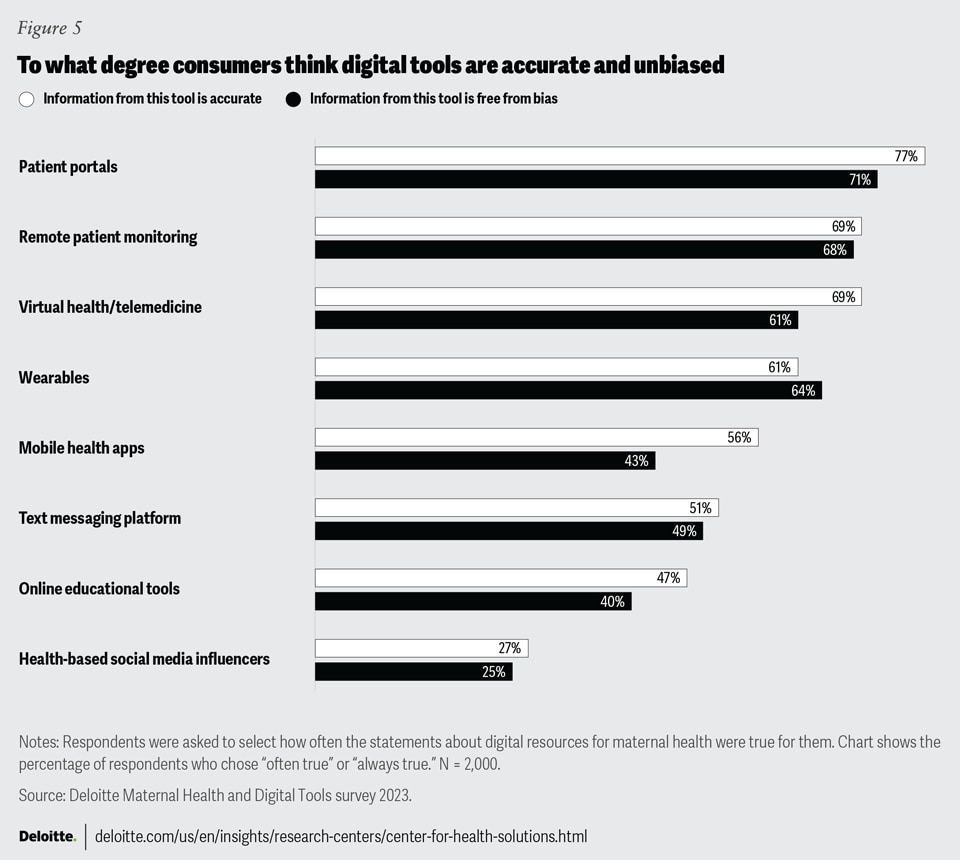
As we look at what could be possible in the future of maternal health, it's clear that the traditional approach should evolve. The task at hand is not just about elevating the standard of care, but also crafting strategies that are as unique as the patients they serve. Stakeholders both within and outside the health system can champion equity and empowerment. And digital tools should be developed such that they are effective, bias-free, and easy-to-use. Such a transformative shift in the maternal health paradigm can contribute to a healthier, brighter future for all.
by
Dr. Kulleni Gebreyes
Heather Nelson
Margaret Punch
Dr. Jay Bhatt
Mani Keita
Christine Chang
The project team’s contributions and ideas were crucial to the success of this project.
Leslie Korenda was an integral team member, starting with ideation of the research concept, designing the survey methodology/sampling and executing the survey, and performing data analysis and interpretation of results. She also contributed to the narrative and helped with editing the paper. Darshan Gosalia facilitated the survey design efforts for this research and played an integral role in secondary research, storyboarding, project management, working with the Data Science and Survey Advisory team for the regression analysis, and writing. Gargi Khandelwal led the literature review efforts, helped synthesize interview findings, supported case study development, and facilitated outreach efforts.
The authors would like to thank several colleagues from our Data Science and Survey Advisory team who supported us on the project. Paula Payton and David Levin reviewed and provided feedback on the survey instrument. Pavan Kumar Bhoslay, Srinivasarao Oguri, and Sandeep Vellanki conducted the regression analysis and provided analytical insights for this paper.
The authors would also like to thank Wendy Gerhardt, Jen Radin, Nicole Kelm, Nefertiti Wade, Brittani Spaulding, Nicole Levine, Eden Hankins, Phillip Ayoub, Julius Tapper, Caroline Cobb, Jane Makhoul, Carissa Clark, Marc Perlman, Diana Sessions, Haley Viall, Kristen Santaromita, Rebecca Knutsen, Annalyn Kurtz, Prodyut Ranjan Borah, Julie Landmesser, Christina Giambrone, Jessica Overman, and many others who contributed to this project.
The study would not have been possible without the participants who graciously agreed to take part in the focus group discussion, survey, and interviews. The authors wish to thank them for being generous with their time and insights.
Cover art by: Sonya Vasilieff
Visit the Deloitte Center for Health Solutions
Access more insights for the hospital, health system and provider, pharmaceutical manufacturer, health plan and payer, medtech, and health tech organization sectors.