

Deloitte Access Economics Retail Forecasts
A chill in the air
Subscribe to access the full report
01 September 2026: The economic shadows from the first half of
2026 are starting to loom over Australian retailers, with higher interest
rates, a softening labour market, falling real wages and declining house prices creating an unwanted headache for households that will not go away overnight.
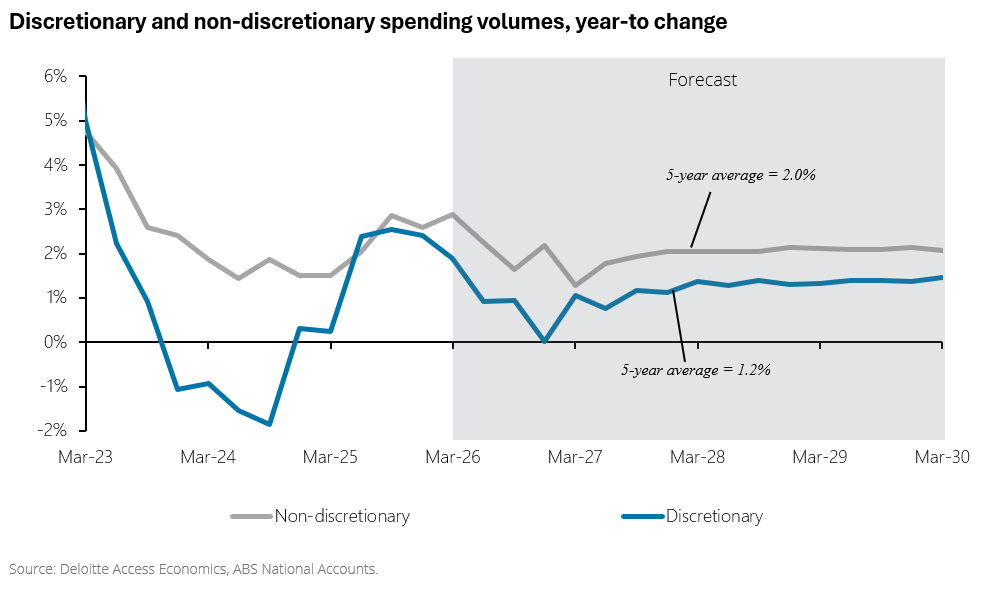
According to the latest edition of Deloitte Access Economics’ quarterly Retail Forecasts, levels of spending recently supported by strong end-of-financial-year discounting are expected to weaken. Growth in real retail turnover is expected to slow from 2.8% in 2025-26 to 1.5% in 2026-27 as tougher economic conditions weigh on household spending.
Releasing the report, Deloitte Access Economics Partner and principal report author, David Rumbens, said: “The economic consequences of events over the first half of 2026 are starting to come home to roost for Australian households.
“Domestic price pressures and higher energy costs due to the conflict in the Middle East mean inflation is still running too hot. Despite three consecutive interest rate hikes in the first half of this year, the RBA does not expect inflation to return to target until mid-2027.
“The effects are starting to show for households. Unemployment rose to 4.5% in July, while the rising cost of living outpaced wage growth and real wages fell 0.7% over the year to June. Rising mortgage costs and the Federal Budget’s tax changes are also causing house prices to soften.
“Looking ahead, household spending is expected to moderate in the September quarter as mid-year discounts unwind, cost-of-living pressures build and the recent softening in house prices feeds through to consumer spending decisions.”
Discretionary spending is likely to bear the brunt of the slowdown as households delay, trade down or pull back on non-essential purchases. Overall, discretionary spending growth is expected to slow from 1.9% in 2025-26 to 0.7% in 2026-27. Non-discretionary spending will not be immune to the spending pinch, with growth expected to ease from 2.6% to 1.7% over the same period.
David Rumbens said: “The slowdown will not be felt evenly across retail categories. Households are beginning to redirect some of their constrained discretionary spending from larger items towards smaller luxuries and experiences, while categories tied to the housing market are likely to face greater pressure as consumers delay, trade down or pull back on non-essential spending.”
Food and smaller discretionary purchases are expected to prove relatively resilient. Food volumes growth is forecast to recover from a 0.1% decline in 2025-26 to 1.6% growth in 2026-27, while growth in cafés, restaurants and takeaway food services is expected to moderate from 3.5% to 1.6%.
Larger discretionary categories face a sharper slowdown as consumers become more selective and the housing market softens. Growth in department stores and large online retailers is expected to slow from 2.2% in 2025-26 to 1.1% in 2026-27, while clothing and footwear growth is forecast to fall from 1.7% to 0.1%.
The household goods category is expected to be the most affected, with fewer property transactions weighing on purchases of furniture and other big-ticket items. Its growth is forecast to fall from 5.8% to a 0.2% decline.
AI RESHAPES THE PATH TO PURCHASE
AI is reshaping how consumers discover and compare products, giving prepared retailers an opportunity to reach them earlier in the path to purchase. According to Deloitte’s 2026 Retail Report, 45% of consumers use AI to compare products and services, 38% to research options that match their needs and 11% to complete or automate purchases.
The use of AI in shopping is only set to grow. Deloitte’s Global Retail Industry Outlook finds chat-based tools are already driving 15% to 20% of referrals for some retailers, while 81% of retail executives expect generative AI to weaken brand loyalty by 2027.
David Rumbens said: “AI makes online shopping faster and more convenient by bringing price, delivery and product fit into view earlier in the decision. Consumers are not necessarily asking AI to buy for them yet, but they are using it to decide what to consider, where to look and how to compare.
“For retailers, this means the point of competition is moving upstream. Visibility and relevance need to be won before the consumer reaches the retailer’s own channel. AI is lowering information barriers for consumers, but it is also influencing who is found, compared and ranked.
“In a world where widespread comparison is made easy, price becomes the dominant signal and brand loyalty may become harder to defend. Retailers will need sharper value propositions and online storefronts that AI systems can find, interpret and recommend.
“AI can also help retailers turn consumer interest into a transaction more quickly, tailor the customer experience and sharpen how they price and promote products. The opportunity is significant, but retailers need to keep pace with AI without losing sight of the consumer.
“If consumers feel AI is being used to exploit urgency or limit choice, rather than improve value and convenience, the commercial benefit could quickly give way to reputational risk. Retailers that invest early in data quality, digital infrastructure and transparent governance will be better placed to remain visible, protect margins and convert demand in a market increasingly shaped by algorithms.”
About Retail Forecasts
Retail Forecasts is produced quarterly and provides analysis of current retail spending and the economic drivers that influence this. It includes ten-year forecasts of retail sales by major category and of key economic drivers.
Further information (publications):
T: 1800 673 647
Email
Disclaimer
This publication contains general information only and Deloitte is not, by means of this publication, rendering accounting, business, financial, investment, legal, tax, or other professional advice or services. This publication is not a substitute for such professional advice or services, nor should it be used as a basis for any decision or action that may affect your business. Before making any decision or taking any action that may affect your business, you should consult a qualified professional advisor.
Deloitte shall not be responsible for any loss sustained by any person who relies on this publication.
About Deloitte
Deloitte refers to one or more of Deloitte Touche Tohmatsu Limited, a UK private company limited by guarantee (“DTTL”), its network of member firms, and their related entities. DTTL and each of its member firms are legally separate and independent entities. Please see www.deloitte.com/au to learn more.
Copyright © 2026 Deloitte Development LLC. All rights reserved.
Press contact(s):
Lachlan Moffet Gray
Media and Brand Communications
M: +61 413 739 290
lmoffetgray@deloitte.com.au
Media Enquiries
media@deloitte.com.au
