
Building a future-fit model for sustainability talent
Despite challenging business conditions—or perhaps because of them—organizations are seeking multidisciplinary leaders to advance their sustainability and business goals
Corporate sustainability and talent leaders often contend with dynamic and sometimes competing pressures, amid uncertainty in the business environment. This challenging situation makes having a resilient, well-rounded sustainability team as important as ever.
Deloitte’s analysis of corporate sustainability job postings and survey responses from 46 chief sustainability officers shows both significant progress toward that outcome, but also some warning signs. Going forward, as organizations continue to see business value in sustainability,1 they will likely need to build future-fit, resilient sustainability teams that mirror their companies’ ambitions; invest in robust career pathways; and actively manage the talent impacts of emerging technologies like artificial intelligence.
Understanding the broader evolution of the sustainability talent market can help leaders better navigate those challenges, unlocking not just compliance or reporting gains, but business value, innovation, organizational resilience, and sustainability impact.2
To identify how the landscape for sustainability talent is evolving, Deloitte drew on data from Lightcast, a labor market analytics firm that integrates job postings, government data, and compensation sources.3 The Lightcast database spans from 2014 to the present and includes over 2.5 billion global job postings, covering approximately 1,900 occupations and 30,000 distinct job skills. Lightcast’s data is structured using proprietary taxonomies for skills, occupations, and job titles.
To identify corporate sustainability–related roles, the Deloitte research team first extracted job titles using a broad set of sustainability-related keywords such as “environment,” “sustainability,” and “climate.” This process yielded more than 5,000 unique job titles, which were then manually reviewed and filtered to exclude roles not clearly related to sustainability.
A secondary screen was then applied to focus on corporate sustainability roles specifically, excluding such job titles as “environmental educator” or “soil conservationist,” but retaining titles such as “sustainability manager” or “chief sustainability officer.” The resulting data set includes both “in-house” corporate roles as well as those within companies that provide corporate sustainability services. Job titles were also categorized by estimated seniority level into three groups: senior, mid-level, and entry-level.
A fourth category, “technician or other,” captures roles that did not have a clear seniority level assigned to them or were more specialized, like “sustainability engineer” or “environmental underwriter.”4
Deloitte’s research also reflects the perspectives of 46 chief sustainability officers, who answered surveys in spring 2025 about their functions’ organizational structures, talent models, and priorities.
A spike in demand for sustainability talent
The corporate sustainability talent market has undergone a step-change. For much of the past decade, job growth in the corporate sustainability field was incremental and concentrated in specialized roles, such as environmental health and safety, compliance, or corporate social responsibility. The last decade saw increasing regulatory requirements and climate commitments5 as extreme weather and sustainability awareness intensified,6 with demand for sustainability talent also accelerating (figure 1).
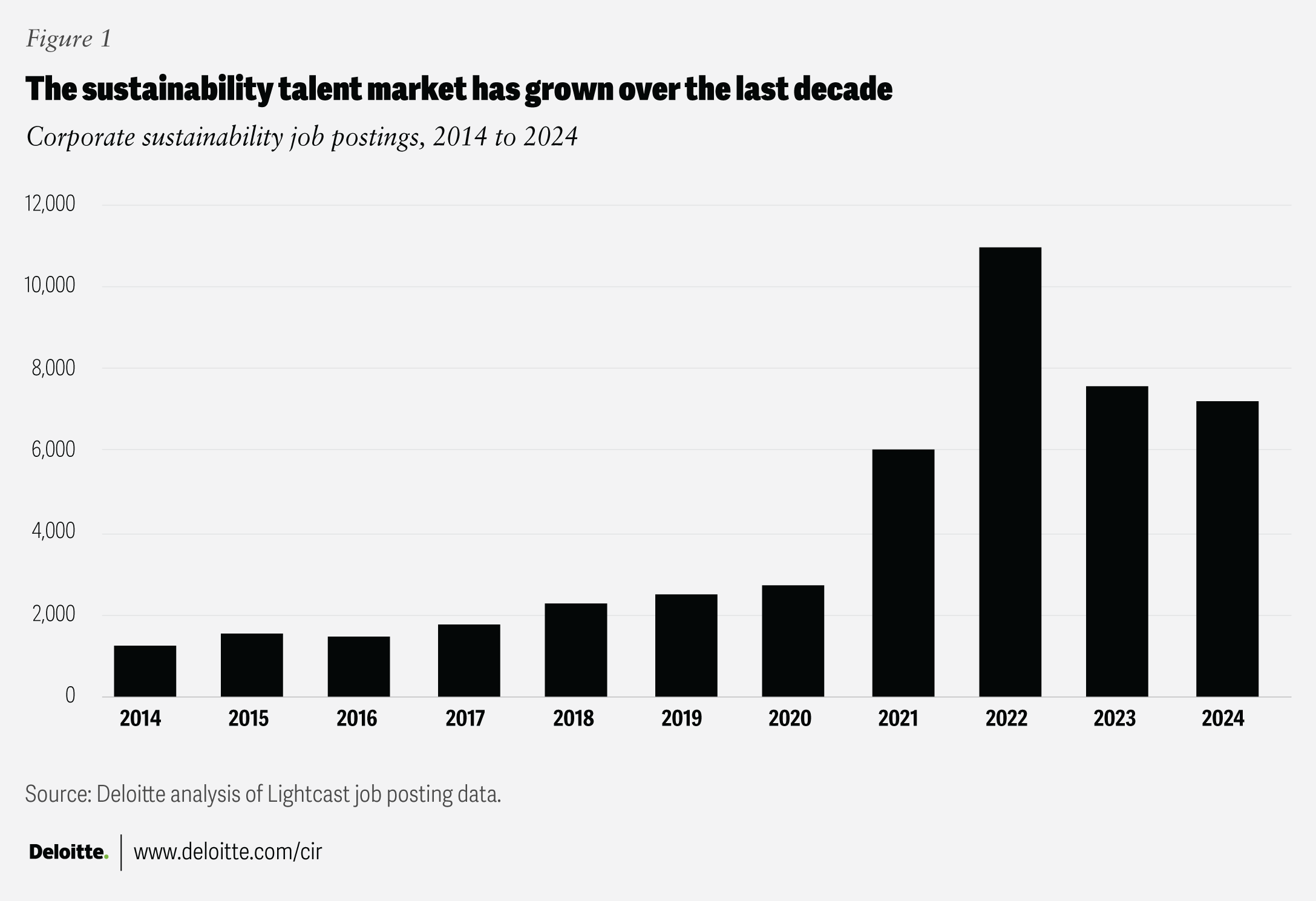
The number of companies with public emission-reduction targets surged from 315 in 2019 to over 2,000 in 2022.7 During that same period, job postings for internal sustainability roles surged across all seniority levels. This was most notable at the mid-career level, which saw a five-fold increase from 2019 to 2022 (1,305 to 6,780), as companies focused on building the teams needed to be able to deliver on public commitments. With impending changes and regulatory shifts, many organizations prepared efforts to manage sustainability disclosures and improve resilience in supply chains and operations.8 During the same period, public awareness around environmental issues also rose.9
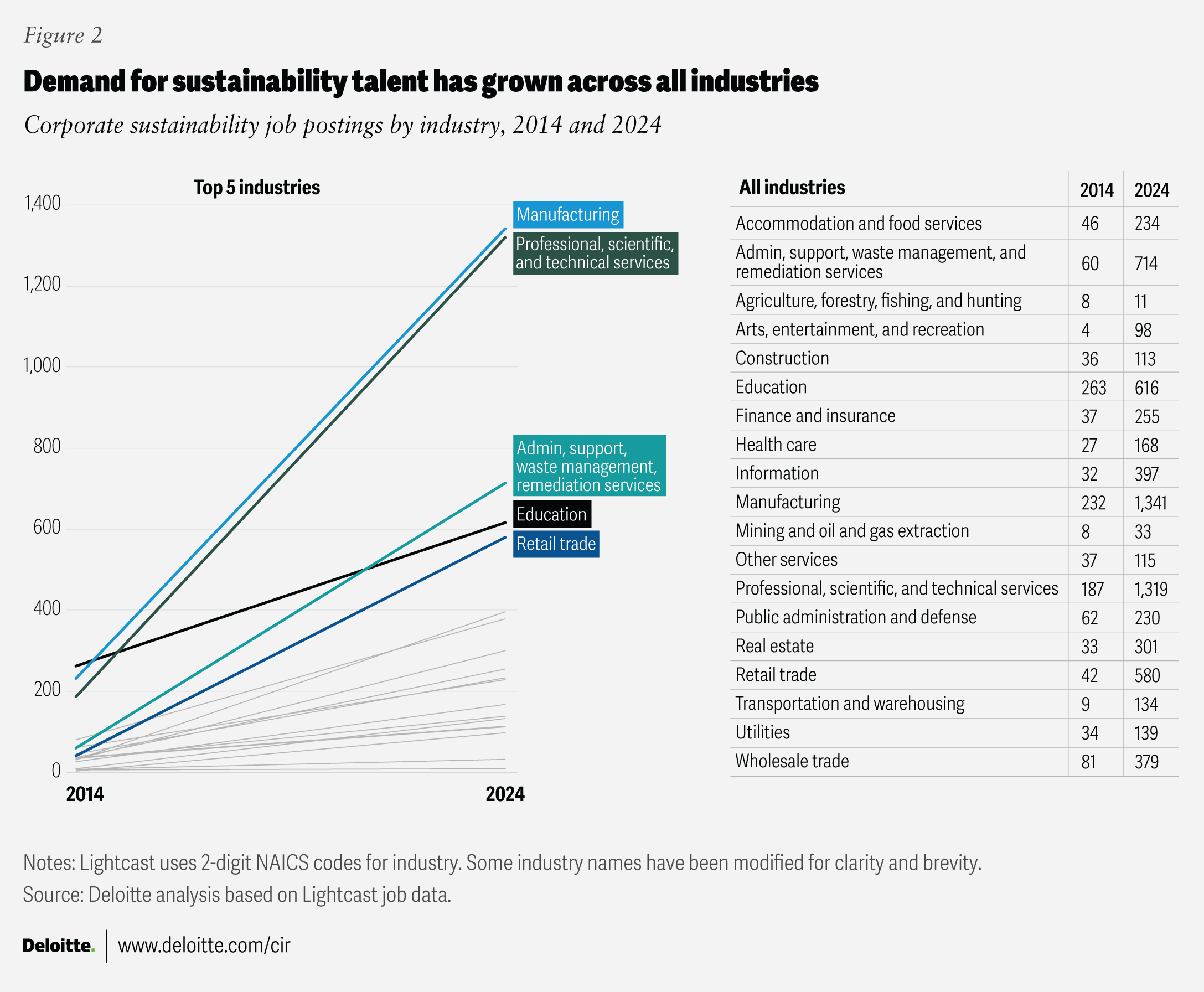
This wave of hiring reflected not just market momentum, but an emerging recognition at some companies that sustainability can drive growth as a business imperative.10 And hiring wasn’t confined to just one or two sectors. Every industry saw expanding demand for sustainability talent during this period (figure 2), with the highest growth taking place in retail (1,280%) and information technology (1,140%).
Between 2023 and 2024, the number of job postings began to plateau, but at a new, elevated baseline. Demand for sustainability professionals through 2024 remained well above pre-pandemic levels, signaling that this remains a focus area for corporate hiring. This suggests that sustainability is not a passing trend but a lasting shift in companies’ approaches.
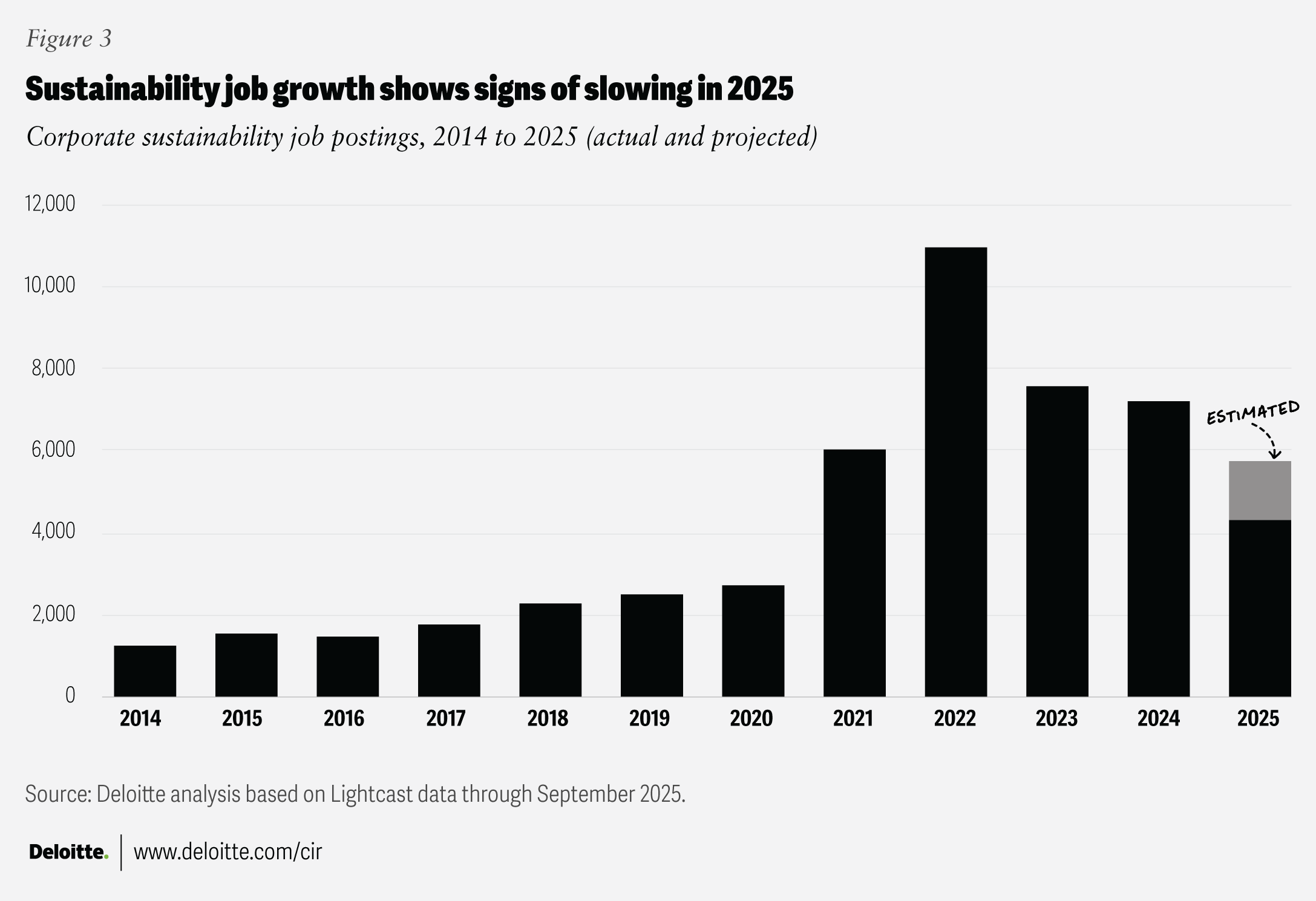
2025 has seen profound shifts in the sustainability landscape. From evolving energy market dynamics to reporting and disclosure requirements, the regulatory and policy environment for sustainability has rapidly changed, with significant variability across geographies. Economic uncertainty and supply chain challenges have brought fiscal discipline into tighter focus for many companies. And rapid advances in the deployment of advanced AI systems are prompting firms to think hard about their investments and talent models.
Based on partial-year data, corporate sustainability hiring has not been immune to these changes. Data through September 2025 suggests hiring has cooled across all job levels, assuming minimal seasonality (figure 3).
The new normal: The demand for corporate sustainability talent by experience level
Even as the post-2020 surge in corporate sustainability hiring reshaped the volume of roles, their distribution across seniority levels remained unevenly distributed, with mid-level roles outpacing both senior and entry-level ones (figure 4). In 2024, there were roughly six mid-level roles for every senior position posted, and about two mid-level roles for every entry-level position.
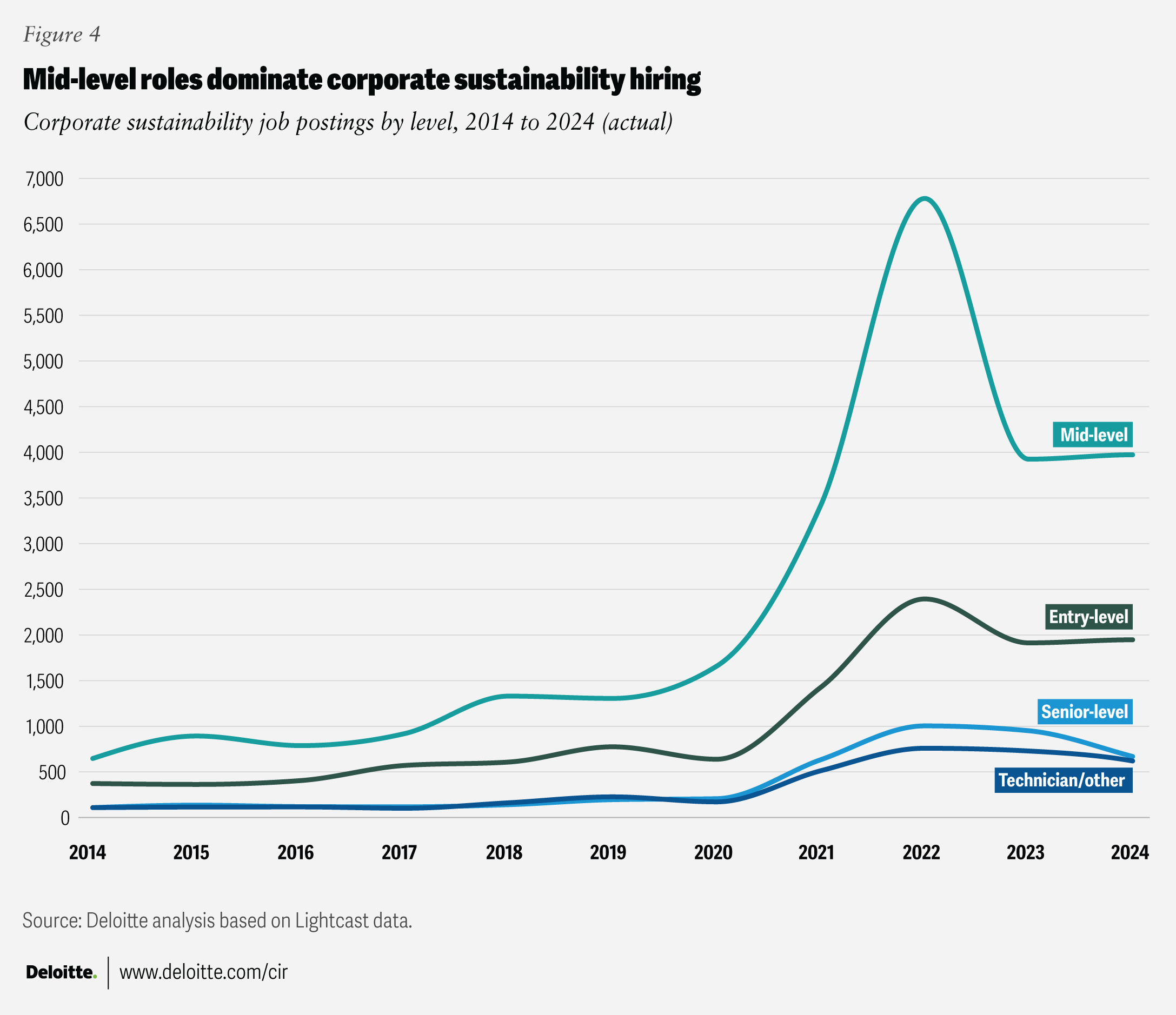
Entry-level openings grew, but did not close the gap with mid-level positions. This matters because entry-level roles can help employees gain important experience, critical thinking skills, and a sense of the company’s culture. These skills could be difficult for organizations to find in the future talent pool, especially if AI tools can substitute for some entry-level roles.
Postings for directors, heads of sustainability, or equivalent roles peaked at less than 1,000 in 2022—a fraction of the mid-level volume but consistent with many organizations’ typical leverage and staffing models.11 Just as organizations only have one chief financial officer, even those with mature sustainability functions may have relatively limited openings for the senior-most roles.
Within the data set, some roles defied easy classification by seniority. These roles, which we have categorized as “technician or other,” represent a diverse mix of jobs, often requiring specialized or technical skills. These are the least frequently posted roles among corporate sustainability jobs, but are actually common jobs in the sustainability field overall as they are not limited to corporate functions.
These trends raise questions about the long-term talent pipeline, training efforts, leadership development, and how companies are preparing the next generation of sustainability professionals. Underscoring the challenge, the chief sustainability officers surveyed by Deloitte rated learning and development as the capability their teams were least effective at—out of 20 possible options.12
Corporate sustainability’s evolving skill set
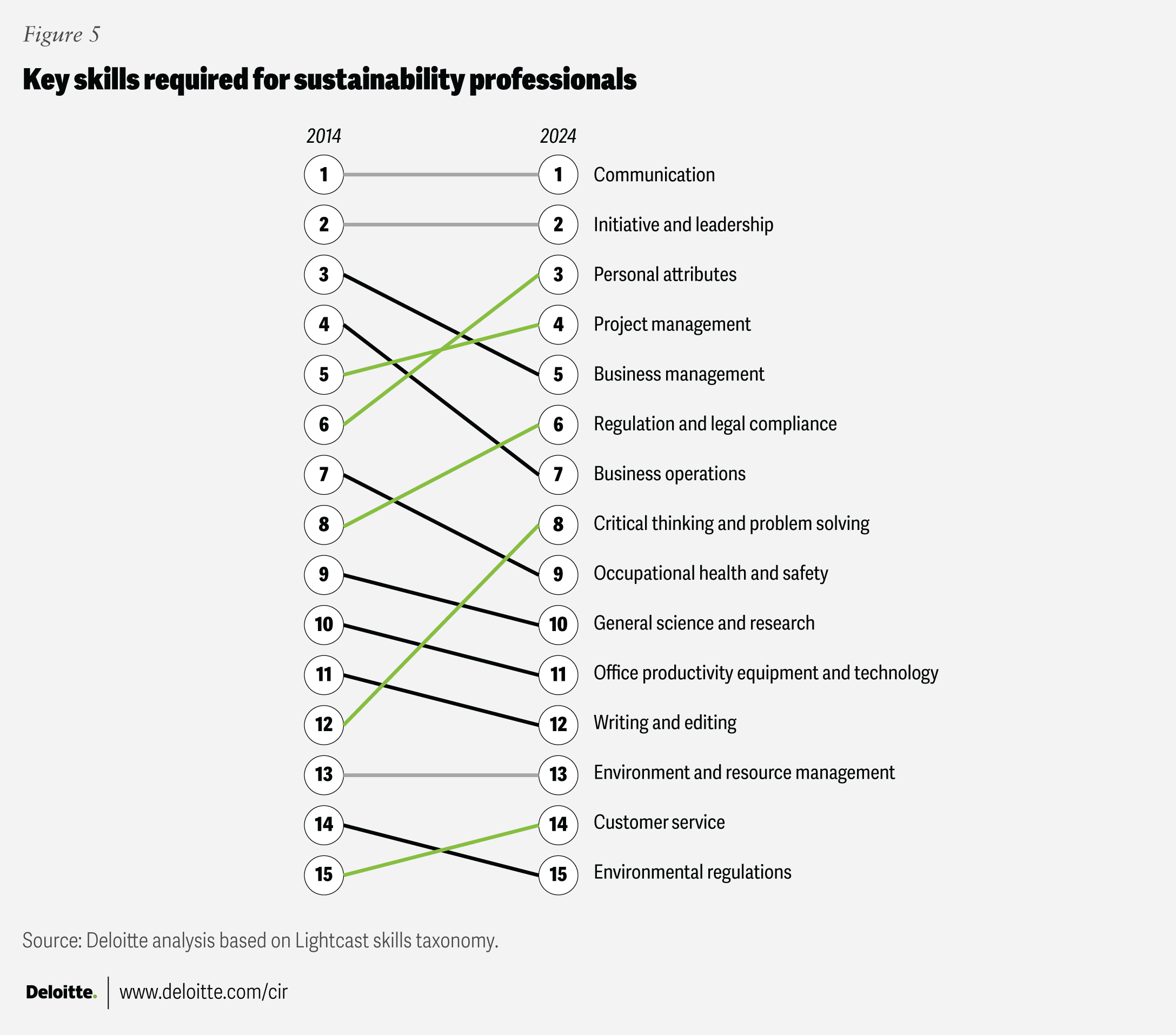
As sustainability functions have matured, so too have the skills demanded of the professionals who lead and support them. In addition to looking at changes in the number of corporate sustainability job postings, the analysis also examined the leading skills employers seek for those roles, using Lightcast’s skill taxonomy. Shifts in sought-after sustainability skills resemble an evolution, not a revolution.
Many of the top skills across corporate sustainability jobs today are similar to those desired a decade ago. That said, there are important changes, with greater demand for a dynamic combination of strategic business fluency, technical depth, regulatory knowledge, and cross-functional influence. These changing skill profiles are indicative of not only who gets hired, but how organizations are developing and structuring their talent over time. Three broad categories now define the skill architecture for sustainability roles.
First are core business and strategic skills, which are foundational across all levels of sustainability work. These include capabilities like communication, critical thinking, strategic planning, people management, and operations and process optimization. Their growing importance reflects a significant shift. Sustainability is not an ancillary function or messaging-focused initiative for an increasing number of companies.13 As more companies work to embed sustainability into the operational core of the business, organizations need professionals who can both design and execute initiatives that deliver measurable value.
Data from Deloitte’s 2025 survey of chief sustainability officers reinforces the point: The highest-priority areas for sustainability teams to learn about were business case development, financial reporting principles, change management, and stakeholder engagement.14
The second competency area is an emphasis on technical, scientific, and regulatory knowledge. As the landscape of sustainability requirements has become more sophisticated and complex, demand has risen for expertise in areas such as regulatory compliance and legal requirements, science and research, financial resource management, natural resource management, and environmental science. While this type of expertise is often associated with specialists, it is also becoming a baseline requirement for broader roles in sustainability.
Finally, a third category of cross-functional skills are table stakes. Leadership, communication, and project management appear among the most in-demand skills for sustainability professionals in job postings over time and regardless of seniority. Sustainability professionals need to bring the same core competencies to their roles as any employee.
Many job postings require professionals with skills that span across all of these categories. For example, one large automotive supplier posted a sustainability controller position seeking candidates with: a track record in managing sustainability reporting, including risk assessments and implementing reporting systems; technical knowledge on a wide variety of regulatory frameworks; strong writing and communication skills; and “business acumen” and problem-solving skills.
Every role and every organization is unique, but taken together, these trends suggest that sustainability roles are not diverging into technical versus strategic tracks, but rather converging. Whether entry- or executive-level, sustainability professionals are expected to bring subject matter expertise and technical skills, navigate and execute within a business environment, and work across disciplines. For human resources and sustainability leaders alike, the implications are clear: upskilling, reskilling, and redefining roles should be central to workforce strategy to help organizations achieve their sustainability goals.
Building tomorrow’s sustainability function
As sustainability functions transition from adolescence to adulthood, organizations can become more intentional in how they design, develop, and deploy their sustainability talent. For many, it will warrant long-term thinking, adaptable models, and experimentation.
Align team structure to organizational ambition and action
Currently, sustainability talent distribution resembles a bell curve: Most of the hiring happens at the mid-level, with fewer roles at the top or bottom. Traditional organizational models might suggest moving toward a pyramid structure, with many junior staff feeding into fewer senior roles over time.
But sustainability is not a traditional function. The right “leverage model” may differ dramatically depending on industry, strategic orientation, maturity level, and other factors. A flat team of embedded advisors may work for one firm; a centralized hub-and-spoke model with deep technical experts may work better for another.
Indeed, responses from more than 40 chief sustainability officers in early 2025 show a mix of centralized, decentralized, and hybrid approaches.15 What’s clear is that structure should follow purpose: The design of the sustainability team should align with the company’s broader sustainability goals, regulatory exposure, and operational complexity.
The data suggests this is a moment of continued investment and opportunity. According to Deloitte’s 2025 Chief Sustainability Officer Survey, 24% of leaders expect their head count to grow, while another 64% expect it to remain stable in the coming year.16 Job postings for chief sustainability officer positions have held steady since 2022—evidence that companies are maintaining strategic sustainability capacity, even amid broader economic uncertainty.
Build the pipeline
The current distribution of sustainability roles is bell-shaped, skewing heavily toward the mid-level. While this was understandable during the surge between 2020 and 2022 surge, when companies needed immediate execution capacity, it may not be a viable long-term structure. Entry-level hiring has plateaued, even as interest in sustainability careers from early-career professionals remains high.
Learning and development emerged as a clear opportunity for chief sustainability officers in Deloitte’s survey. Across 20 sustainability capabilities surveyed, sustainability learning and development was the lowest ranked, indicating additional challenges with internal engagement and upskilling.17 To strengthen the sustainability talent pipeline, organizations can invest more deliberately in career pathways. Where appropriate, this could include creating true entry-level roles with growth potential and broadening the aperture on where and how they recruit.
Sustainability talent can come from environmental science programs—but also from operations, data science, public policy, or communications. Expanding the breadth and internal and external sources for sustainability talent and upskilling pathways will likely be important. Developing apprenticeship or rotational opportunities can not only help build sustainability talent for the future but also integrate a sustainability mindset and knowledge across the business.
As they refine their talent model, leaders can ask:
- Given expectations for how our sustainability ambitions and efforts are likely to evolve over the next one to five years, what should a modern and future-fit sustainability workforce look like at our organization to enable our goals?
- What’s the right mix of technical expertise and business acumen for us to be building in our workforce?
- What skills, experiences, and capabilities do we need today and in the future? How can we develop and train employees on these desired skills and capabilities and through experiences?
- What career paths are available for sustainability professionals? Is there opportunity for advancement? Can they move into other parts of the organization or are they pigeonholed as “sustainability” workers?
- How can we develop and provide the skills for existing employees looking to move into sustainability-focused roles?
Finally, sustainability is not immune to the use of AI. Already, generative AI tools are being tested in tasks such as drafting sustainability reports, modeling environmental risks, and developing sustainable supply chains.18 Because these tools may reduce the need for some entry-level tasks, they risk exacerbating the talent imbalance already visible in the marketplace. AI may also end up compressing early career learning curves, making it harder for professionals to gain foundational skills.
Critical thinking, company culture, and other “soft skills” may suffer to the extent those tasks—and entry-level roles more broadly—are entirely delegated to AI. Forward-thinking organizations should focus on developing their employees, so they are skilled at collaborating with AI tools by pairing automation with intentional training, ensuring mentorship doesn't get lost, and rethinking what developmental roles look like in an AI-augmented environment.
Building tomorrow’s sustainability function today
Despite ongoing evolution in the corporate sustainability landscape—or perhaps because of them—Deloitte’s analysis shows that organizations continue to seek multidisciplinary leaders with business savvy who can advance their sustainability goals.
Today’s leaders should ask themselves if their sustainability team has the people and skills to meet today’s needs and tomorrow’s goals. To sustain progress, they can explore intentional workforce strategies that build strong pipelines, invest in skills, and adapt to AI’s growing influence. Those who align talent models with their company’s ambitions can be well-positioned to bring sustainability into the heart of the business.
Continue the conversation
Meet the industry leaders
by
Bill Marquard
Kimberly Betts
Caroline Rourke
Derek M. Pankratz
David R. Novak
The authors would like to thank Elizabeth Payes for editing this article. The authors would also like to thank Akshay Jadhav and Aditi Vashishtha for their contributions with the data analysis for this article. The authors would also like to thank Dan Goldenberg and Janice Armbrust from the CSO program for providing data and insights to support this research.
Cover image by: Sofia Laviano; Adobe Stock
Visit the Deloitte Center for Integrated Research
Access more insights on some of the most complex issues facing businesses today.