
Wearable technology in health care: Getting better all the time
Smartwatches and wearable medical devices help people monitor their health 24/7. Their impact could increase if doctors trust their utility and people feel their data is secure
Advances in sensors and artificial intelligence (AI) are helping millions detect and manage chronic health conditions and avoid serious illness on devices small enough to be worn on a wrist or penny-sized patch. Deloitte Global predicts that 320 million consumer health and wellness wearable devices will ship worldwide in 2022 (figure 1). By 2024, that figure will likely reach nearly 440 million units as new offerings hit the market and more health care providers become comfortable with using them. These numbers include both smartwatches, which are marketed to and purchased by consumers, and medical-grade wearables—typically called “smart patches”—which are often prescribed by health care professionals but are increasingly becoming available off the shelf.

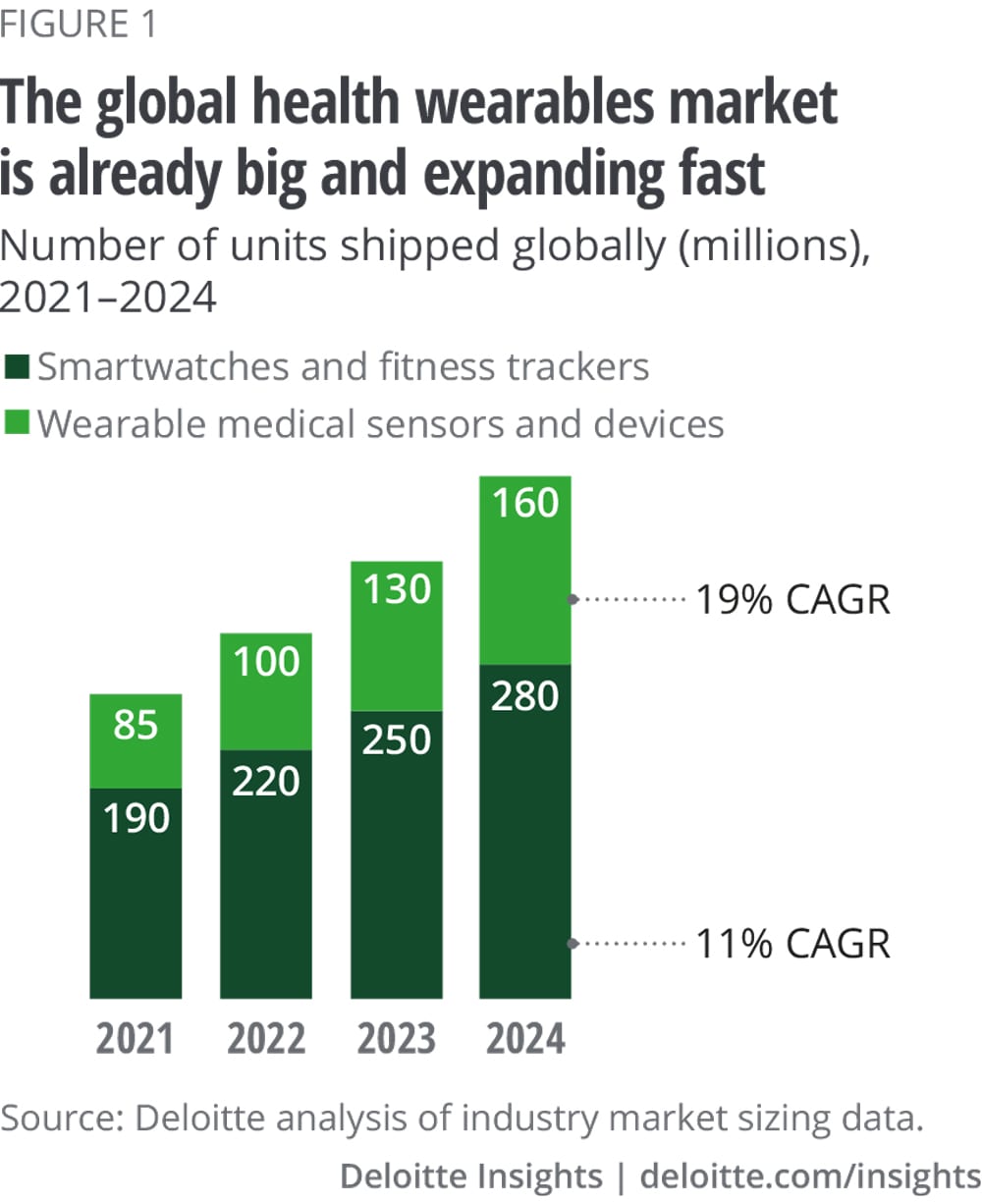
Smartwatches and smart patches are getting smarter about health—and more widely used
While health care companies produce a range of devices that help patients monitor health markers intermittently—including blood pressure cuffs and ECG monitors—our analysis focuses on smartwatches and smart patches, which are seeing rapid consumer adoption.
Deloitte’s 2021 Connectivity and Mobile Trends survey found that 39% of respondents owned a smartwatch.1 Their most common uses have historically been to help people get fit, lose weight, and beat their personal best in their next race (figure 2). But increasingly, people are using smartwatches to monitor their health, not just their running pace, as new hardware, software, and apps have turned them into personalized health clinics. Heart rate monitors are now standard on most smartwatches, and some have FDA approval for detecting abnormalities such as atrial fibrillation, a major cause of stroke. As these devices get more sophisticated, the percentage of consumers using them to manage chronic conditions and detect symptoms of serious diseases will likely increase.
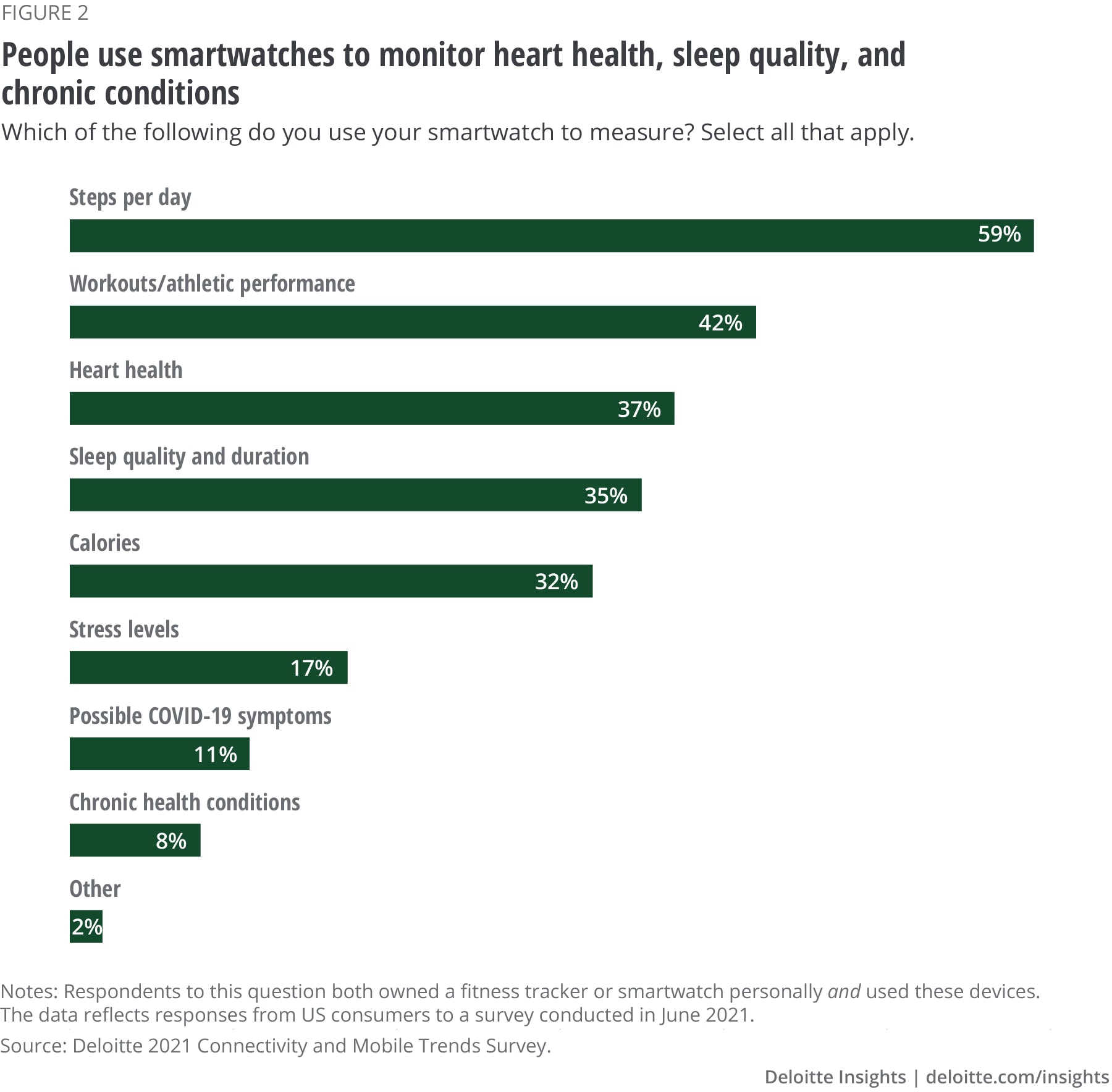
The pandemic highlighted the value of smartwatches for monitoring health. As COVID-19 spread, smartwatches that measure blood oxygen saturation (SpO2) became widely available, alerting people with low SpO2—a life-threatening symptom that is hard for people to detect unassisted.2 More than 10% of US consumers who own smartwatches are now using them to detect COVID-19 symptoms. The pandemic may even have encouraged smartwatch sales: Fifteen percent of US consumers who own a smartwatch purchased it after the onset of COVID-19.3
Smartwatch innovation is progressing rapidly, driven by advances in sensors, semiconductors, and AI. For example, some smartwatches now feature optical sensors that continuously measure variations in blood volume and composition using a technology called photoplethysmography (PPG). Algorithms produced and continually improved via machine learning use data from these sensors to provide insights into users’ activity levels, stress, heart pattern anomalies, and more.4
As another example, companies are getting closer to enabling smartwatches to monitor blood pressure, using PPG and other technologies such as Raman spectroscopy, and infrared spectrophotometers.5 Measuring blood pressure with a cuff is inconvenient and uncomfortable. Most importantly, periodic blood pressure measurements can miss signs of chronic hypertension, which can cause heart disease, heart attacks, and strokes. Accurate, continuous, unobtrusive blood pressure measurement could expand the smartwatch market: 1.3 billion adults worldwide suffer from hypertension.
Of course, there are limits to what current smartwatch sensor technology can do without attaching to—or getting under—a person’s skin. That’s where smart patches come in.
Smart patches, developed mostly by medtech companies, are typically small and unobtrusive, affixing directly to a person’s skin. Some “minimally invasive” smart patches use microscopic needles that painlessly penetrate the skin to act as biosensors and sometimes to deliver medications.
Unlike smartwatches, which provide a broad range of health data and insights, smart patches are typically designed for a single indication such as diabetes management, patient monitoring, and drug delivery. Smart patches also employ a broader range of technologies. For example, smart patches that measure heart rate variability often use electrocardiogram technology that tracks the heart’s electrical activity directly and more accurately than smartwatches.6
Smartwatches and smartphones still play an important role. Data from smart patches is being integrated with smartwatch and smartphone apps, sending data to these devices for display and analysis. With the right technology, including interoperability capabilities, doctors could see wearable health data on a patient’s health record, gaining access to more comprehensive information to inform diagnosis and care.
BY
Jeff Loucks
Ariane Bucaille
Duncan Stewart
Gillian Crossan
The authors would like to thank the following individuals for their contributions to this chapter: Ankit Dhameja, Wendy Gerhardt, Sonal Shah, and Glenn Snyder.
Cover image by: Jaime Austin