For every new entrant under 25 years, there are more than five utility workers who are 45 years and older—more than double the economywide ratio.1 No other major growth industry is simultaneously expanding and preparing to replace most of its experienced workforce.2 Artificial intelligence–driven growth and workforce aging have converged as AI transforms the workforce and the work itself in an “AI-ging” moment. Utilities must now address aging, growth, and AI all at once. Success hinges on workforce redesign to enable effective human-machine collaboration across a new generation of talent and technologies. Utilities that act now may find that the retirement wave presents an opportunity to reinvent how work gets done.

30-second “AI-ging” readiness check

How many of these statements are true for your organization?

  • We know where and when retirements will create the greatest operational risk.
  • We have captured the knowledge that would leave with exiting employees.
  • We have quantified the workforce gap between retirements and growth.
  • We understand which work AI can help automate, augment, or leave to people. 
  • We have a strategy to attract and develop new talent in an AI-enabled workplace.

Scoring guide:

5 checks: Your workforce strategy looks to be well positioned for the “AI-ging” transition.

3–4 checks: Capabilities are in place, but key vulnerabilities likely remain.

0–2 checks: Your workforce strategy may not keep pace with the combined pressures of growth, retirements, and AI.

Historic growth ahead

AI has sparked a momentous surge in the utilities industry, building on long-term structural growth from electrification. The sector is among the nation’s fastest-growing, as are many of its occupations.3 Related careers may require some of the fastest-changing skills.

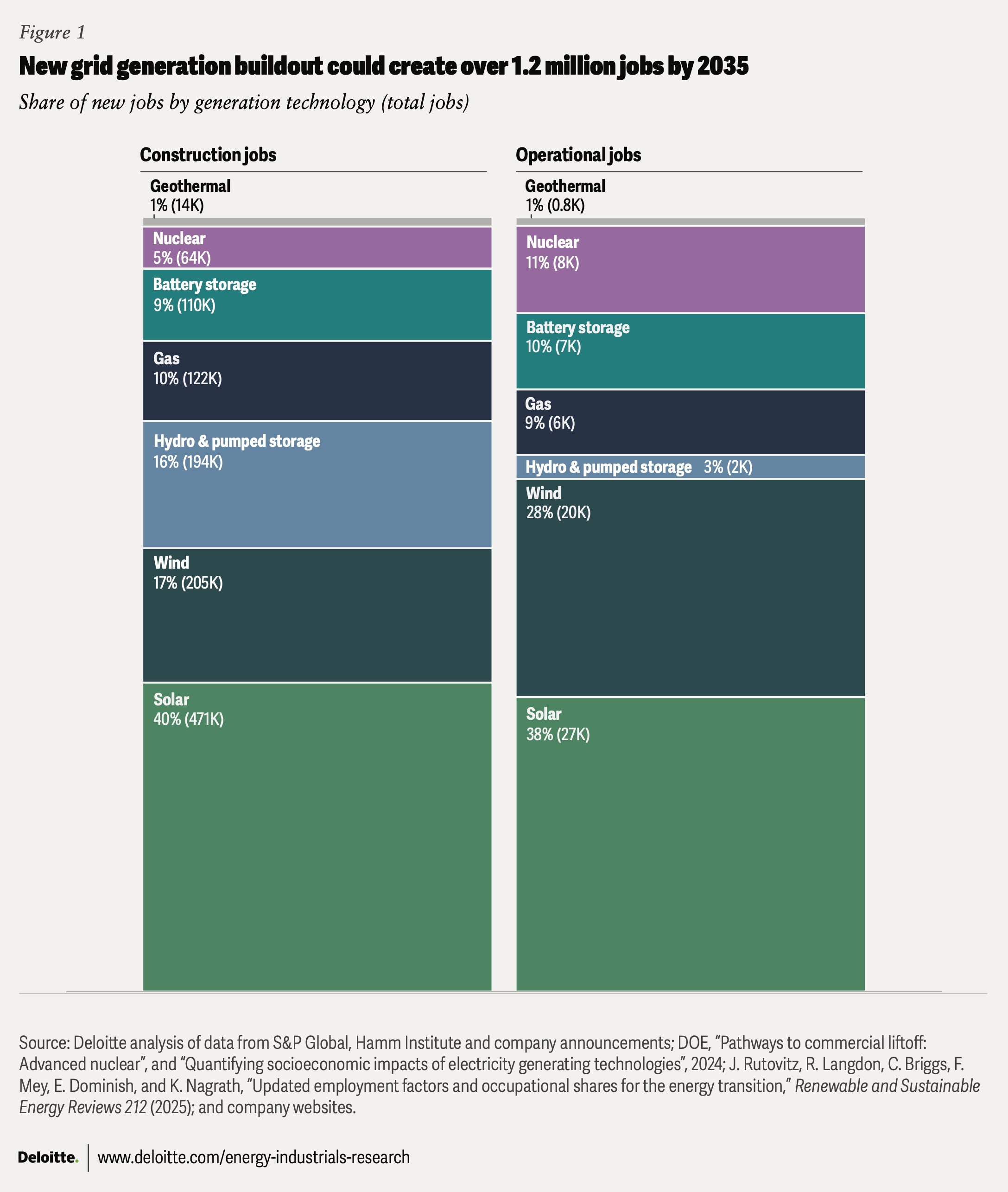
Deloitte estimates that the announced expansion of utility-scale grid-connected generation could create the equivalent of more than 1.2 million additional jobs in the United States by 2035.4 These include temporary construction jobs measured in job-years5 and permanent operational jobs in labor-intensive nuclear, hydroelectric, and geothermal generation, in addition to the solar, wind, storage, and gas projects that account for the bulk of planned generation (figure 1). Many jobs involved in the AI economy buildout are in this power infrastructure, which Deloitte estimates could create more than 12 times as many jobs as planned data centers.6
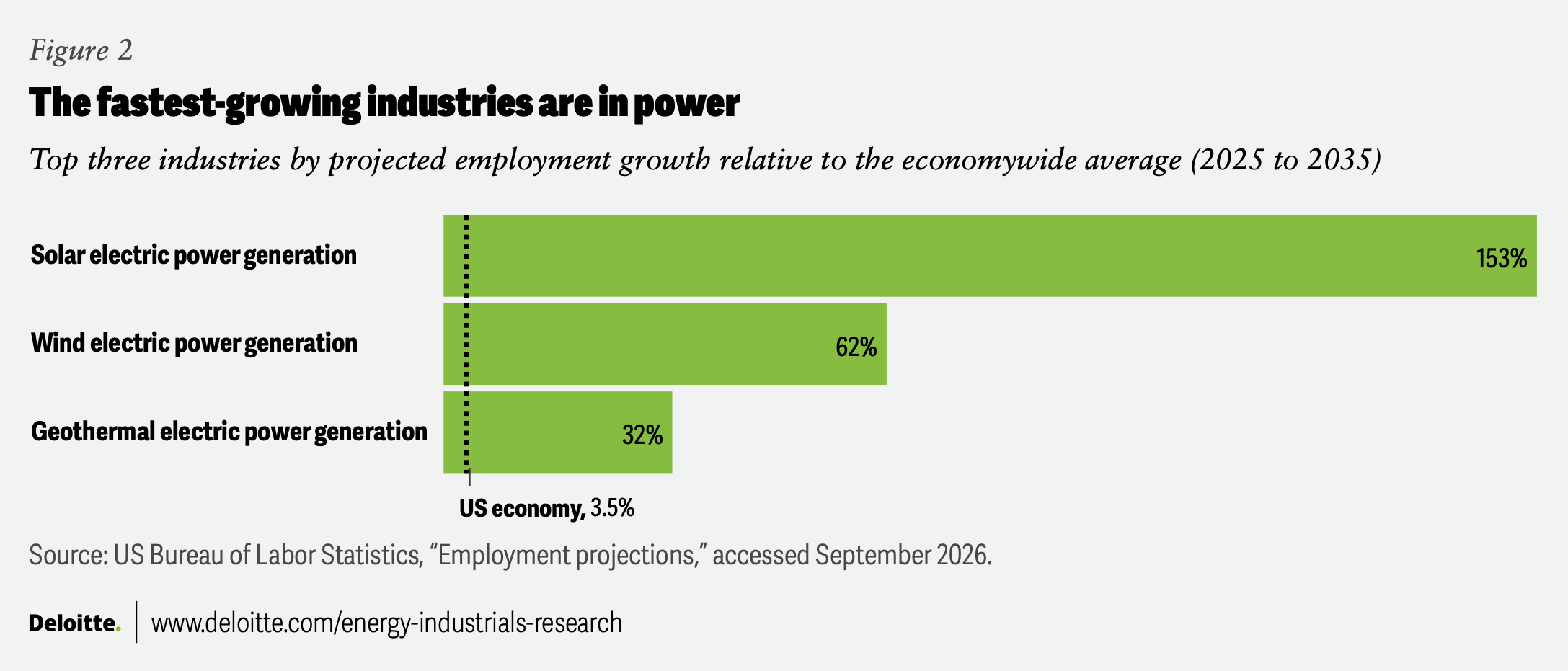
Utilities are the fastest-growing major industry sector of the US economy.7 Moreover, in terms of employment growth, the top three fastest-growing industries are tied specifically to electric power, with electric equipment manufacturing in the top five, and other electric power generation in the top ten (figure 2).8

Within these industries are the nation’s second and fourth fastest-growing occupations—solar photovoltaic installers and wind turbine service technicians—which also have rapidly evolving skill requirements.9 Over the past three years, about three-quarters of the skills required for these occupations have changed.10 Energy and nuclear engineers also rank among the top 20 occupations experiencing the highest levels of skill change.11

The utilities sector is short of both workers and the skills it needs to grow.12 And the shortfall is deepening at a time of intensified competition for the same talent pool from other AI infrastructure builders and operators.13 Also standing in the way of utilities seizing the opportunities that the AI economy has opened is a looming retirement cliff.

An aging workforce

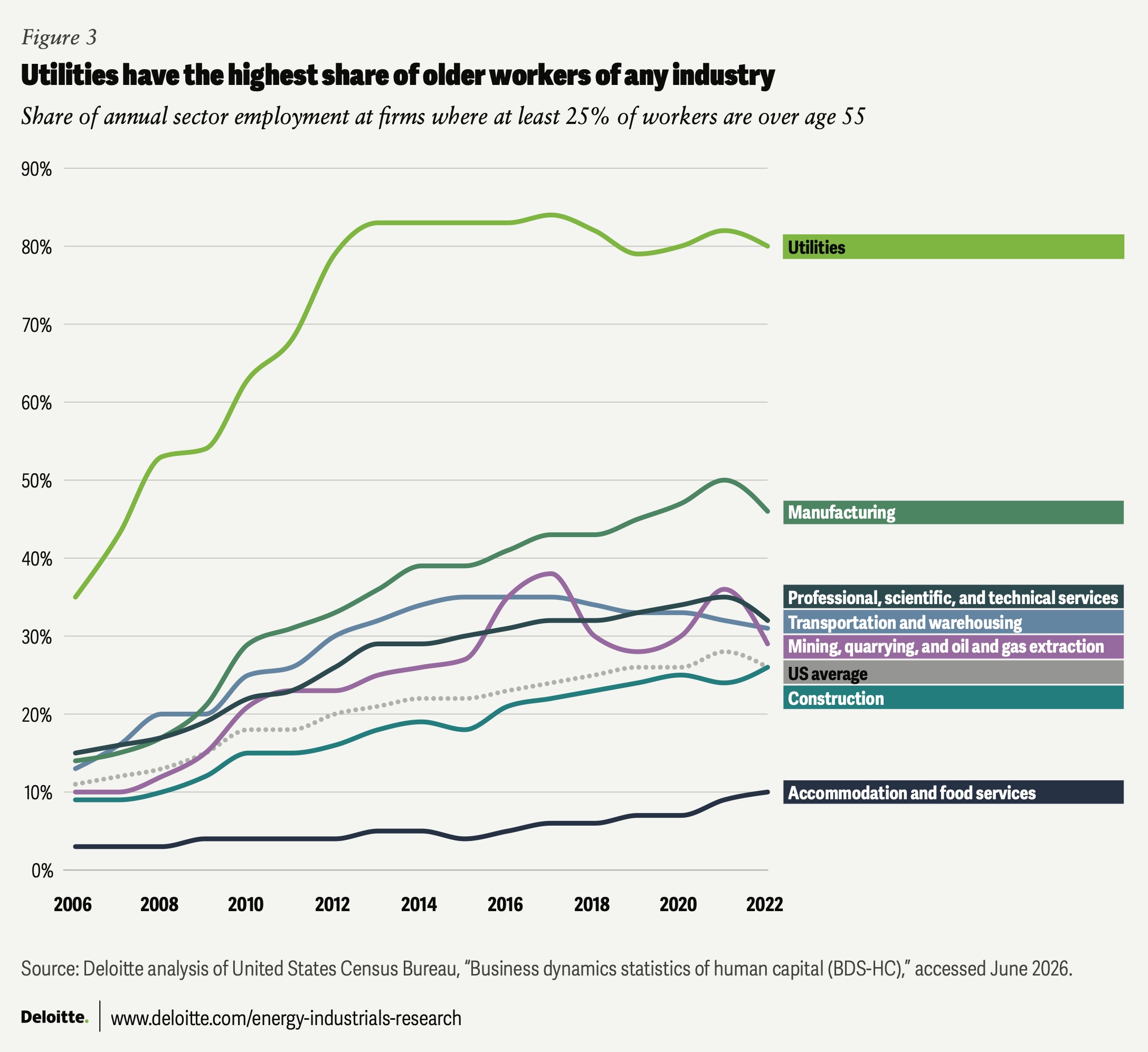
Across industries, utilities have the highest concentration of older workers: Eighty percent of utility employment is at firms where at least a quarter of workers are over 55 years.14 By this metric, utilities are in a league of their own (figure 3). In manufacturing, the sector with the second-highest concentration, only 46% of employment is at firms with at least a quarter of workers over 55 years.

The utilities industry’s age profile has also changed over the past two decades. The concentration of older workers has risen sharply, outpacing all other industries.15

Historically, long tenures have contributed to utilities’ outlier workforce. Median employee tenure peaked at 9.5 years in 2018, the highest for any industry across private and public sectors and more than double the national median.16

While tenure has since declined, the ratio of retiring workers to young entrants remains high due to low turnover among the experienced workforce. As retirements accelerate, that imbalance could become one of the industry’s defining workforce challenges.

A closing window for action

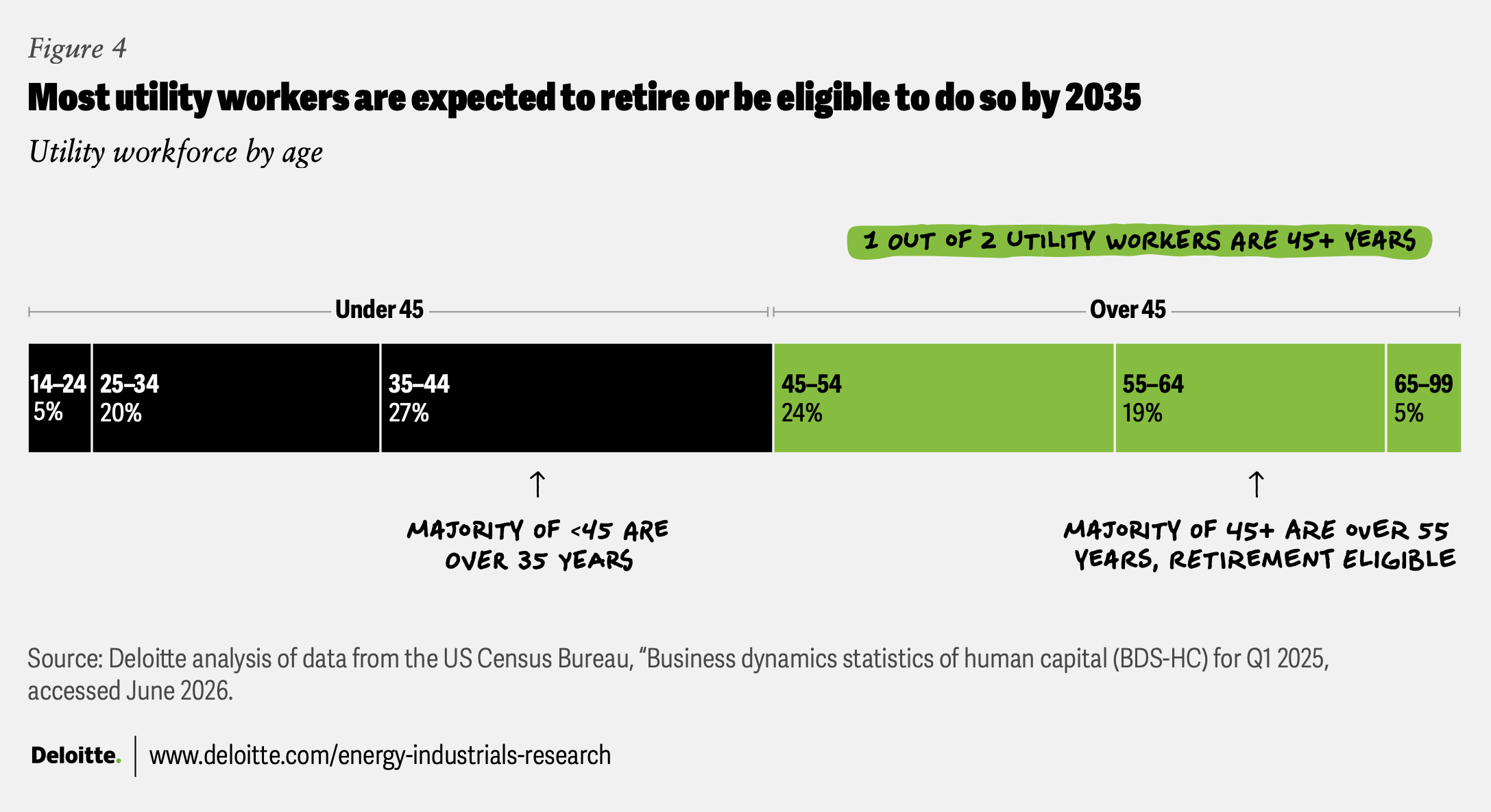
These aging trends leave utilities with a limited window to act. There are more than five utility workers age 45 and older for every new entrant under age 25, compared with the economywide ratio of less than 2:1.17 With half of their workers being over 45 years, utilities could lose much of their current talent and knowledge base to retirements within the next decade (figure 4).
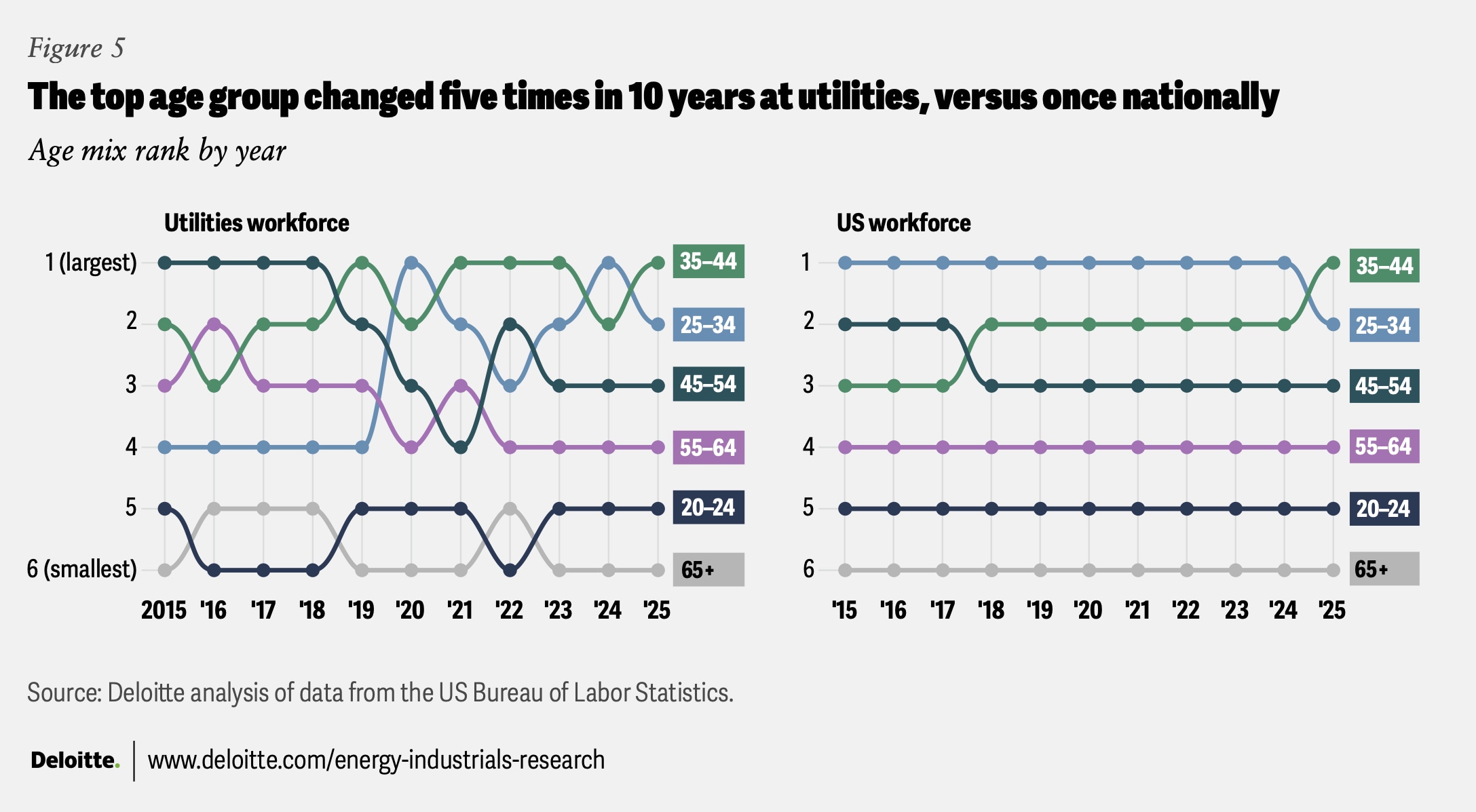
Complicating workforce planning is the uneven timing and distribution of utility workforce aging. The largest age cohort in utilities has shifted five times over the past decade, compared with just once for the US workforce overall (figure 5).18 Utilities should anticipate not only how many workers are expected to exit but also the moving target of when and where transitions will occur.
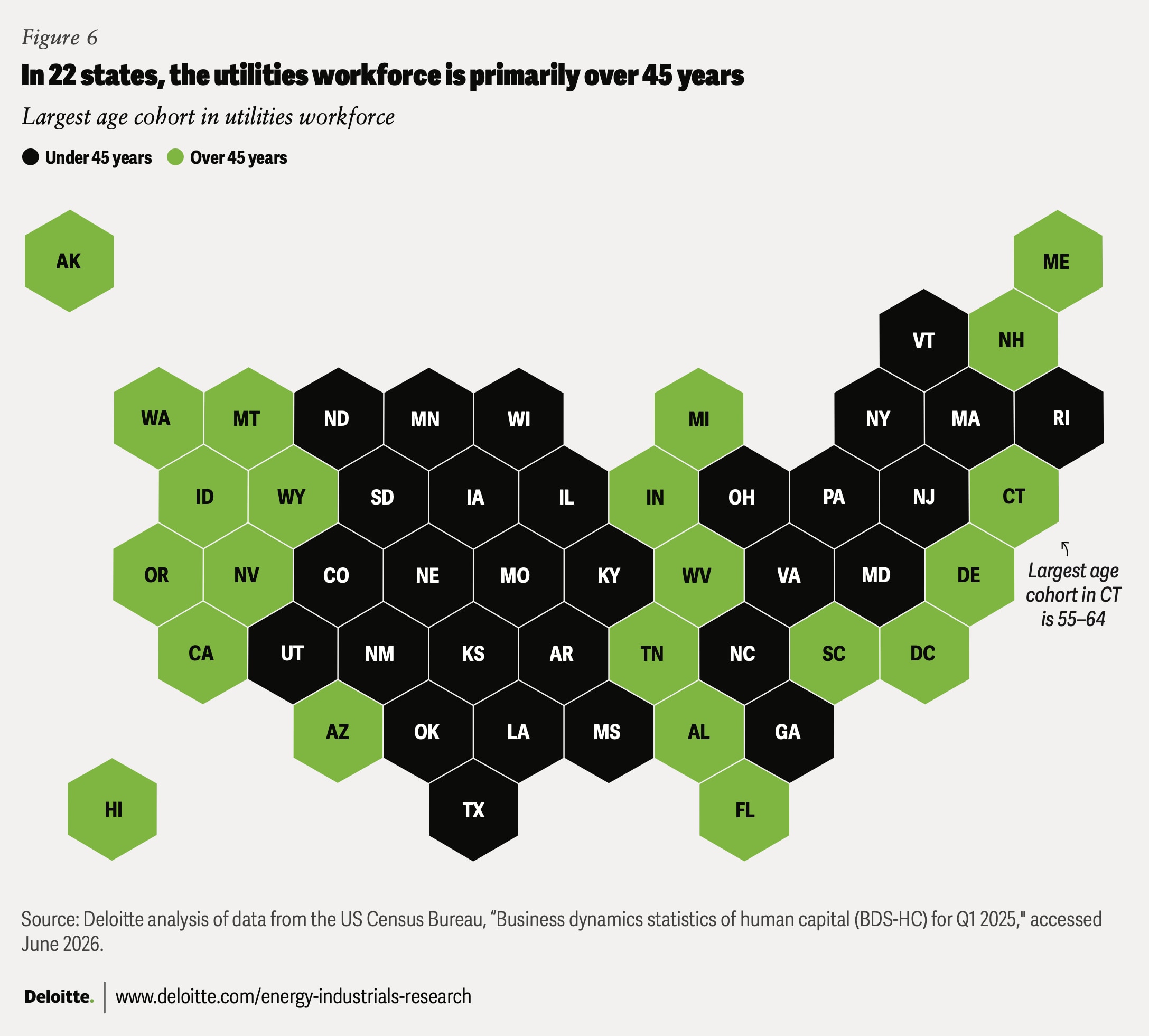
The challenge is uneven geographically too. Utility workforce trends do not align with broader state aging trends.19 The largest age cohort may be over 45 years for a state, but under 45 years for utilities in the state, and vice versa. Yet, in nearly half of the US states, older age groups already dominate their utilities sector (figure 6).
In business-as-usual times, a large generation of older workers exiting the sector without younger workers entering could pose an operational challenge. Today, it indicates a workforce shortage as the industry grows. Rapid expansion in capital investment has further impacted traditional approaches to building the workforce needed to keep pace with AI infrastructure execution demands.

Utilities may need to leverage AI itself to multiply what each worker can do.

“AI-ging” the utilities workforce

As it drives industry growth, AI is also redefining workforce capabilities. An aging workforce managing an aging grid under legacy models is not likely to deliver growth at the pace needed. Utilities could leverage AI to help.

Securing a future-ready workforce likely goes beyond like-for-like replacement of retiring workers and headcount growth. For utilities, the path forward may include redesigned processes that can unlock true human-machine collaboration in managing knowledge and delivering value. As utility work is broken into tasks, effort can gradually shift from today’s aging workforce to a new generation of workers in redefined roles, supported by AI that becomes increasingly embedded in workflows as it matures across generative, agentic, and physical forms. Orchestration of AI-enabled people and processes toward outcomes will likely become a premium human skill, as will the ability to operate assets manually if needed. 

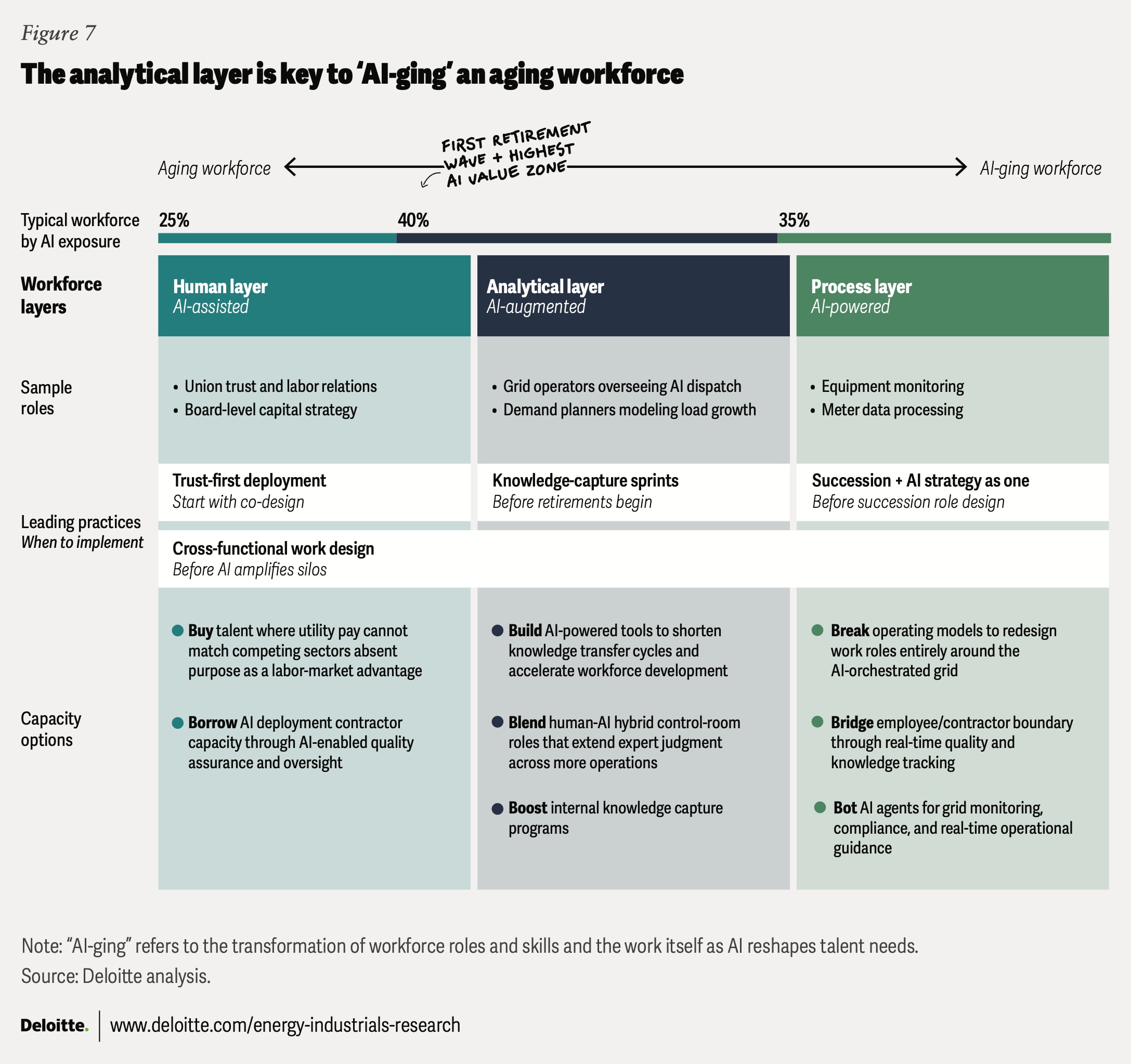
AI is expected to impact most utility roles, albeit in different ways and on different timelines.20 Foundational data capabilities should be in place to help enable AI-assisted, -augmented, and -powered solutions. Resistance to adopting new processes that change decades-long practices can also be a challenge. But once these solutions are implemented alongside operating model changes, they can help counter workforce aging through “AI-ging”—the transformation of workforce roles and skills and the work itself as AI reshapes talent needs (figure 7).
While AI can help utilities maximize the capabilities of each worker, it will likely also be important to help address the underlying talent pipeline issues. Few organizations have succeeded in offsetting workforce aging and related outflows while attracting sufficient new talent to meet historic growth. But if utility firms can close the gap with AI-fluent workers, their odds of rising to the occasion might improve.

A gen AI to Z opportunity

Untapped opportunities exist to connect AI-fluent workers’ capabilities with the industry’s growing workforce needs. Demand for AI talent is accelerating: The share of utility job postings requiring AI skills rose by more than 44% between 2024 and 2025.21 Utility workers are adopting gen AI faster than the US workforce overall, yet they report saving less than half as much time as AI users economywide (figure 8).22 This suggests that realizing AI’s full value may first require improved processes and workforce readiness.
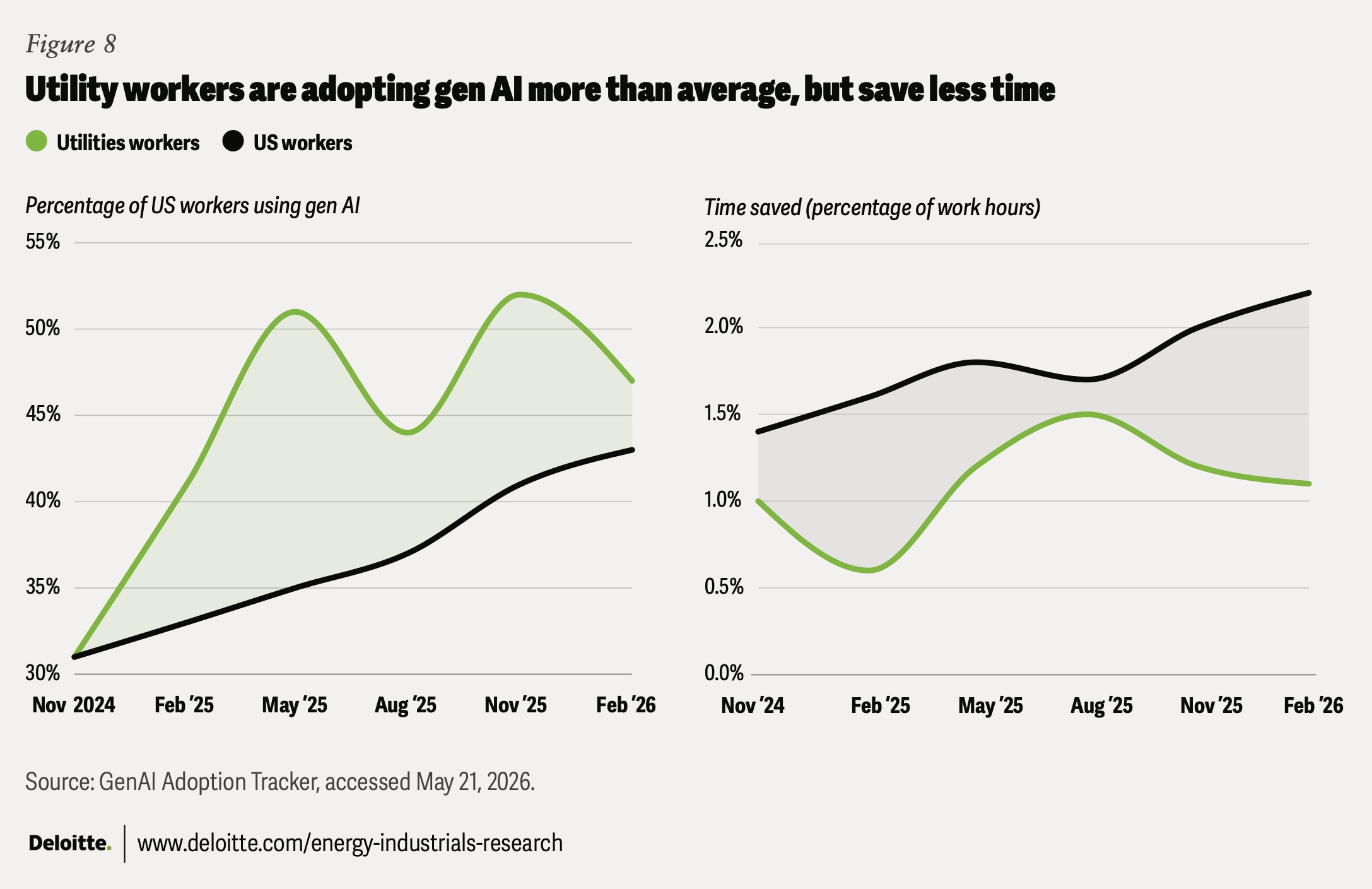
Younger workers may be well positioned to help meet these needs. Gen Z leads in AI adoption, ease of use, and productivity gains.23 Gen Z’s familiarity with AI could help accelerate effective adoption, while experienced workers could contribute domain expertise and operational judgment. Research suggests that Gen Z achieves its greatest productivity gains when advancing AI initiatives on generationally diverse teams.24

Intergenerational collaboration can be especially valuable for utilities. Workers who are new to the industry may benefit from greater guidance in an industry where AI implementation often proceeds with limited communication from leadership—the complexities of utilities’ regulated operating environment may help explain this “stealth adopter” behavior.25 This type of collaboration can also help bridge generational divides. Utilities have an opportunity to intentionally pair experienced workers’ institutional knowledge with AI fluency to strengthen knowledge transfer, accelerate effective AI adoption, and improve productivity. The result might be capabilities that no single generation could achieve alone.

The Gen Z talent equation

Winning Gen Z talent will be important for this opportunity. Backfilling retiring workers and accelerating the industry’s AI transformation may depend on attracting a generation that remains underrepresented in utilities.26 It will likely take more than posting open positions. With relatively low appeal among Gen Z,27 utilities should consider both the career opportunities they offer and how they communicate them to help compete for the next generation of talent.

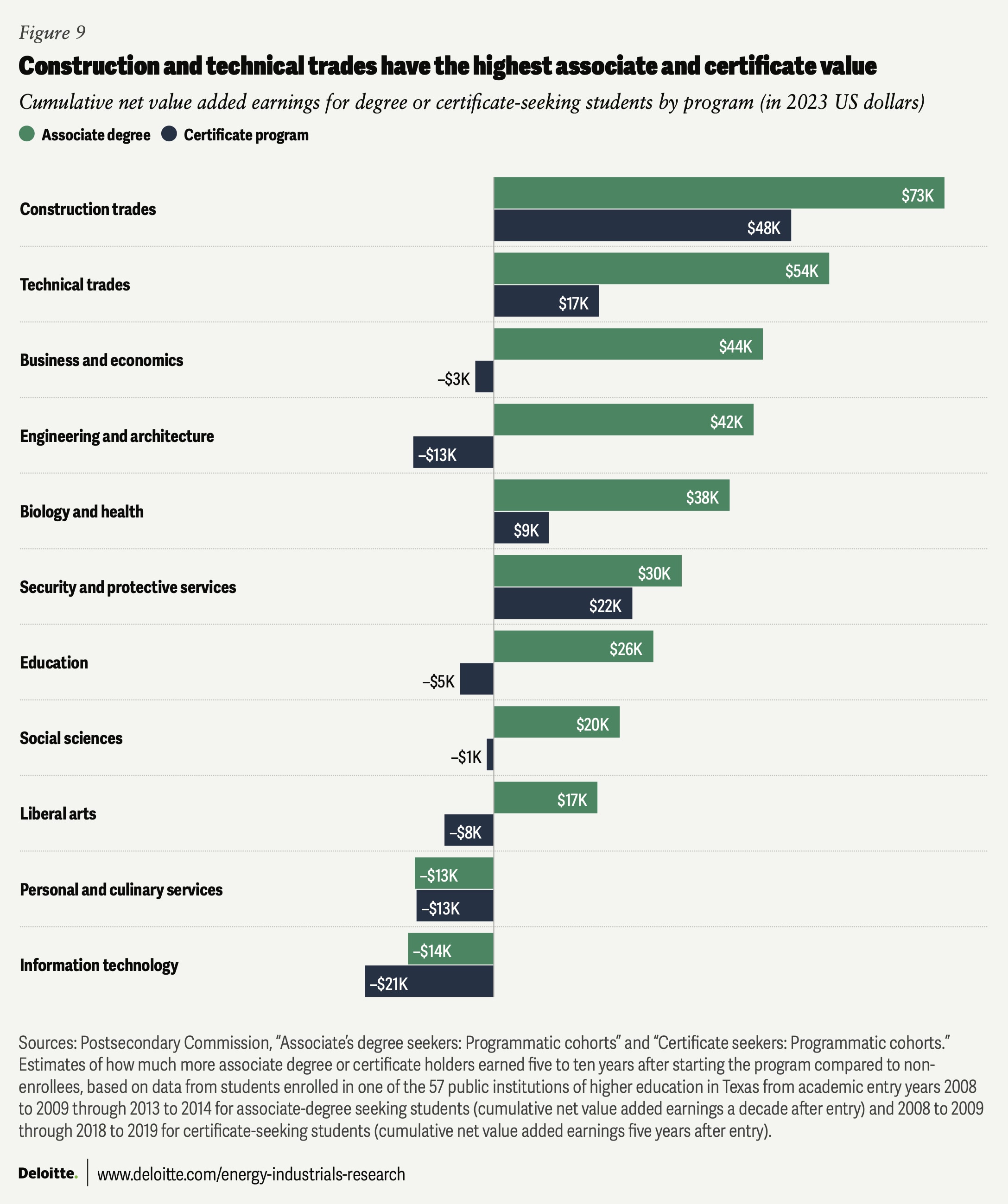
Despite recruiting challenges, utilities possess strong early-career value propositions in the economy, particularly for the growing number of Gen Z workers choosing trades over a four-year degree.28 These core trade roles are where the retirement wave is arriving first and hiring demand is growing fastest.29 In plant operator and trade occupations, Gen Z entrants can advance quickly and earn more than peers in other occupations requiring a certificate or associate degree.30 Construction and technical trades are among the four certificate programs whose graduates earn more within five years of enrollment than comparable individuals who never enrolled, and they are also the two associate-degree fields with the largest earnings gains (figure 9).31

Competitive compensation is only part of the equation. To attract Gen Z, utilities should also align with the generation’s workplace expectations. Work/life balance ranks among the top workplace priorities for Gen Z, reflecting a broader emphasis on well-being.32 Meeting those expectations can be challenging in field operations, which offer less flexibility than the hybrid and remote arrangements that office roles may offer. Even where work from home is possible, it can constrain progression unless utilities provide mentorship and on-the-job learning.33

Purpose is even more important.34 Gen Z considers a sense of purpose crucial to both job satisfaction and well-being, with 80% of Gen Z adults surveyed seeking careers centered on making a positive impact, although fewer than half of Gen Z workers surveyed say they have found one.35 Here, utilities may be underselling one of their strengths. While the industry’s current growth story centers on powering AI, younger workers may connect more strongly with a broader mission such as the energy transition. Indeed, Gen Z’s engagement with renewable energy suggests that this mission may be resonant: According to the March 2026 Deloitte ConsumerSignals survey, 53% of US Gen Z respondents regularly power their home with renewables, compared to 17% for Gen X, boomers, and older generations combined.36

Finally, there are gaps between Gen Z expectations and experiences with their supervisors in the workplace. Fifty-three percent of US Gen Zs surveyed in the energy and industrials sector expect managers to coach employees, but only 33% experience such coaching.37 Meanwhile, 42% of US Gen Zs in the sector expect close supervision of day-to-day tasks, but 58% experience it.38

An industry’s age profile can shape workplace norms, technology adoption, and employee expectations, reinforcing itself over time. Workers of the same age tend to cluster, creating a workplace that reflects their preferences.39 Without stronger recruitment, utilities could risk becoming more digitally constrained just as AI capabilities become increasingly important. On the other hand, attracting and empowering more Gen Z workers could inject the digital fluency, evolving workplace expectations, and cultural momentum needed to transform utilities into truly AI-native organizations.

Pathways to close the talent gap

In utilities, an acute workforce aging trend has run up against explosive growth. To help manage both, utilities should look to redesign work with AI-enabled processes that augment knowledge transfer and skill development. Utility leaders can consider the following actions (figure 10).
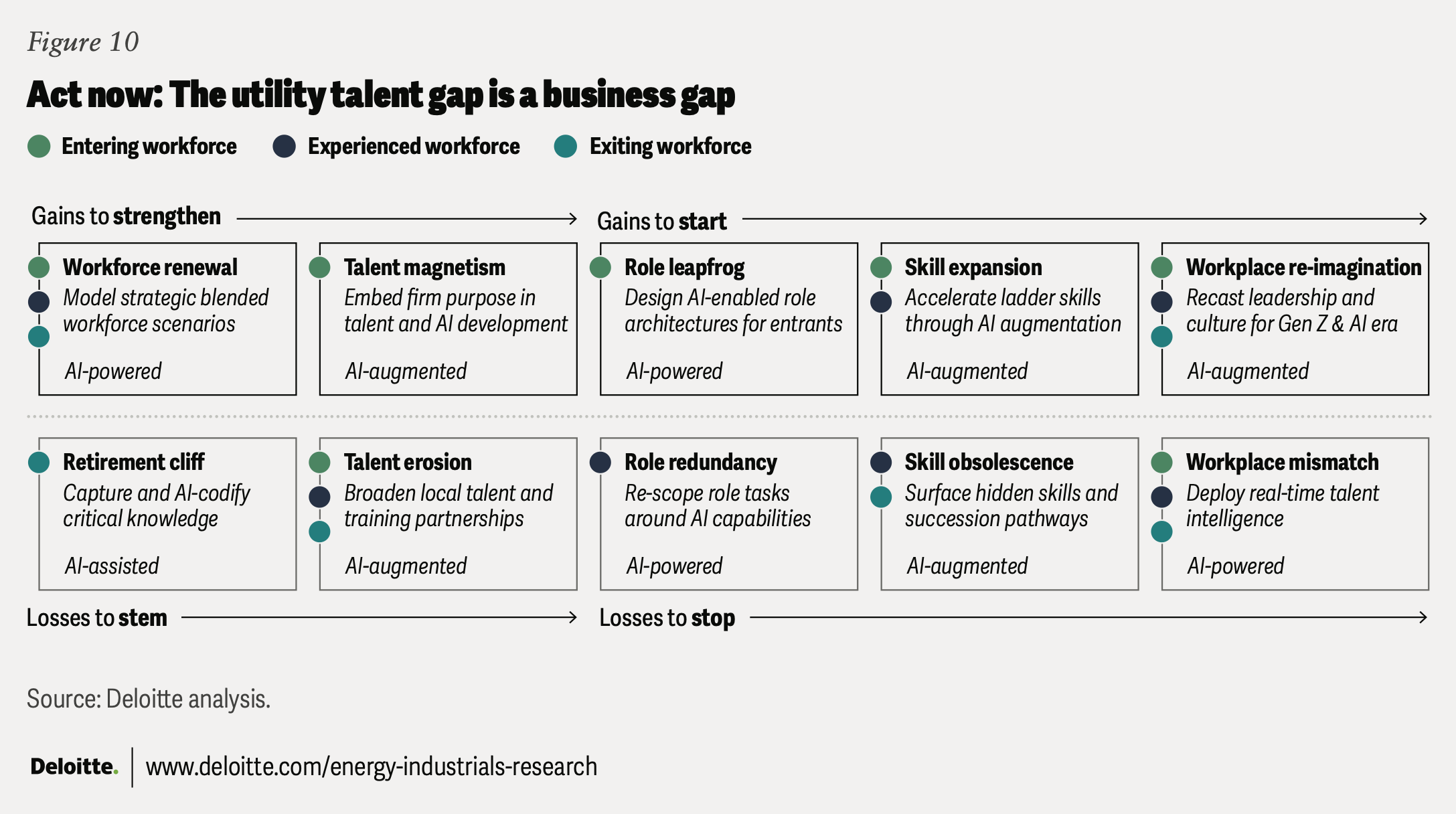
  1. Test transition timelines. Scenario plan around workforce turnover, demographic trends, and AI usage and exposure. This can help define the windows for action to maintain and manage knowledge by role. It can also lay the foundation for longer-term strategic workforce planning.
  2. Capture, codify, and communicate knowledge. Identify critical and concentrated core role knowledge. Accelerate the capture of siloed knowledge. Consolidate and codify content to help it be consumable and usable across age cohorts, platforms, and worksites.
  3. Gauge the gap to growth. Assess ways to fill the gap between retirement-driven workforce losses and AI-driven demand. Rethink the size, scope, and complexity of roles across the core, contingent, and contractor workforces. Segment categories of talent to recruit, onboard, train, and retrain for existing and new roles and skills. Compare these needs with local workforce and skill availability, especially as manufacturers increasingly compete for the same talent.
  4. Draw out hidden and ladder skills. Recognize skills learned on the job that may not be documented. Quantify the operational continuity risk of these hidden skills sliding down the chute as talent retires. Identify ladder skills that workers could climb more quickly by leveraging AI.
  5. Tailor training to top off and attract. Develop appealing, accessible, and calibrated training that tops off uncovered skills and employees’ existing skills. Implement new forms of delivery informed by real-time workforce analytics. Tie training more closely to industry purpose. Partner with educational and workforce development institutions, unions, manufacturers, and tech companies to create training centers and expand the locally available talent pool for shared core roles facing shortages.

In a broader national context of workforce aging and “AI-ging”—trends that could complement, complicate, or compound each other—utilities can act based on measured realities and the unknowns those measurements reveal. Utilities facing the paradox of aging fast while growing faster could integrate gen AI and Gen Z to help resolve it. The retirement wave could become an opportunity to reinvent the organization.

‘AI-ging’ in action: How Deloitte is helping clients get there

Deloitte is working with some of the larger players in the AI infrastructure buildout on “AI-ging” the workforce.

Example 1

The goal: Achieve enterprisewide AI transformation.

The problem: The business was looking to embed AI across all its functions and businesses to accelerate business processes; increase efficiencies from the back-office to front-office engineering, production, and construction delivery; and improve client delivery speed. It sought to position itself at the forefront of AI innovation and adoption to expand the business amid resource constraints and client demand for accelerated delivery.

The approach: A forward deployed engineering program was developed to build agents, fully integrate AI applications, and deploy AI across the core of the business. Forward deployed engineering embeds engineering, business leadership, risk, and adoption into a single delivery system focused on measurable outcomes.

Value delivered: The operating model, decision-making, leadership, talent, and ways of working are evolving in lockstep as AI reinvents the business.

Example 2

The goal: Deliver a road map for an AI work-design program with measurable outcomes across revenue growth, operating margin, asset efficiency, and cost management.

The problem: Return on investment did not materialize at the pace warranted by AI spend. The business was deploying AI capabilities into roles, structures, and behaviors that had not been redesigned to absorb them.

The approach: A structured analysis of the company’s largest workforce concentrations was conducted, including a task-level decomposition across functions. Each process was scored across six work-type dimensions and mapped to the three-tier model: AI-powered, AI-augmented, and AI-assisted. The analysis produced heatmaps pinpointing where AI impact would land first within each process and what work design changes could help capture that value.

Value delivered: AI value was captured across the finance, information technology, human resources, and supply chain functions.

Example 3

The goal: Stand up a scalable, agent-first operating model for customer care that enables AI agents, automation operations, and targeted human oversight to work together to drive reliable outcomes and continuous performance improvement as agentic capabilities mature.

The problem: As customer expectations continued to rise, the client’s current operating model had not kept pace with the expanding role of automation. Risk and complexity were growing as a result of inconsistent ways of working across functions, unclear accountability between AI agents and people, and a staffing model that was struggling to flex as capabilities matured.

The approach: A scalable global customer care model was built to help strengthen human and AI roles, improve visibility and consistency, and ultimately shift capacity from repetitive tasks to higher-value, customer-focused work.

Value delivered: This approach led to a reshaped organization where roles shifted from transactional processing toward higher-value oversight and judgment, freeing people to focus on protecting recurring revenue and supporting growth alongside the sales organization.

An ‘AI-ging’ READY assessment

How prepared is your organization for the “AI-ging” era? Are you confident in your organization’s ability to navigate the convergence of historic industry growth, workforce aging, and AI adoption?

Rate your organization on each of the five dimensions of the “AI-ging” READY workforce maturity model (figure 11). The model assesses five capabilities across a maturity curve ranging from reactive workforce management to a continuously regenerating human-machine workforce. Select the description that most closely reflects your current state. Your overall readiness is determined by your lowest-scoring areas, not your highest.

‘AI-ging’ READY workforce maturity model:

R: Retirement visibility

E: Expertise continuity

A: AI-enabled work

D: Demand planning

Y: Young talent pipeline

R: Retirement visibility

Anticipate workforce exits, operational risks, and transition needs before retirements occur.

Level 1: Exploring

Reactive—retirement is an HR event

  • Retirement eligibility is tracked primarily for benefits or HR purposes.
  • Limited visibility into where departures could disrupt operations or remove critical capabilities.
Level 2: Experimenting

Aware—retirement risks are identified

  • Workforce demographics are tracked.
  • Some critical positions have been identified.
  • Leaders understand broad exposure but rely largely on periodic reviews.
Level 3: Establishing

Forecasting—retirement scenarios inform decisions

  • Retirement scenarios are incorporated into workforce planning.
  • High-risk business units and locations are identified.
  • Succession planning covers many key roles.
Level 4: Scaling

Predictive—retirement risks drive workforce actions

  • Retirement risks are modeled by role, geography, skill, and business priority.
  • Workforce plans adjust as demographics change.
  • Leadership regularly reviews workforce risk dashboards.
Level 5: Innovating

Dynamic—workforce transitions are continuously managed

  • Workforce risk is continuously monitored.
  • Retirement scenarios trigger hiring, training, automation, and knowledge-transfer actions.
  • Workforce transitions are anticipated years in advance.

E: Expertise continuity

Capture, transfer, and evolve institutional knowledge as experienced workers transition out of the workforce.

Level 1: Exploring

Insular—knowledge resides with individuals

  • Critical knowledge resides primarily in experienced employees.
  • Documentation is inconsistent.
  • Expertise can leave when individuals exit.
Level 2: Experimenting

Documented—knowledge is captured selectively

  • Important processes and lessons learned are documented.
  • Knowledge capture occurs near retirement.
Level 3: Establishing

Structured—knowledge transfer is systematic

  • Critical knowledge domains have been identified.
  • Standardized capture and mentoring programs exist.
  • Searchable repositories are emerging.
Level 4: Scaling

Seamless—knowledge becomes accessible at scale

  • Tools help organize, retrieve, summarize, and recommend institutional knowledge.
  • Experts routinely contribute and validate content.
Level 5: Innovating

Perpetual—knowledge renews itself as work happens

  • Knowledge capture occurs continuously during work
  • AI agents assist employees using accumulated organizational expertise
  • Knowledge remains current regardless of workforce turnover

A: AI-enabled work

Redesign work so that humans and AI can collaborate effectively to improve productivity, resilience, and decision-making.

Level 1: Exploring

Experimental—AI use is individual and fragmented

  • AI use depends on individual initiative.
  • Few processes have changed.
Level 2: Experimenting

Piloting—AI use cases are emerging

  • Selected use cases have been deployed.
  • Productivity gains are localized.
  • Governance is emerging.
Level 3: Establishing

Incorporated—AI improves defined workflows

  • Major workflows have been evaluated for automation, augmentation, or human ownership.
  • AI supports employees in multiple business functions.
Level 4: Scaling

Integrated—human and AI roles are intentionally defined

  • Workflows are redesigned around human-machine collaboration.
  • Employees are trained to supervise and collaborate with AI.
Level 5: Innovating

AI-native operations—work is built for human-machine collaboration

  • Processes are designed around human-machine collaboration from the outset.
  • AI agents coordinate work across functions.
  • Human effort focuses on judgment, resilience, customer trust, and complex decisions.

D: Demand planning

Understand future workforce requirements and align talent, skills, technology, and capacity with business growth

Level 1: Exploring

Vacancy management—workforce needs are addressed as gaps emerge

  • Hiring is based primarily on filling open positions.
  • Growth needs are estimated separately.
Level 2: Experimenting

Capacity planning—workforce projections are improving

  • Retirement and hiring projections exist.
  • Contractor needs are tracked.
  • Planning remains largely annual.
Level 3: Establishing

Strategic workforce planning—future needs shape talent decisions

  • Workforce demand reflects business growth scenarios.
  • Skills, not just positions, are forecast.
  • External labor market conditions inform planning.
Level 4: Scaling

Skills-based planning—capacity is managed by capabilities

  • Workforce plans combine retirements, growth, automation, contingent labor, and AI.
  • Skills inventories guide hiring and development.
Level 5: Innovating

Workforce orchestration—talent supply dynamically matches demand

  • Workforce supply and demand are continuously optimized.
  • Human, contractor, robotic, and AI capacities are planned together.
  • Talent decisions are tied directly to business outcomes.

Y: Young talent pipeline

Attract, develop, and retain the next generation of digitally fluent utility workers.

Level 1: Exploring

Recruiting—talent acquisition fills immediate needs

  • New talent development pipeline focuses on open roles.
  • Expectations of incoming generations are not well understood.
Level 2: Experimenting

Competing—employer appeal is improving

  • Employer branding and recruiting have improved.
  • Internship and apprenticeship programs exist.
  • Retention remains inconsistent.
Level 3: Establishing

Developing—early-career talent is intentionally built

  • Career pathways are clearly defined.
  • AI-enabled learning accelerates onboarding.
  • Cross-generational mentoring is common.
Level 4: Scaling

Engaging—the workplace is designed for emerging talent

  • Work, learning, flexibility, and purpose are intentionally defined for emerging talent.
  • AI fluency is treated as a strategic capability.
  • Employees actively contribute to digital transformation.
Level 5: Innovating

Regenerating—the utility has created a talent flywheel 

  • New talent is continuously developed into future technical and operational leaders.
  • AI, experienced workers, and young talent accelerate each other’s productivity.
  • The organization has become a destination employer for digitally native energy talent.
  • The organization has broken down roles to skill levels and stitched them back together. It more effectively leverages skill sets to plug gaps while creating solid recruitment pathways for new skills needed as a result of AI enablement.

Identify your lowest maturity level. That is likely your organization’s biggest constraint. In the “AI-ging” era, utilities are unlikely to fail because they lack technology. They often struggle when retirement risk, workforce planning, AI adoption, and talent strategy mature at different speeds. Competitive advantage can come from advancing all five together.

Continue the conversation

Meet the industry leaders

Thomas L. Keefe

Vice Chair, US Power, Utilities & Renewables Leader | Deloitte & Touche LLP
Deloitte United States

Zac Quayle

Principal, Deloitte Consulting LLP
Deloitte United States

Kate Hardin

Executive director | Deloitte Research Center for Energy & Industrials | Deloitte Services LP
Deloitte United States

by

Michael Cleveland

United States

Zac Quayle

Deloitte United States

Chris Murphy

United States

Kate Hardin

Deloitte United States

Carolyn Amon

Deloitte United States

ENDNOTES

  1. Deloitte analysis of data from US Census Bureau, Quarterly Workforce Indicators, accessed June 2026.

  2. Deloitte analysis of US Bureau of Labor Statistics, “Employment projections,” accessed September 2026.

  3. Ibid.

  4. Deloitte analysis of data from S&P Global for planned generation; DC Byte for planned data centers; Angela Ryu and Shon R. Hiatt, “Combined cycle gas turbine (CCGT) plants employment forecast analysis,” Hamm Institute for American Energy at Oklahoma State University, Dec. 22, 2025 for gas employment factors; Jay Rutovitz, Rusty Langdon, Chris Briggs, Franziska Mey, Elsa  Dominish, and Kriti Nagrath, “Updated employment factors and occupational shares for the energy transition,” Renewable and Sustainable Energy Reviews 212 (2025) for renewable generation employment factors; and company announcements and Department of Energy, “Pathways to commercial liftoff: Advanced nuclear,” and “Quantifying socioeconomic impacts of electricity generating technologies,” 2024 for nuclear.

  5. A job-year refers to one year of one job. This unit of measurement is used for the duration of inherently temporary construction jobs due to their limited nature. A project that creates 600 job-years could be a project that employs 600 construction workers for one year, 300 construction workers for two years, or 200 construction workers for three years.

  6. Deloitte analysis of Angela Ryu and Shon R. Hiatt, “Data center employment forecast analysis,” Hamm Institute for American Energy at Oklahoma State University, Dec. 3, 2025; Deloitte 2035 data center estimate from Martin Stansbury, Kelly Marchese, Kate Hardin, and Carolyn Amon, “Can US infrastructure keep up with the AI economy?Deloitte Insights, June 24, 2025.

  7. US Bureau of Labor Statistics, “Employment projections,” accessed September 2026.

  8. Ibid.

  9. Deloitte analysis of US Bureau of Labor Statistics and Lightcast data.

  10. Deloitte analysis of Lighcast skills disruption index.

  11. Deloitte analysis of Lightcast data.

  12. Deloitte analysis of data from Lightcast, US Bureau of Labor Statistics, US Census Bureau, S&P Global, Hamm Institute, and Rutovitz et al.

  13. Zac Quayle, Kate Hardin, Jaya Nagdeo, Shih Yu (Elsie) Hung, and Carolyn Amon, “In the AI age, data centers and power companies compete for the same core workforce,” Deloitte Insights, March 31, 2026.

  14. Deloitte analysis of US Census Bureau, “Business dynamics statistics of human capital,” April 2025.

  15. Ibid.

  16. Deloitte analysis of US Bureau of Labor Statistics data, accessed September 2026.

  17. Deloitte analysis of data from US Census Bureau, Quarterly Workforce Indicators, accessed June 2026.

  18. Deloitte analysis of data from the US Bureau of Labor Statistics, accessed September 2026.

  19. Deloitte analysis of data from US Census Bureau, Quarterly Workforce Indicators, accessed June 2026.

  20. Deloitte analysis.  

  21. The Stanford AI Index Report 2026.

  22. Project on Workforce at Harvard, “Generative AI adoption tracker,” accessed June 2026.

  23. Deloitte analysis of data from Daniel Jolles and Grace Lordan, “Bridging the generational AI gap: Unlocking productivity for all generations,” The Inclusion Initiative at the London School of Economics and Protiviti, October 2025; Ipsos, “Ipsos generations report 2026: Continuity vs rupture,” May 2026.

  24. Ibid.

  25. Deloitte analysis of industry scores from Felipe Ost Scherer, “How to read the 2026 AIDE Index,” AI-Driven Enterprise Institute, June 1, 2026.

  26. Deloitte analysis of data from US Census Bureau, Quarterly Workforce Indicators, accessed June 2026.

  27. International Energy Agency, “World energy employment 2025,” Dec. 5, 2025.

  28. Deloitte analysis of growth in wages over time across occupations in Organisation for Economic Co-operation and Development’s Employment Outlook 2025 and National Student Clearinghouse, “Final fall enrollment trends,” Jan. 15, 2026.

  29. Deloitte analysis of Lightcast data.

  30. Postsecondary Commission, “Associate’s degree seekers: Programmatic cohorts,” accessed June 2026; Postsecondary Commission, “Certificate seekers: Programmatic cohorts,” accessed June 2026.

  31. Ibid.

  32. Bank of America, “Gen Z and the cost of adulting,” May 2026.

  33. Federal Reserve Bank of New York; Natalia Emanuel, Emma Harrington, and Amanda Pallais, “Remote work leaves younger workers sidelined,” June 1, 2026.

  34. World Economic Forum and Global Shapers Community, “Youth pulse 2026: Insights from the next generation for a changing world,” January 2026.

  35. Gallup, Walton Family Foundation, Making Caring Common project at Harvard University, “Gen Z wants to do good: How helping others supports meaning and wellbeing,” June 2026.

  36. Analysis of generational and income data from the Deloitte ConsumerSignals survey fielded in March 2026.

  37. Analysis of data cuts for US workers in the energy and industrials sector of the Deloitte Global 2026 Gen Z and Millennial Survey.

  38. Ibid.

  39. Martha Stinson and Sean Wang, “US workforce is aging, especially in some firms,” US Census Bureau, Dec. 2, 2025.

ACKNOWLEDGMENTS

The authors would like to thank Elsie Hung, Anju Chalil, Tom Keefe, and Ethan Erickson for their subject matter input and review, and Paula Payton, David Levin, and Sameen Salam for their data science expertise.

The authors would like to acknowledge the support of Clayton Wilkerson for orchestrating resources related to the report; Kim Buchanan, who drove the marketing strategy and related assets to bring the story to life; Mariel Balaban for her leadership in public relations; Rithu Thomas and Aparna Prusty from the Deloitte Insights team who edited the report and supported its publication, and Harry Wedel for the visual design.

Editorial (including production and copyediting): Rithu Thomas, Cintia Cheong, Pubali Dey, and Aparna Prusty

Design: Harry Wedel, Pooja Lnu

Cover image by: Pooja Lnu

Knowledge services: Vanapalli Viswa Teja

COPYRIGHT