
The future of materials
Advancements in science and technology are enabling many chemical companies to develop and design materials for a more sustainable future.
Two forces shaping the future of materials
Innovation may be once again changing the game in the chemicals industry. Two forces seem to be driving this innovation: a heightened focus on sustainability (from companies, customers, and policymakers) and changing customer preferences. Yet, this potential transformation is taking place amid historic pressure on the industry. First, some companies are pursuing research and development (R&D) and investments against short timelines set by announced sustainability targets from both private and public entities. Second, these capital expenditure decisions, in some cases, must be made even before supply chains for new feedstocks have been secured and project risk can be mitigated by long-term offtake contracts. Furthermore, the current consumer price premium for sustainable products may change as supplies increase.
Sustainability
The chemicals industry seems to be under increasing pressure to reduce emissions, increase recycled inputs to minimize waste, and develop inherently safer chemicals. Pressure may come from across stakeholder groups: local and federal governments, nongovernmental organizations, investors, industry groups, and downstream consumers. Numerous policies, regulations, and targets have been announced over the last few years, with many investors requiring companies to disclose environmental data.1 In fact, brands are driving demand for more sustainable materials to meet their sustainability targets and prepare for the low-carbon, reduced-waste future that policies are pushing toward.2 Today, more than 1,700 companies and financial institutions, globally, have announced net-zero commitments.3 In addition, according to a Deloitte survey, 59% of respondents reported their companies have started using sustainable materials, such as recycled materials and lower-emitting products.4
Over the last two years, several such policies and regulations have been adopted and proposed. The United States passed the Inflation Reduction Act,5 which provides incentives and funding to clean energy production and infrastructure, and proposed climate disclosure rules,6 which could require listed companies to disclose scope 1, scope 2, and some scope 3 emissions. In September 2022, President Joseph Biden signed an executive order creating a National Biotechnology and Biomanufacturing Initiative to advance American biotechnology and biomanufacturing.7 The European Union also proposed the Fit for 55 package8 and the European Green Deal,9 which could promote several initiatives, including clean energy, energy efficiency, and longer-lasting products that can be repaired, recycled, and reused.
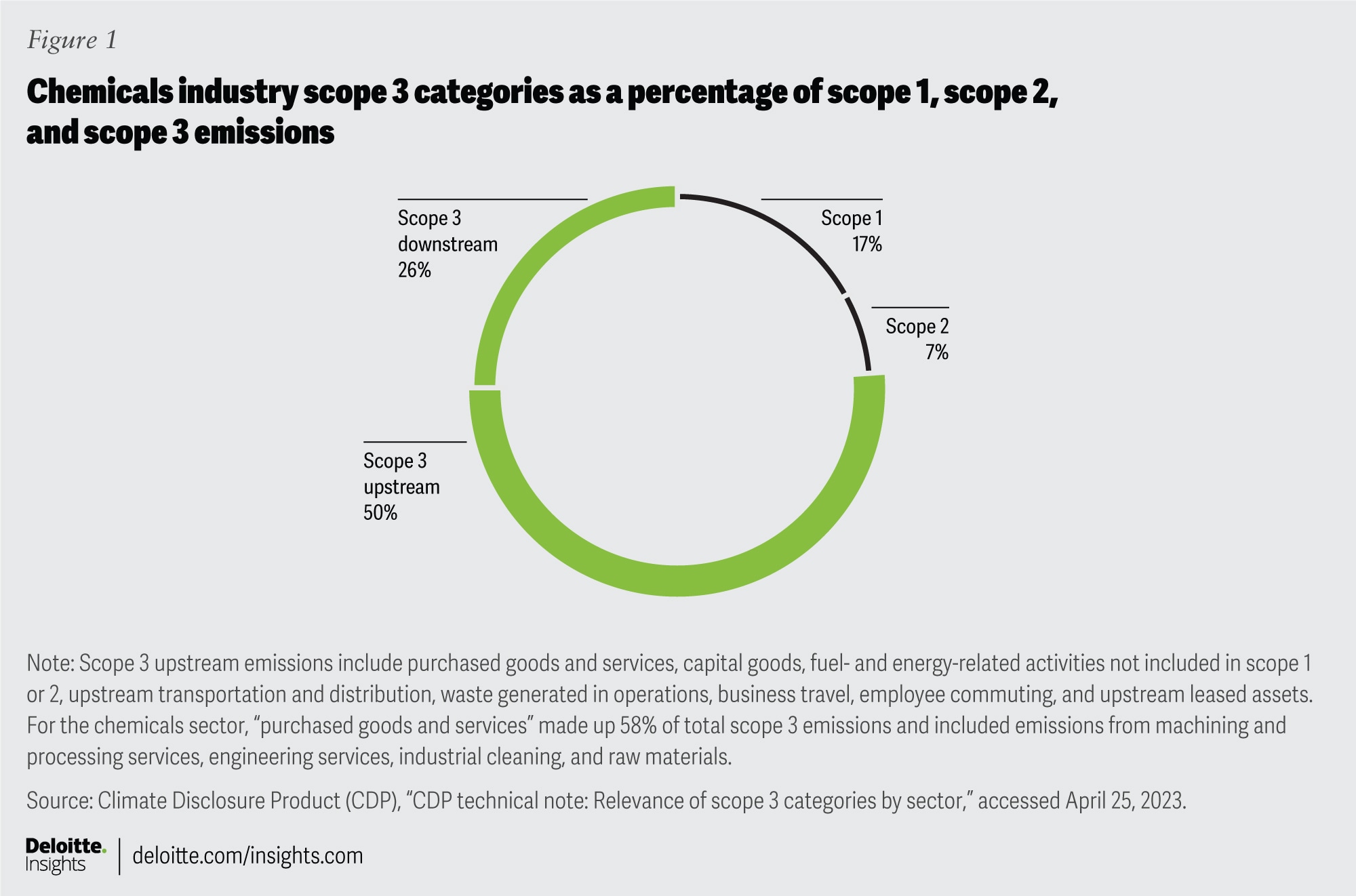
The chemical industry's role in reducing emissions and waste will likely be important as the demand for chemicals and materials grows. For instance, global demand for plastics is expected to triple between 2019 and 2060 from 460 million tons (MT) to 1,231 MT, with increased use in the transportation, construction, and packaging sectors as economic growth drives demand in those sectors.10 It’s important to note that more than 75% of the chemical industry’s emissions are scope 3 (figure 1).11 This has led to an increased focus on decarbonized upstream inputs, low-carbon end uses, and downstream end-of-life options. And meeting targets will likely become increasingly important to brand value as stakeholders pressure brands to demonstrate progress in meeting corporate sustainability commitments. This pressure on brands could inevitably trickle through to original equipment manufacturers and parts and component manufacturers.
Shifts in demand
Consumer preferences may shift as new products are developed and existing products are improved to solve problems, fulfill needs, and enhance the way we live and work. Shifts could continue to occur due to demographic changes. For instance, one forecast indicates that demand for medical devices could rise by nearly 50% between 2021 and 2029 as the population ages and the prevalence of chronic disease increases.12 Global demand for electric vehicles (EVs) is forecast to increase eightfold between 2020 and 2030 (from 3 million to 27.5 million),13 as policy incentives, better performance, and preferences for sustainable products could drive demand in the sector. Shifts could also occur in response to growing public awareness of an issue. For instance, several regions, countries, and states have banned single-use plastics.14 And in March 2022, the resolution to end plastic pollution passed the United Nations Environment Assembly, and a binding United Nations treaty could be signed as early as 2024.15
Each one of these shifts in demand could reverberate through the products’ supply chain. Some shifts may only impact one part or component, but other shifts could impact every part of the supply chain, from feedstocks to end use. This may be especially true when the shift is toward more sustainable goods. Consumers generally want the same (or better) performance and affordability in addition to sustainability. This raises the question of whether it’s more economical for the producer to decarbonize their existing product or start producing a different product that may have slightly different performance metrics but a lower carbon footprint.
This reevaluation of chemical companies’ portfolios is expected to be important as markets continue to evolve because demand for new advanced materials could increase (e.g., lithium-ion batteries for energy storage, graphene for wearable medical devices), while other chemicals and products become outdated (e.g., chlorofluorocarbons [CFCs] after public awareness of their harm to the ozone layer led governments to ban them, and film after the use of digital increased). The difference now is that shifts in demand toward sustainable products could impact all products rather than just a few.
Additionally, while in the past, chemicals companies have generally focused mainly on the volume of product sales, as scope 3 emissions gain importance, chemicals companies may start considering how their products are used downstream. For instance, chemicals companies may choose to sell their products (e.g., plastics, resins) to electric vehicle manufacturers (rather than internal combustion engine vehicles manufacturers) to reduce their downstream scope 3 emissions.
Advanced materials: Making the impossible possible
The drivers of shifting demand and sustainability have contributed to today’s innovation in advanced materials, but the current acceleration is likely due in large part to advancements in enabling technologies such as robotics, artificial intelligence (AI) (for more details, see the sidebar “Enabling technologies: Artificial intelligence”), 3D printing, and material informatics (both physics-based machine learning and de novo simulations and eventually quantum computing). Advanced materials research is extensive, incorporating multiple fields, including material science, chemistry, physics, nanotechnology, and biotechnology (for more details, see the sidebar “Enabling technologies: Synthetic biology”), and its development is being accelerated in part by technologies and policies that shorten the time to market. Additionally, initiatives like the Materials Genome Initiative aim to expand the range of advanced materials and accelerate time to market.16
Emerging sustainable ecosystems
The ability of companies to reexamine existing products and design new products in response to sustainability and consumer preferences may help determine their future success. Companies should evaluate the entire supply chains of each of their products, from feedstock to part to product. Key considerations to examine will include sustainability, cost structure, and performance characteristics at each stage.
Three strategic levers for chemicals companies
The push toward sustainability could challenge the industry to innovate across processes and products. As companies navigate through these new demands—more sustainable, safer, reliable, and better-performing products—three considerations should help guide them.
Realizing value from existing assets and data
For some companies, the first step in developing more sustainable business practices is not just tracking emissions; it’s taking a holistic look at current assets, data, and partnerships. An up-front assessment of current data can help identify opportunities and track progress. Taking a holistic view of all data is important since some data will be useful in multiple parts of the business. This data can be used for the discovery, development, and scaling of new materials, optimizing operations, and minimizing emissions.
Additionally, for some companies and some products, there could be natural areas for the integration of bio-based materials, recycled content, or other sustainable advanced materials. These drop-ins could help companies increase their portfolio of sustainable products with relatively low up-front costs. However, other applications may require companies to redesign the entire supply chain, which may involve a higher upfront cost. Understanding the options and cost implications of each strategy can help companies determine how to develop their product portfolios.
Making the economics work
Forecasting is difficult in the most stable of markets, and the movement toward higher quality, sustainable products can make forecasting even more difficult. Consequently, to make the economics work, companies may need to sign long-term contracts, utilize government funding or incentives, and make efforts to garner customer loyalty.
Maintaining brand trust, increasing enterprise value
Customers that highly trust a brand will purchase from that brand again 88% of the time.103 Consequently, highly trusted companies outperform low-trust companies with up to four times the amplification of market value. Brand trust is generally built upon four factors: humanity, transparency, reliability, and capability.104 For oil, gas, and chemicals companies, the biggest gap between the best-performing and worst-performing companies is in the intent factors (transparency and humanity).105 As chemical companies move toward more sustainable products, it is important that companies be transparent about their successes and failures to help reduce reputational risk and maintain brand trust.
BY
David Yankovitz
Kate Hardin
Robert Kumpf
Ashlee Christian
The authors would like to thank Zubair Azad, Dan Ferrante, Maria Kipreos, Eddie Newland, Jake Riley, Annabel Hernandez Romero, and Emily Werner from Deloitte Consulting LLP, Olivier Jan from Deloitte Conseil, and Aijaz Hussain (former employee) for their subject matter inputs and contributions toward the development of this study.
The authors would also like to thank Ankhi Biswas from Deloitte SVCS India Pvt. Ltd. for her extensive research and analysis support, Scott Van Tilburg from Deloitte Consulting LLP for his inputs, Rithu Thomas from the Deloitte Insights team for providing support for the report’s editing and publication processes, and Katrina Hudson, Dario Failla, Alyssa Weir, Clayton Wilkerson, and Jennifer McHugh from Deloitte Services LP for their operational and marketing support.
Finally, the authors would also like to thank Jeff Carbeck from Eastman for his valuable inputs on the Eastman case study.
Cover image by: Peter Crowther