US munitions by the numbers: Tracking procurement and foreign military sales
Can US arms manufacturers meet both domestic defense needs and foreign demand? Charts on 21 types of munitions, compiled primarily from government data, can help inform the discussion
Mark Cotteleer
Adam Routh
Thirumalai Kannan
Joe Mariani

Behind US defense procurement and foreign military sales sits a complex manufacturing ecosystem—from large contractors to specialized component suppliers—producing everything from precision missiles to artillery shells. It’s an interlocking set of industrial sectors that play a significant role in national security. Can past trends inform future production capacity? How do domestic procurement and foreign sales compare? And how have these numbers changed in recent years?
The data that could help stakeholders—ranging from policymakers and defense officials to manufacturers and suppliers—evaluate these questions is scattered across multiple sources. Detailed budget documents the Department of War submits to Congress annually, known as justification books (or J-books for short), show planned procurement quantities, manufacturing capacity, acquisition timelines, and spending. Meanwhile, a database from the Defense Security Cooperation Agency tracks foreign military sales to other nations. Various other industry sources (for example, press releases) elaborate on production timelines and capacity. Each source captures part of the picture, but no single source brings it all together.
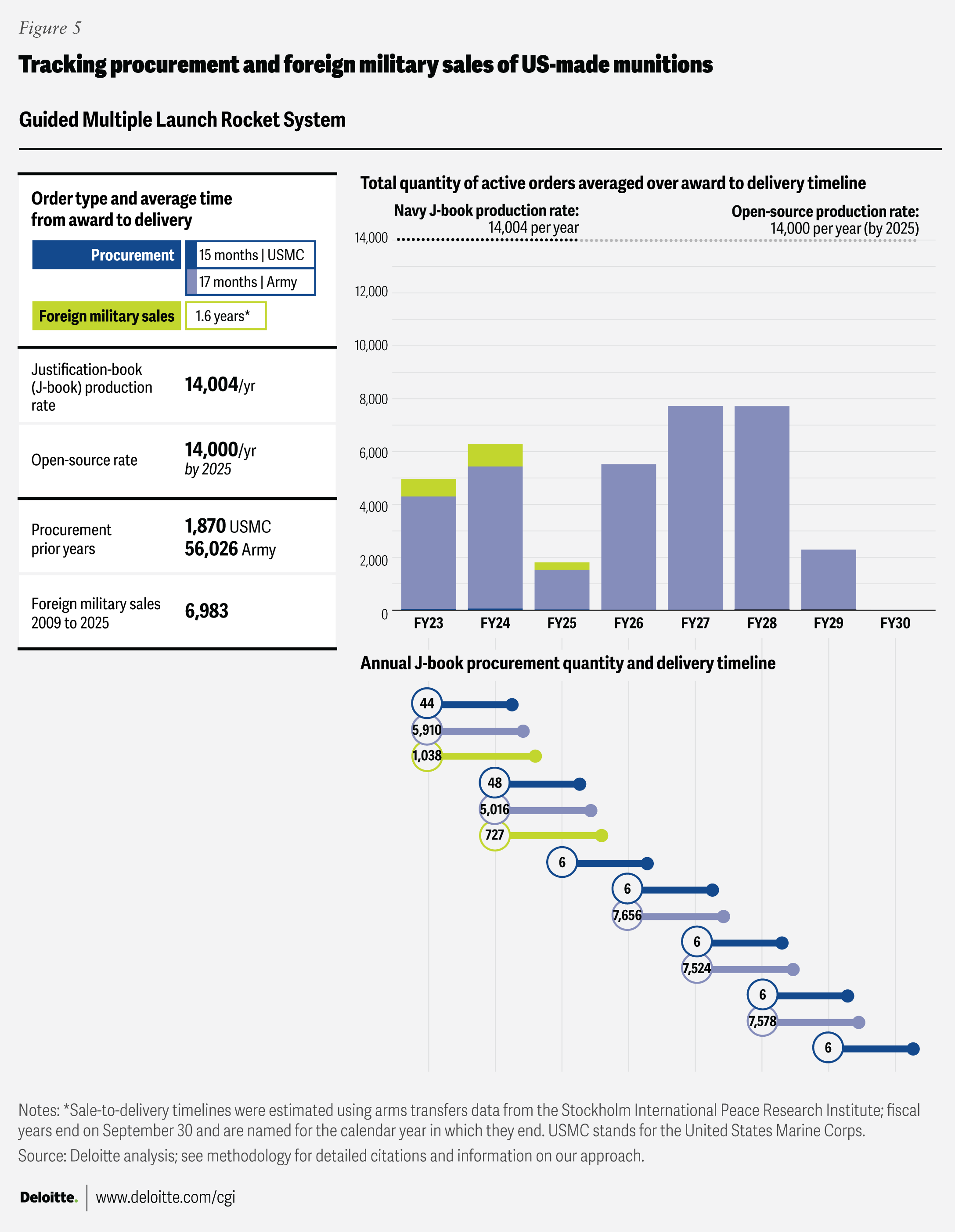
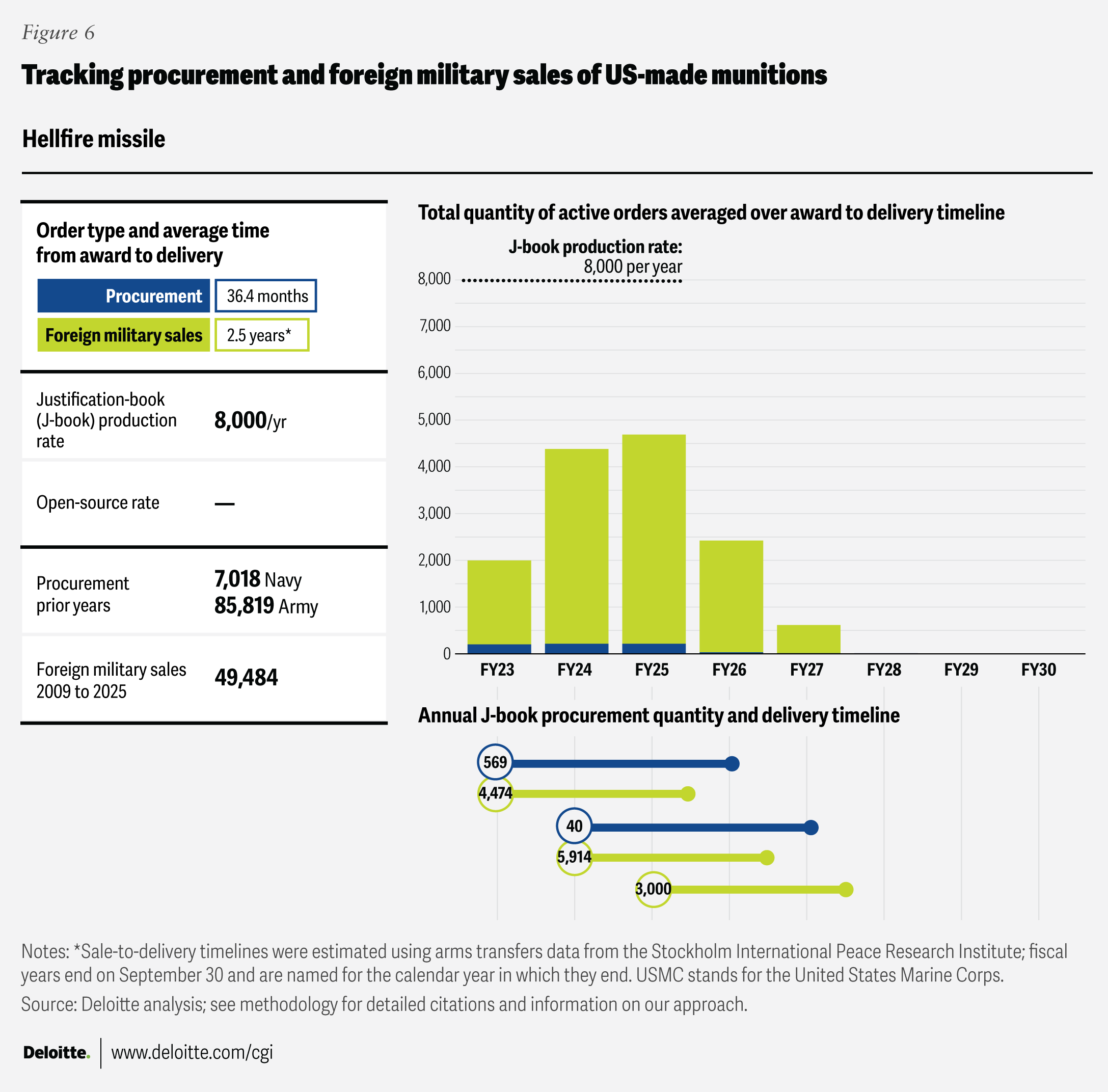
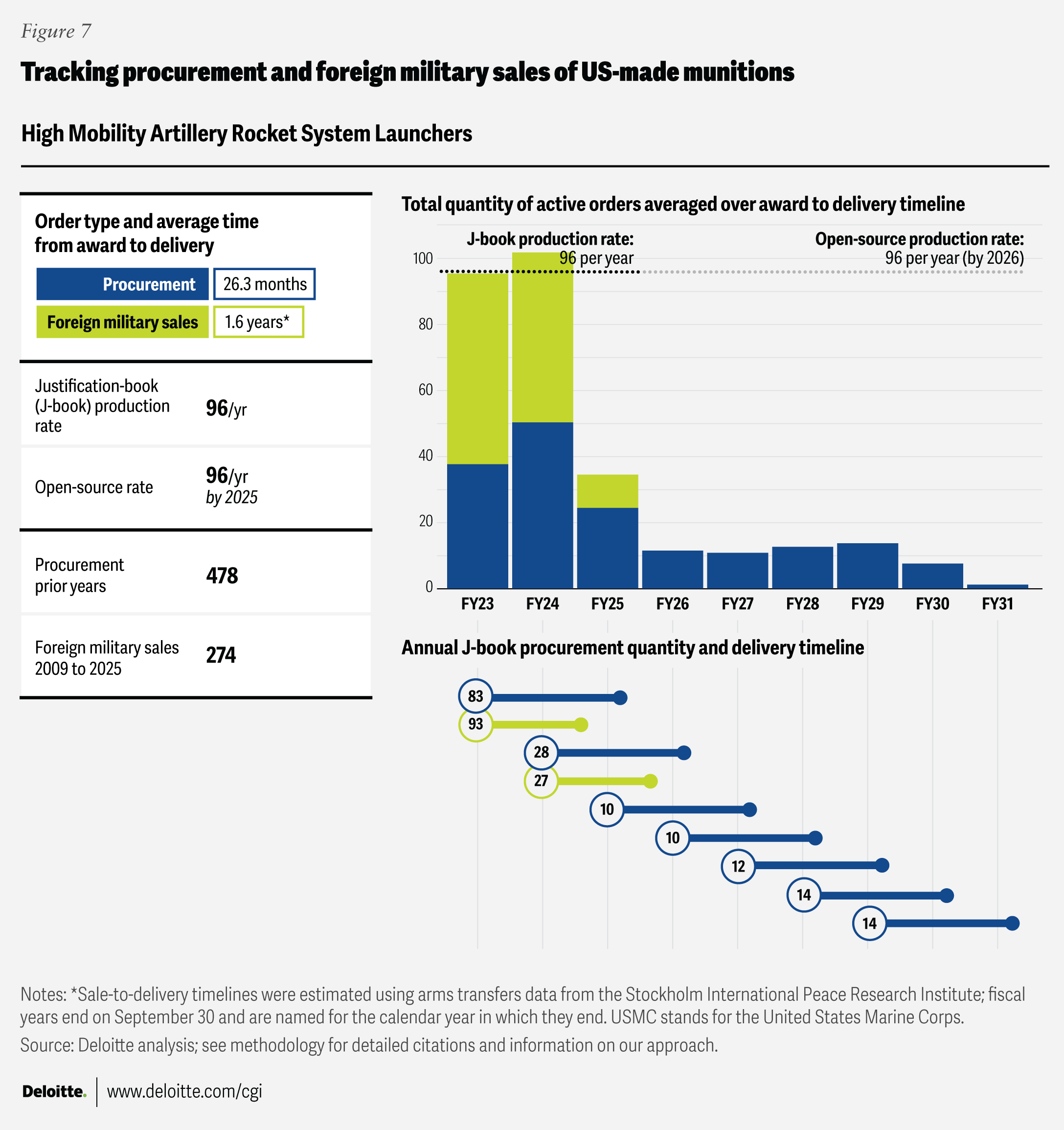
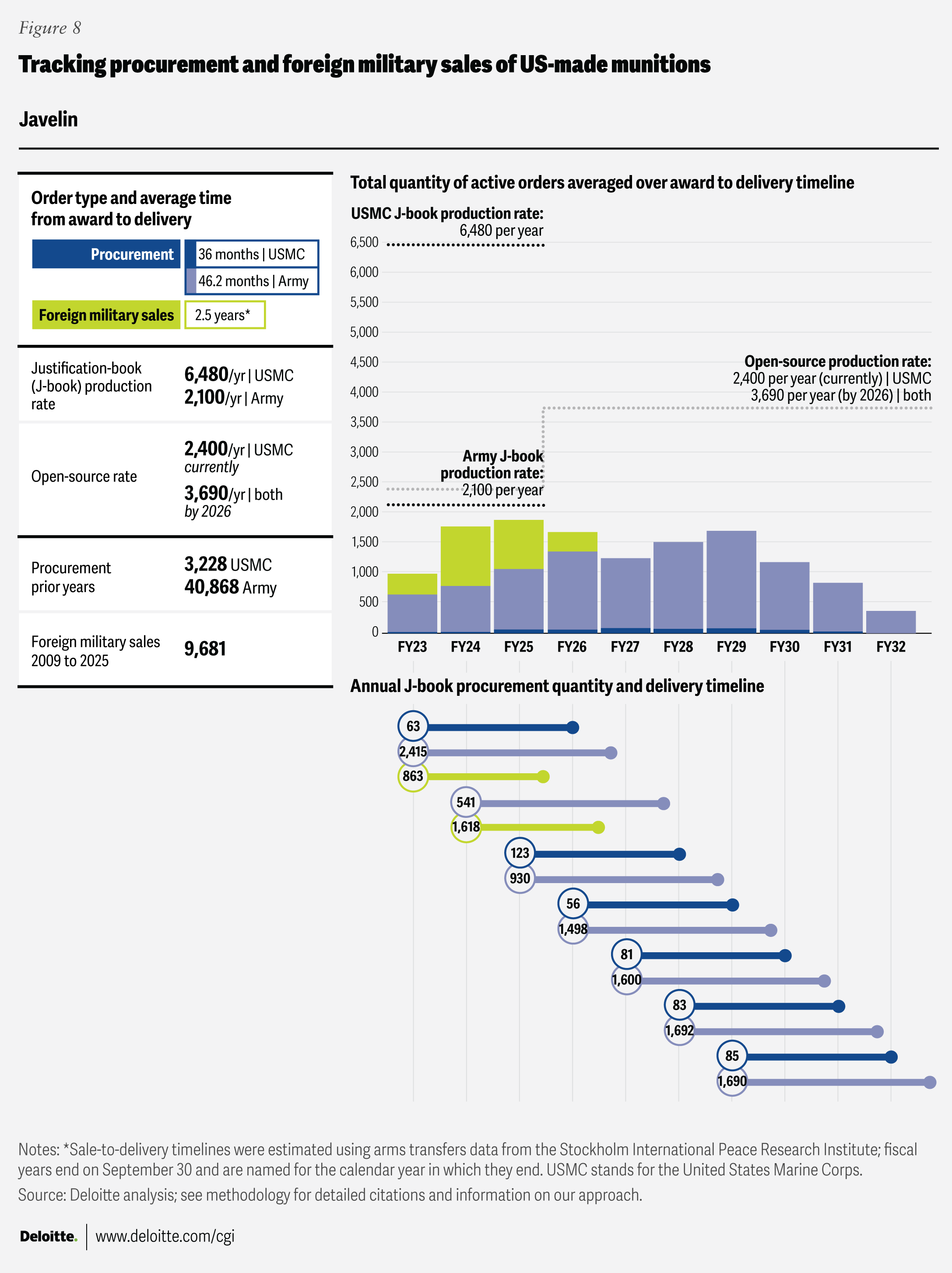
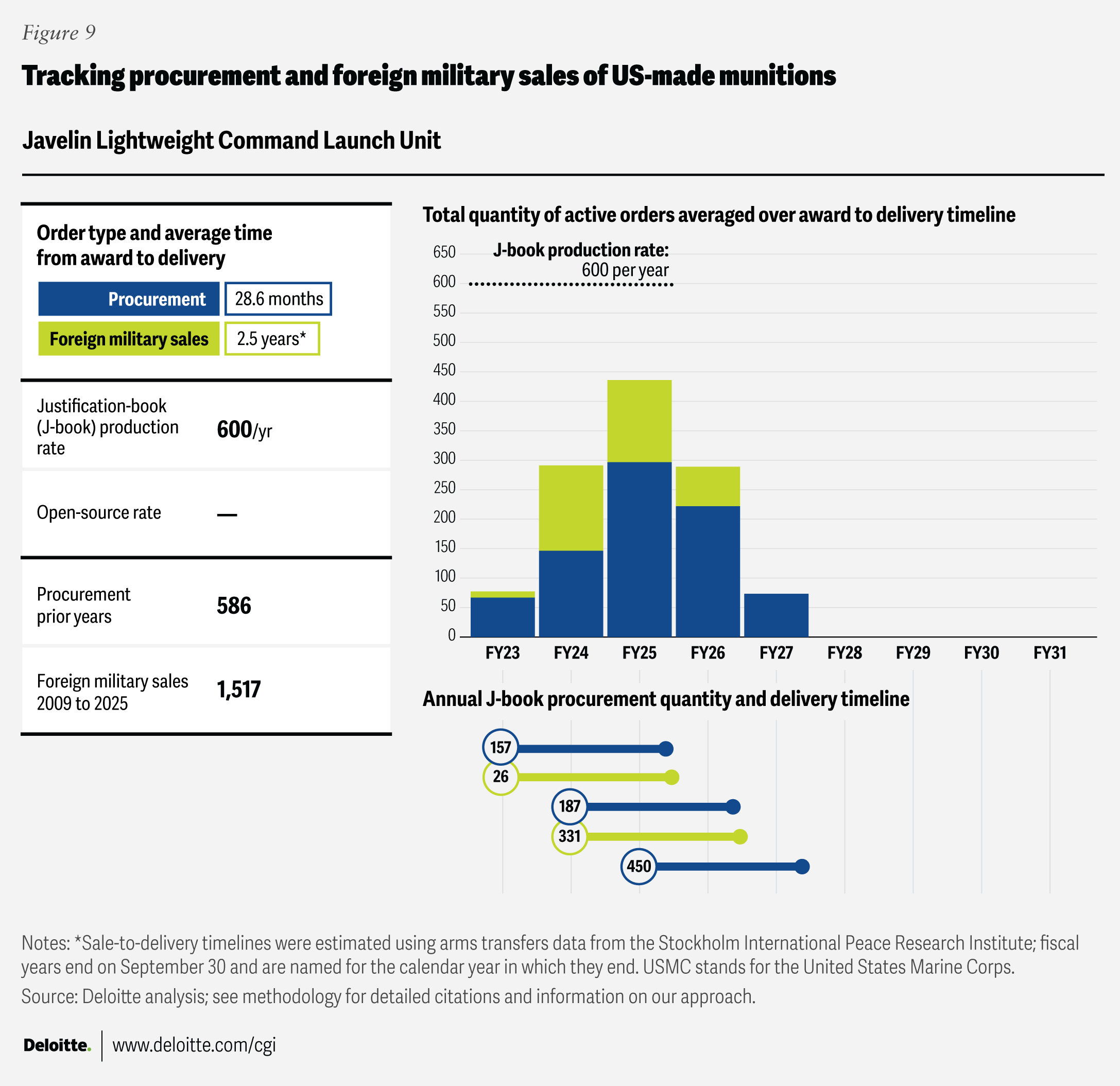
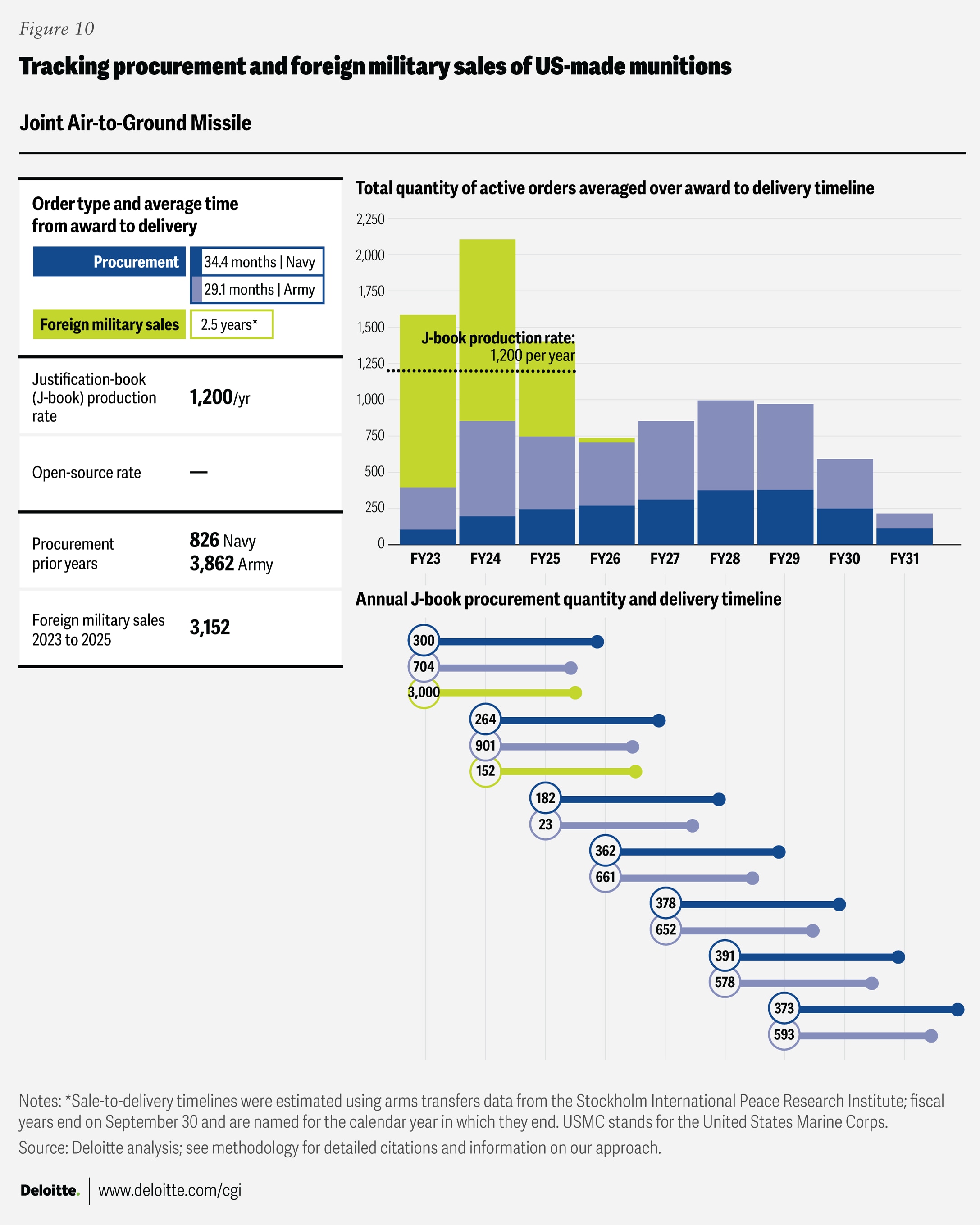
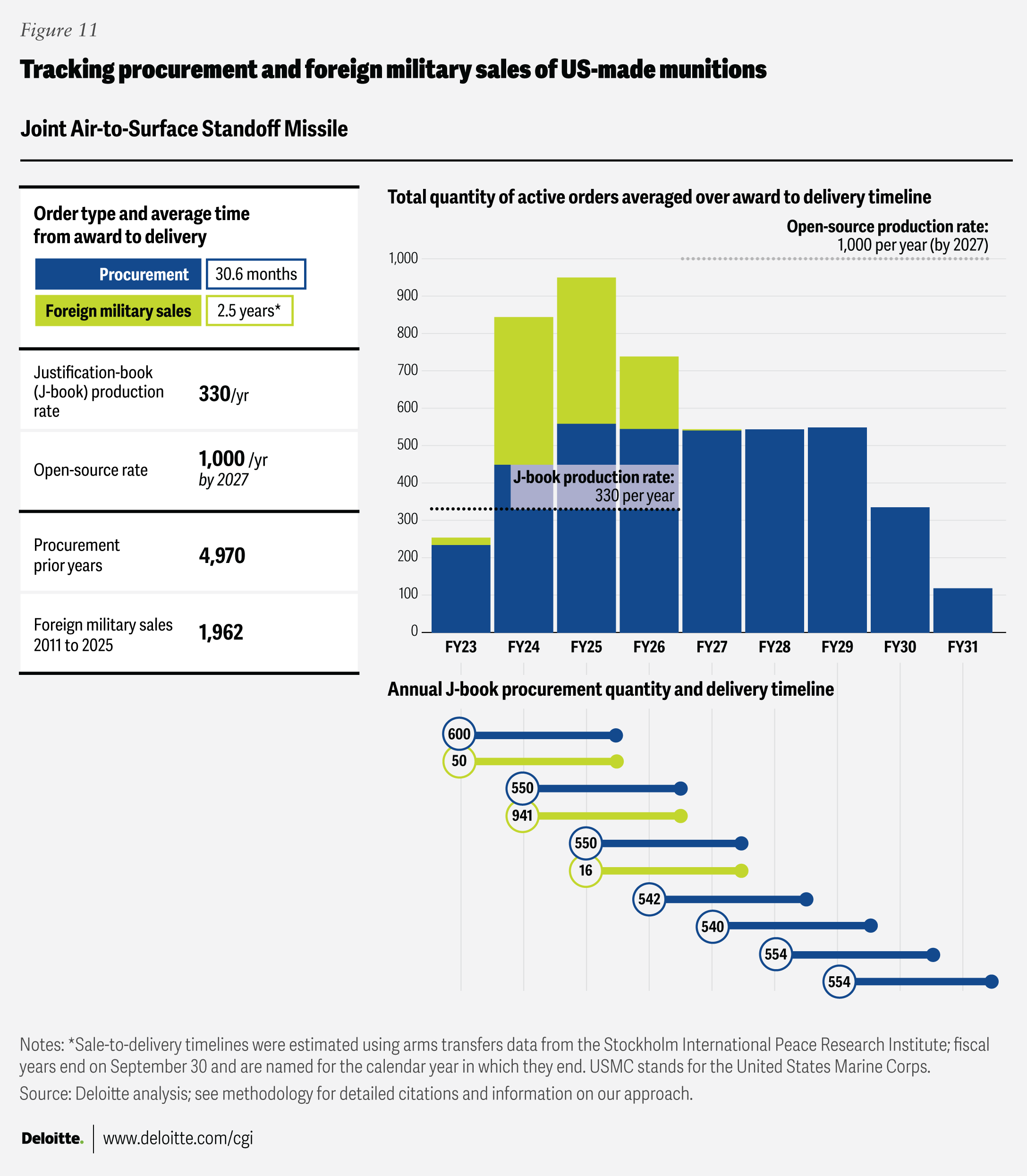
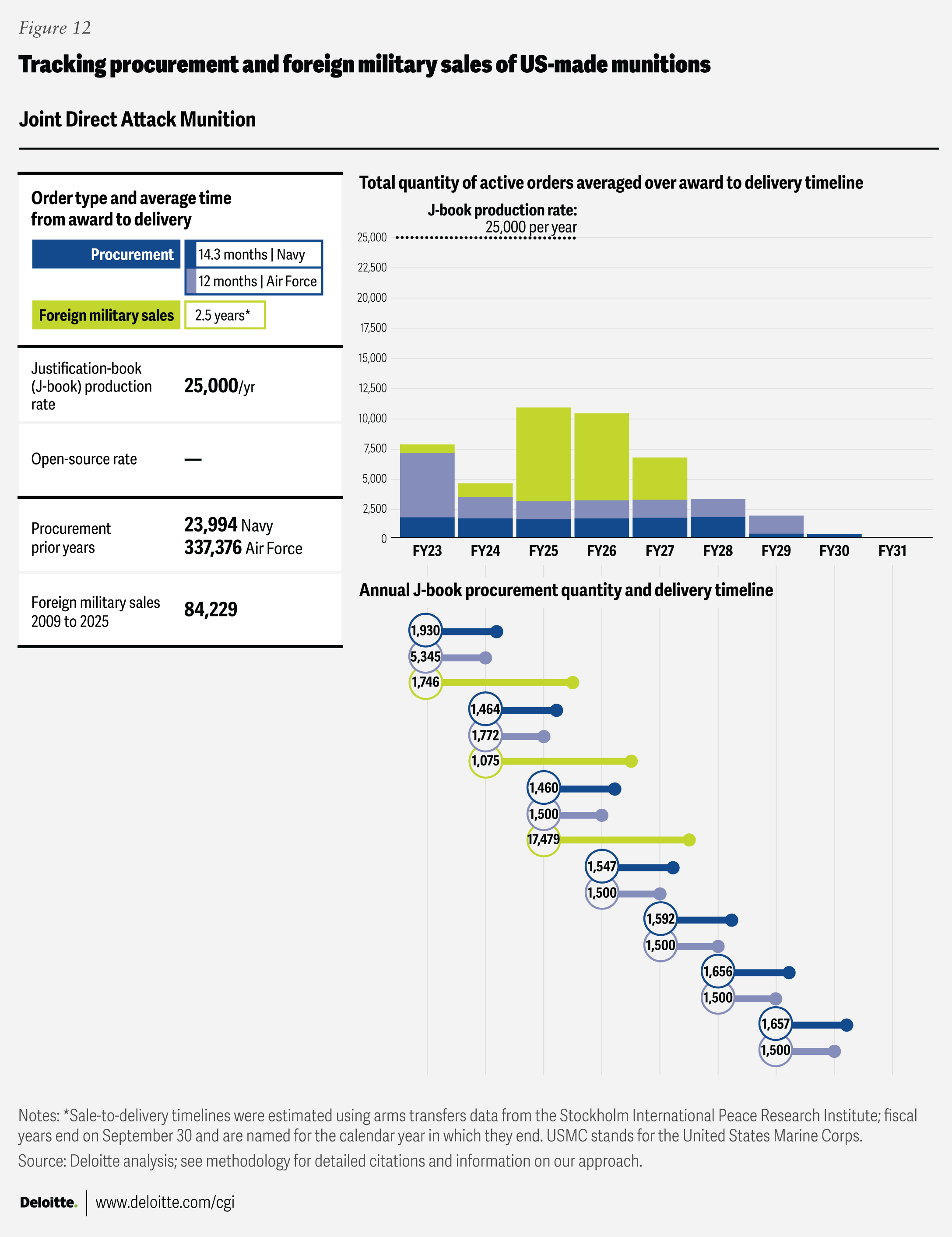
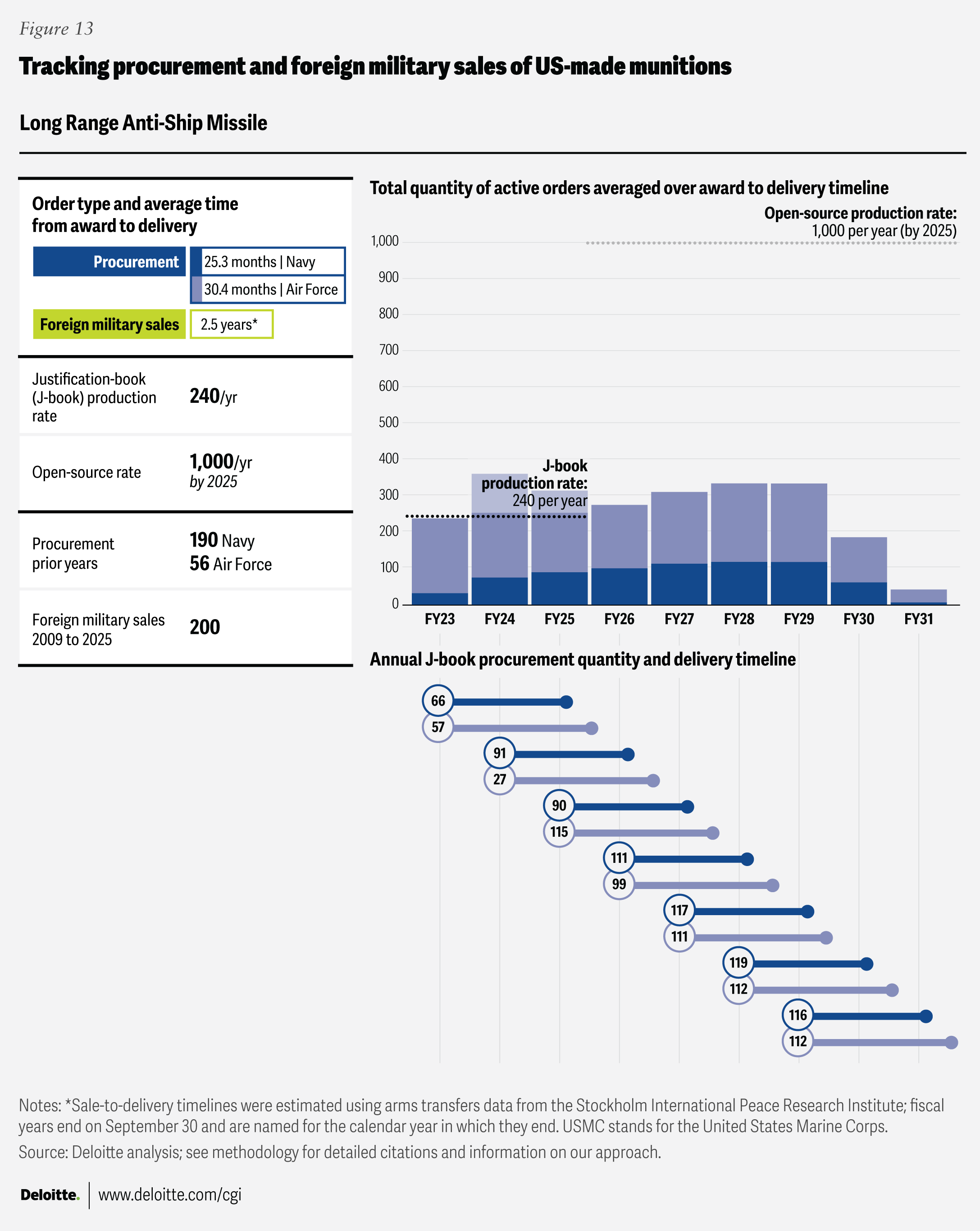
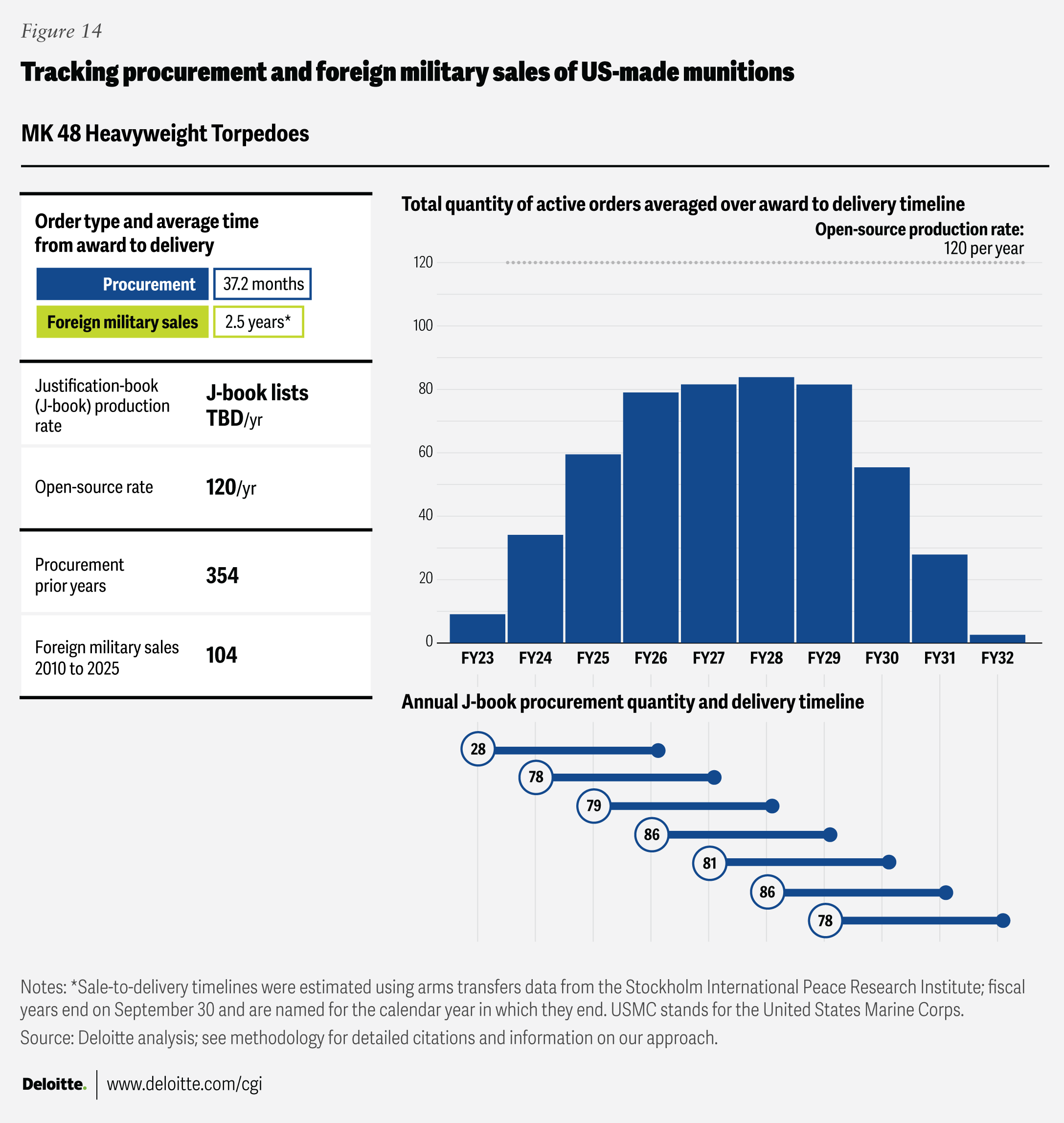
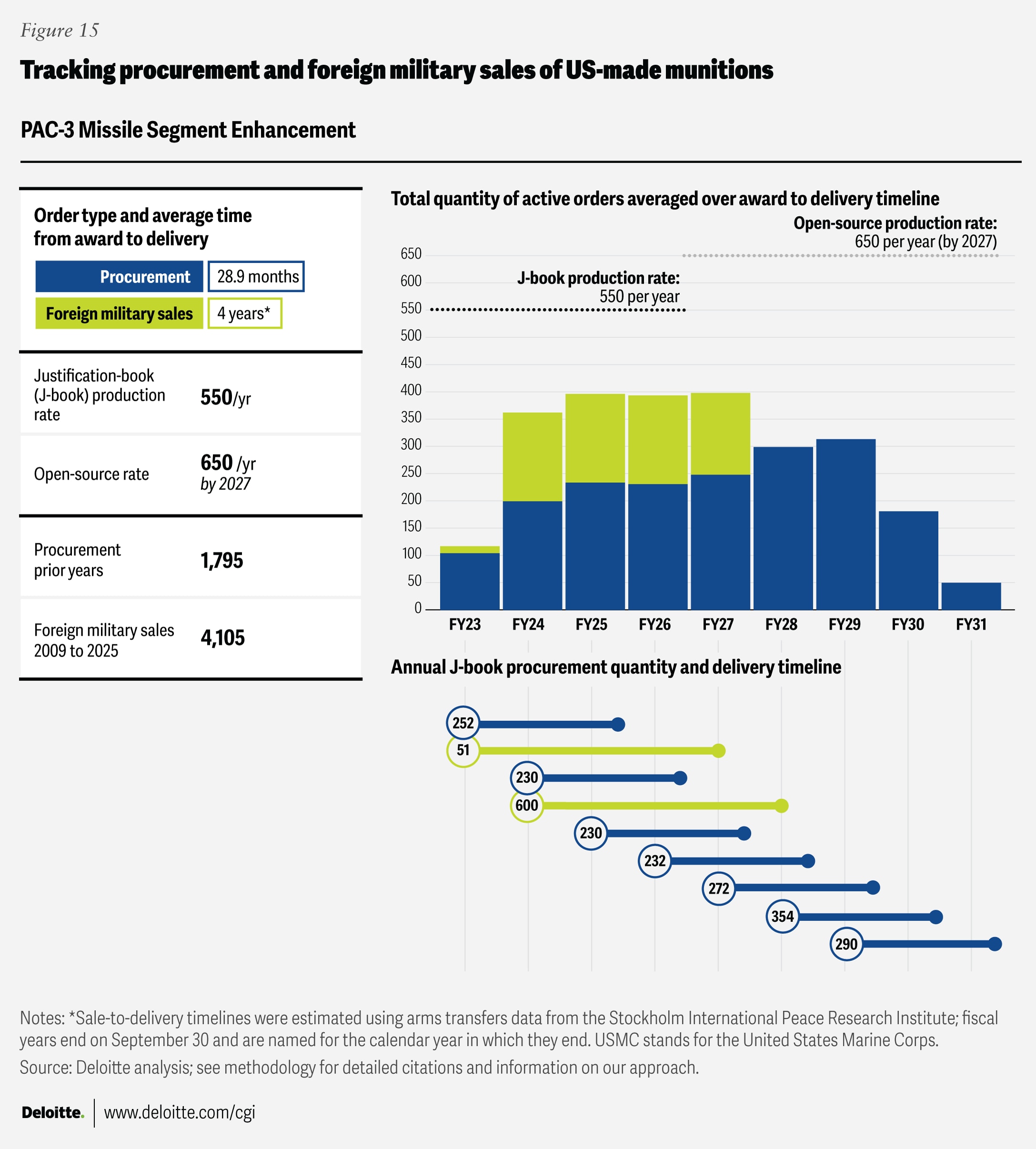
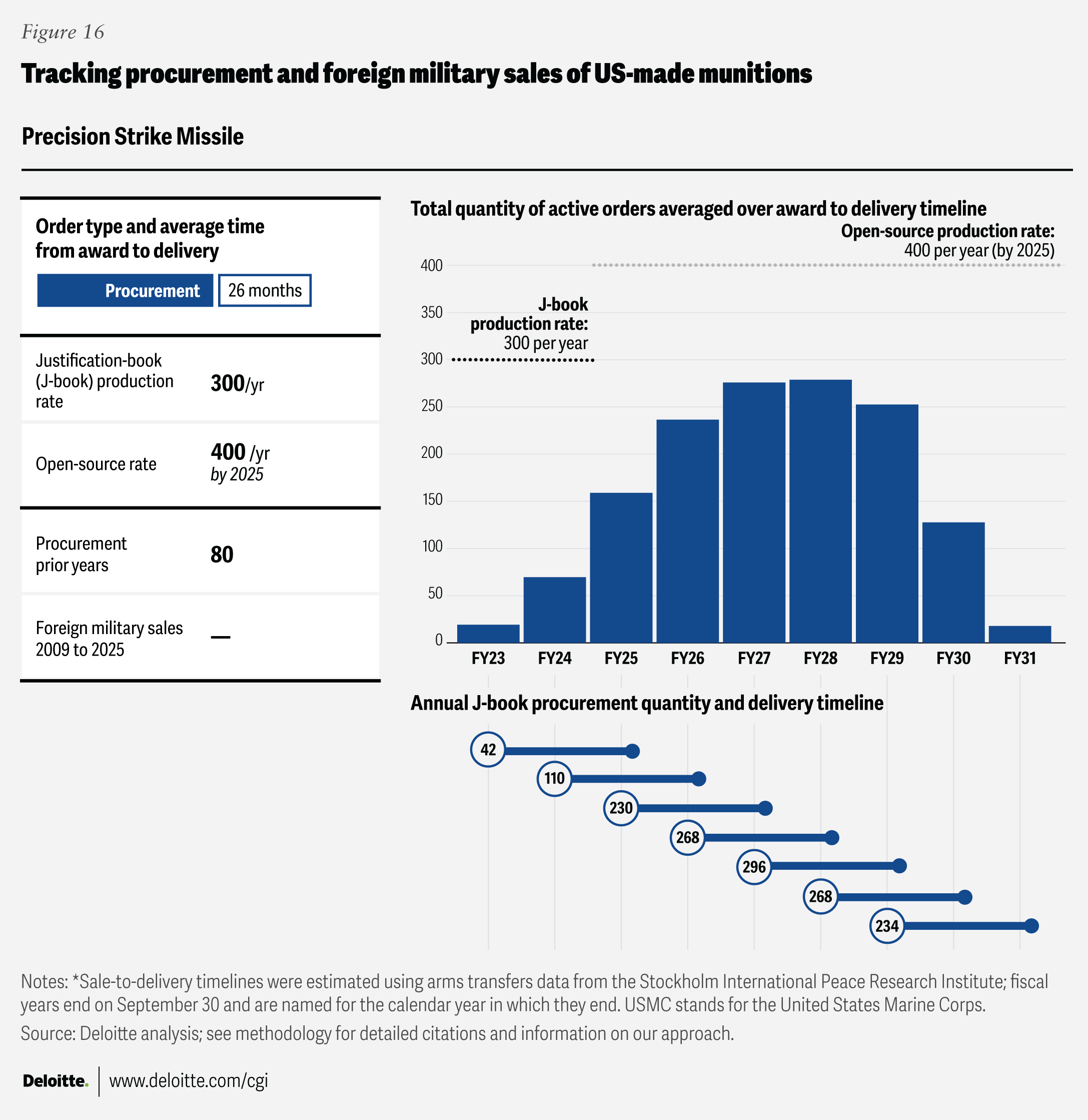
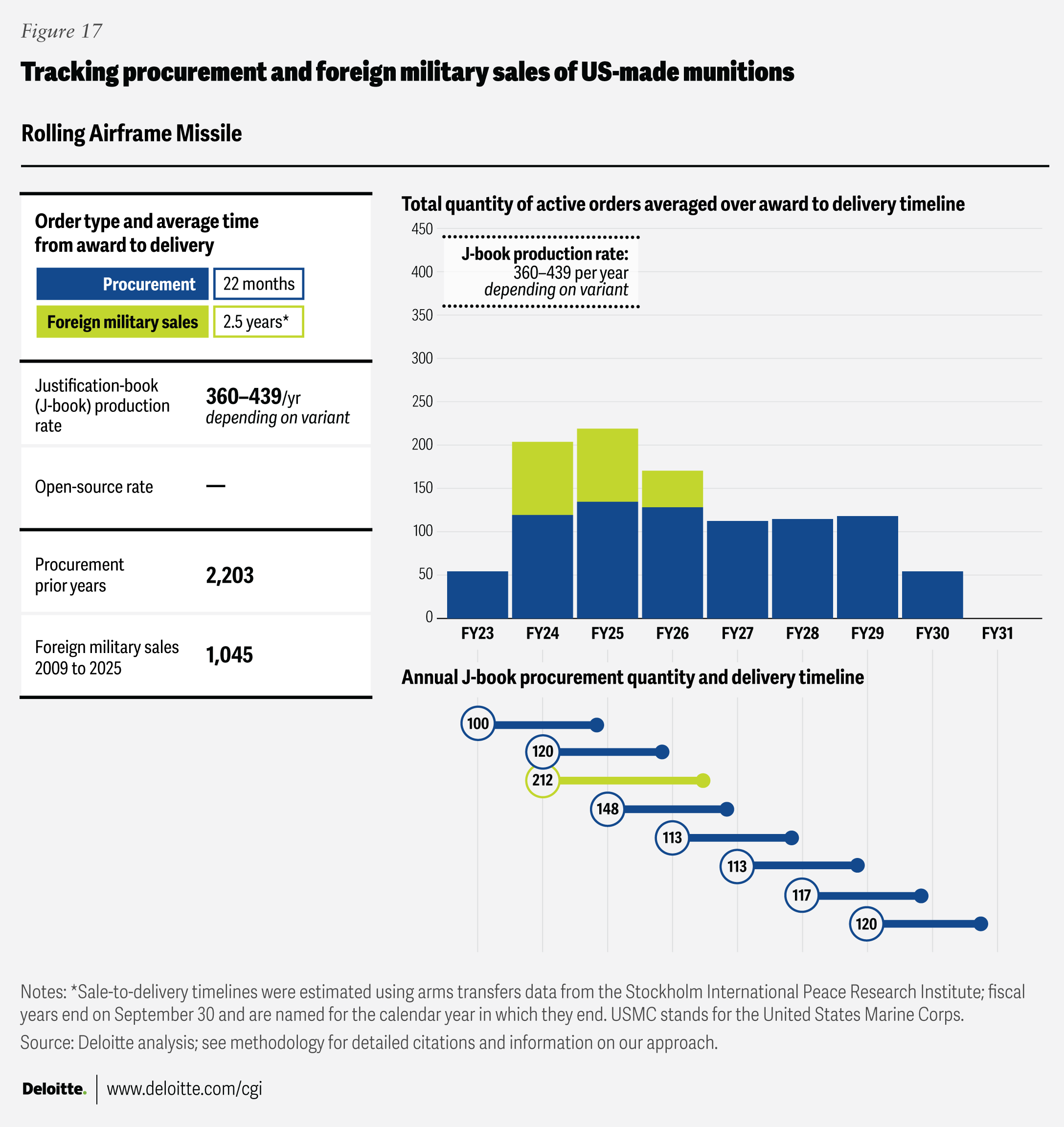
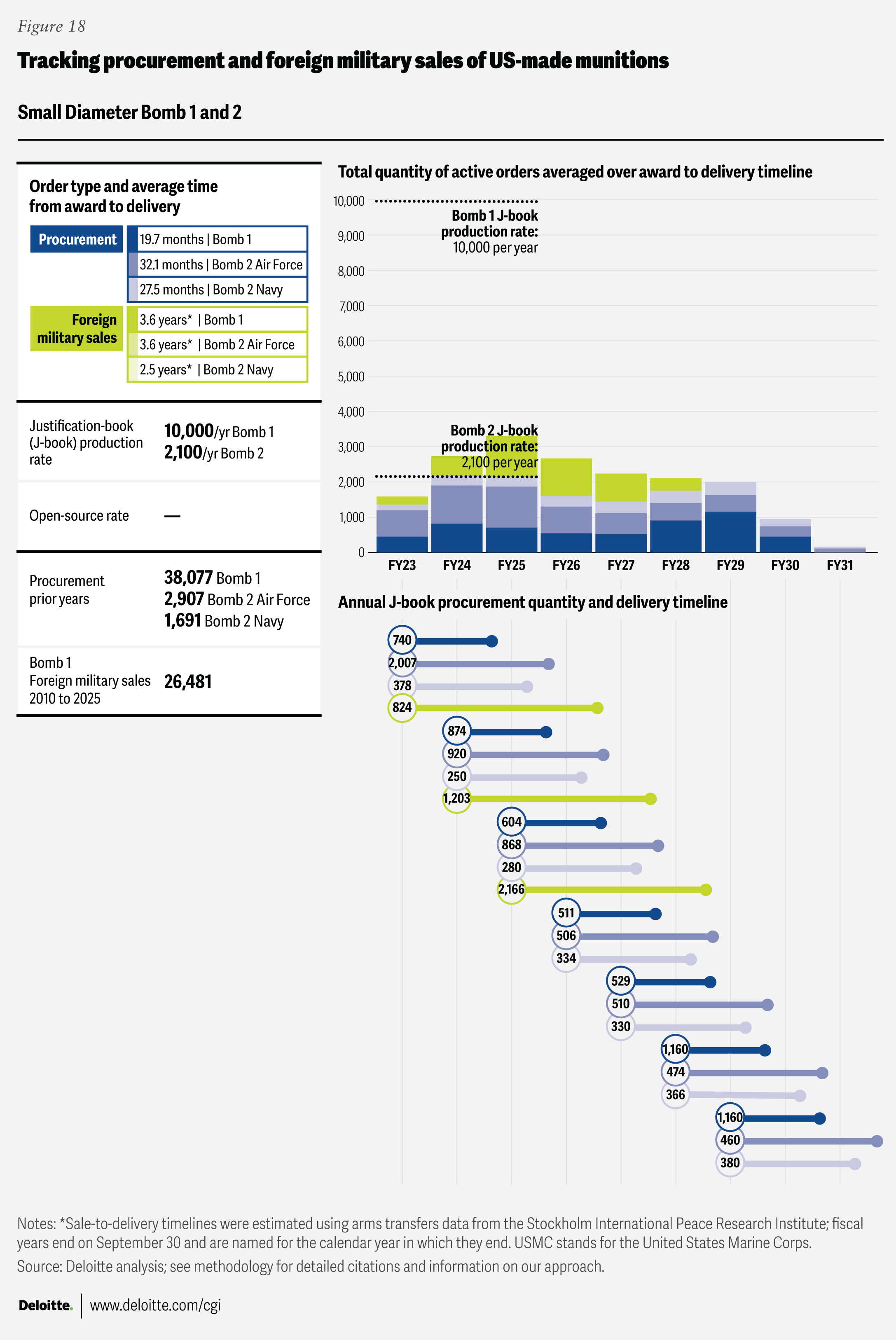
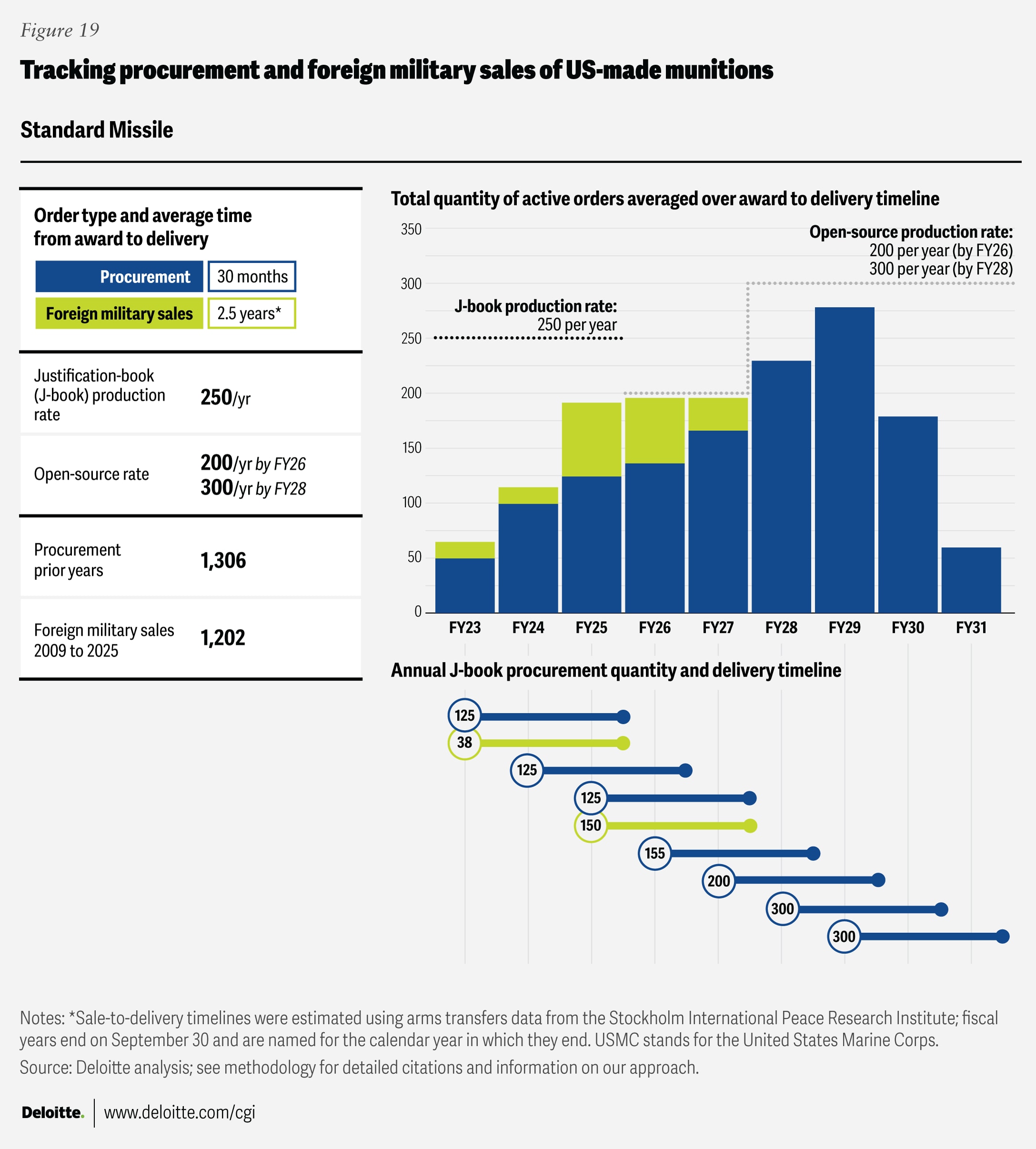
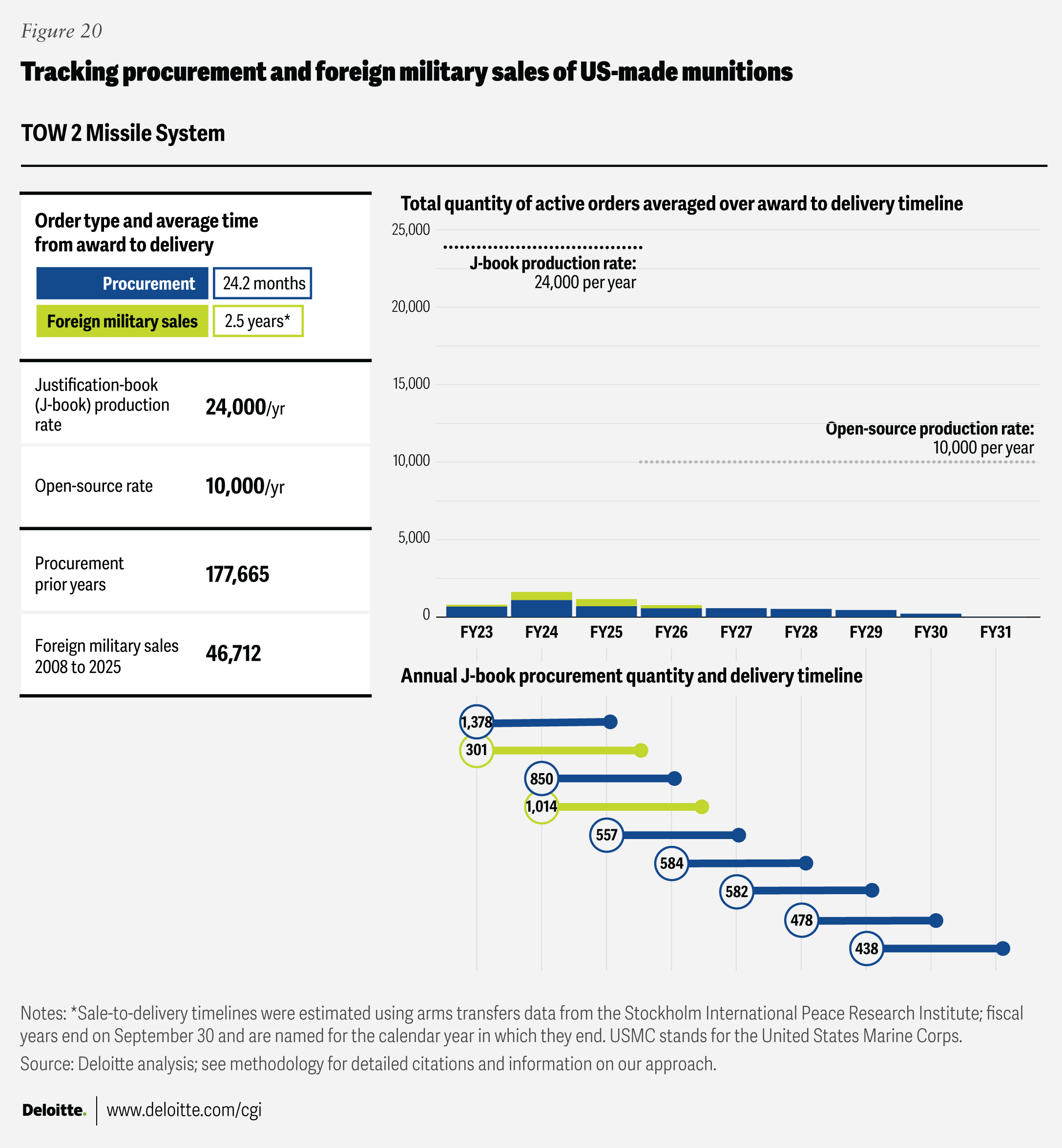
To help illuminate some of the activities shaping the defense industrial base, the Deloitte Center for Government Insights compiled this open-source data into charts tracking procurement and foreign sales across 21 types of munitions. The resulting charts organize and visualize this data to show trends in demand and production over time. Because the Department of War plans and production targets can shift due to policy or budgetary changes, these charts are intended as a baseline snapshot. We plan to update them as new information becomes available. They are intended to inform ongoing discussions about munitions production and defense industrial base resilience by providing a clearer empirical foundation, not to advocate for specific policies or programs. For further details on sources and methods, please see the full methodology section below.
Methodology
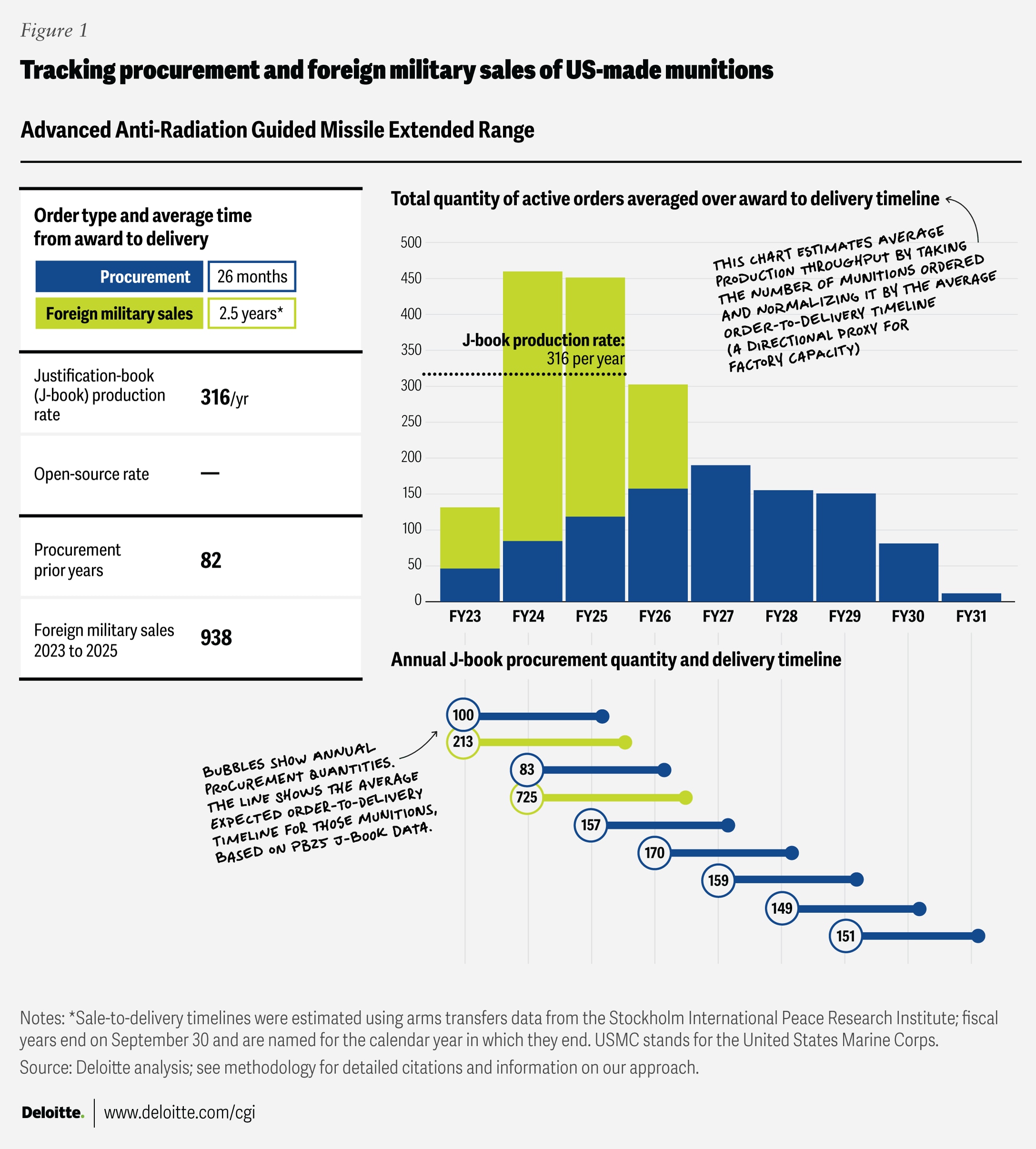
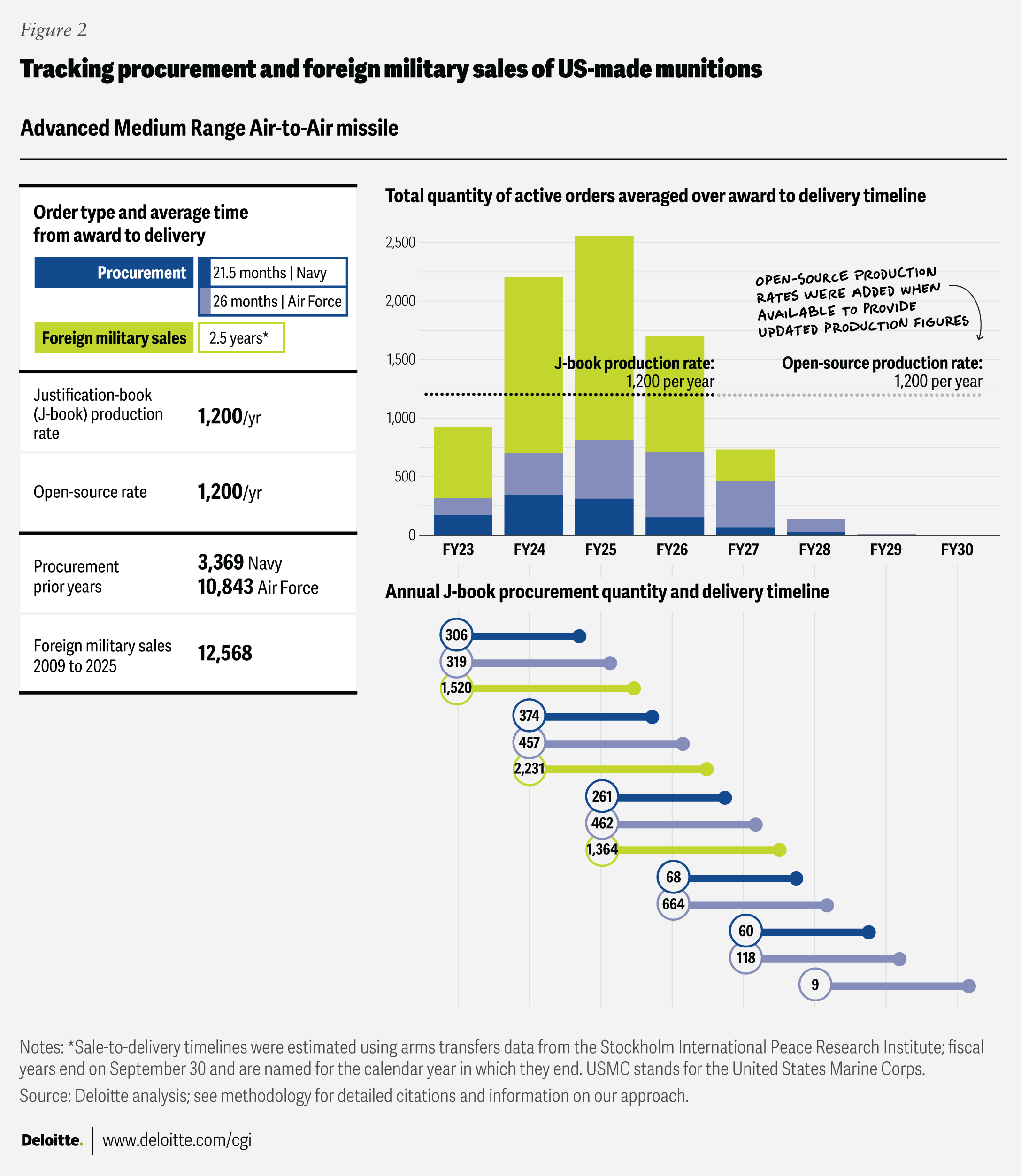
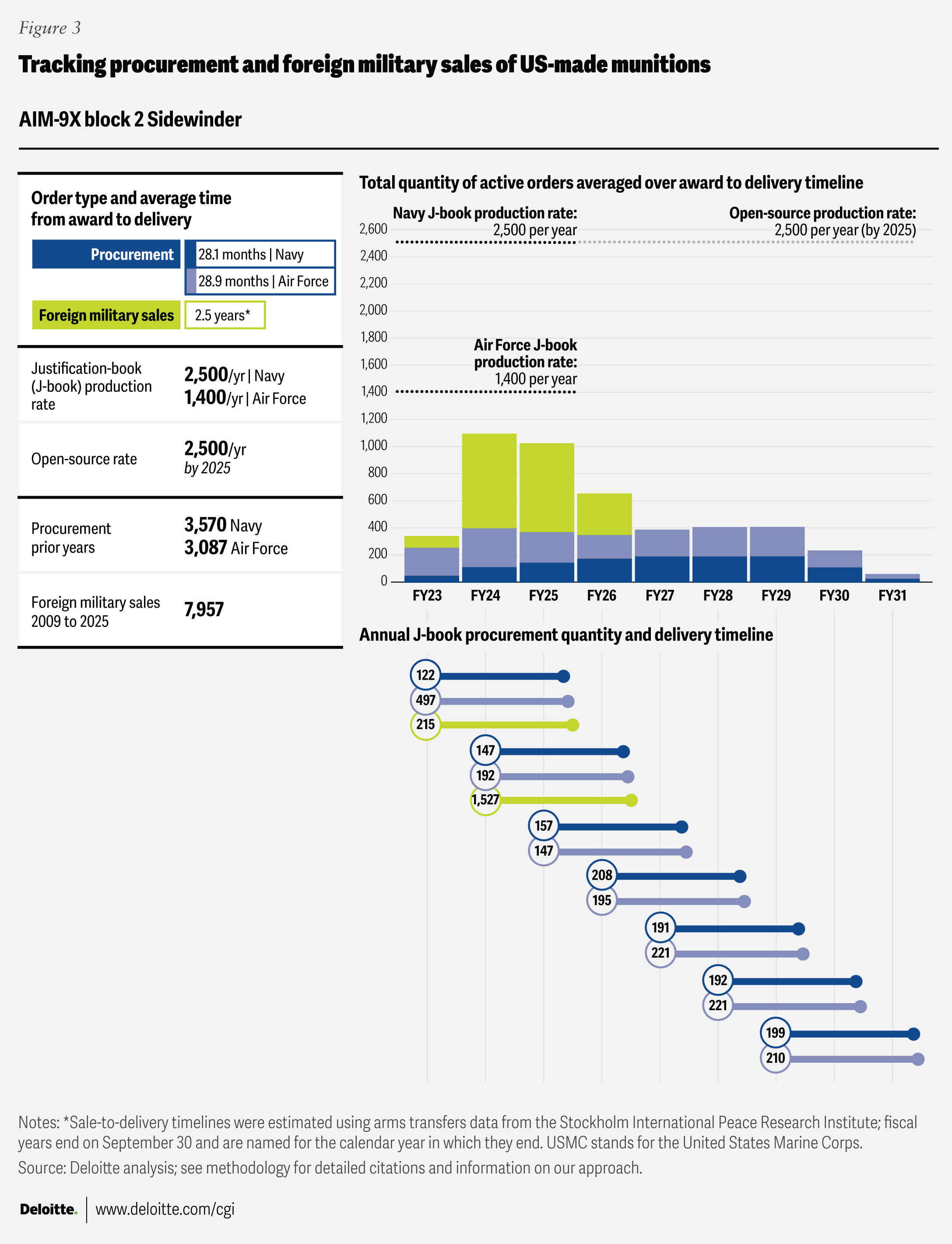
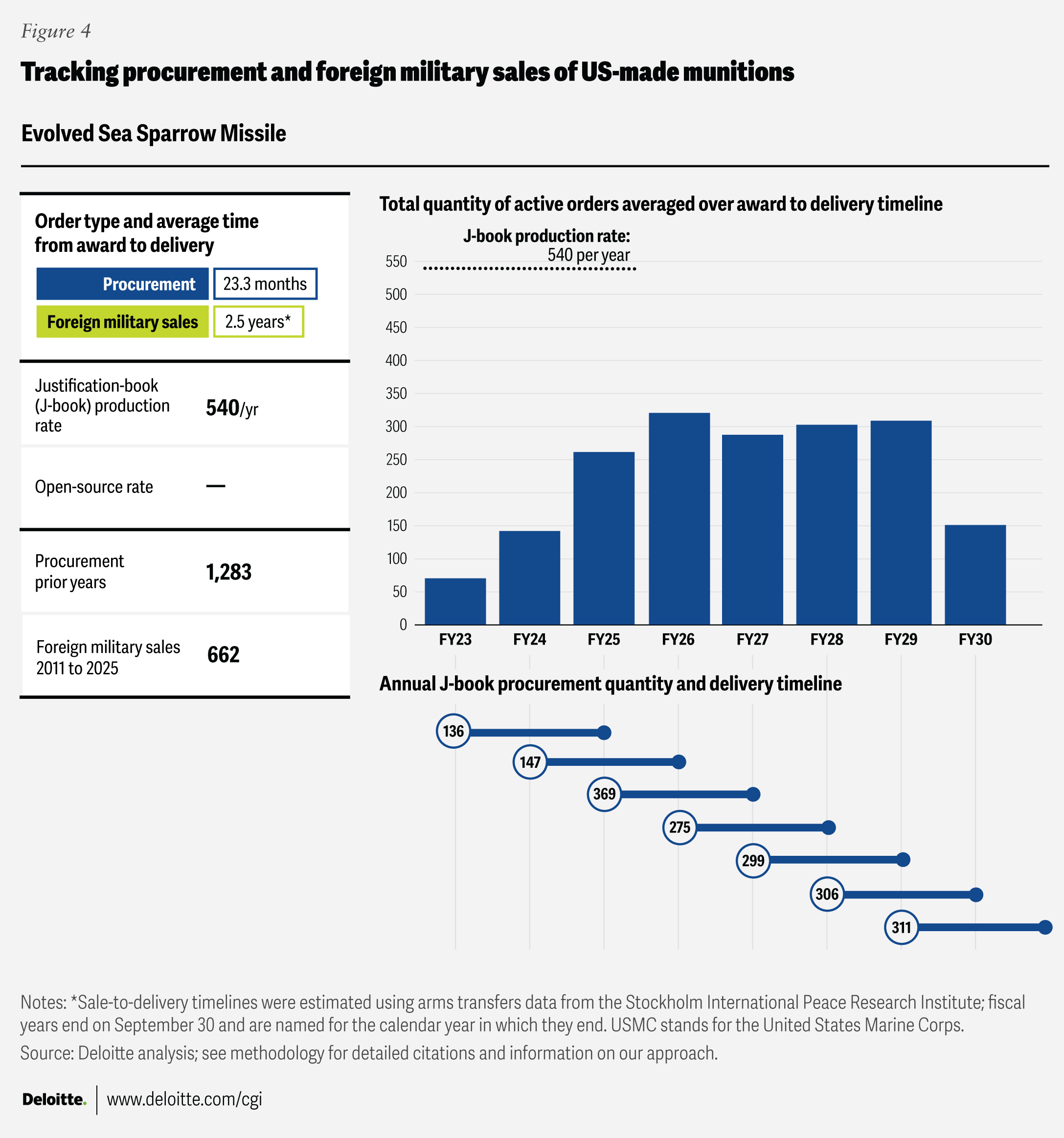
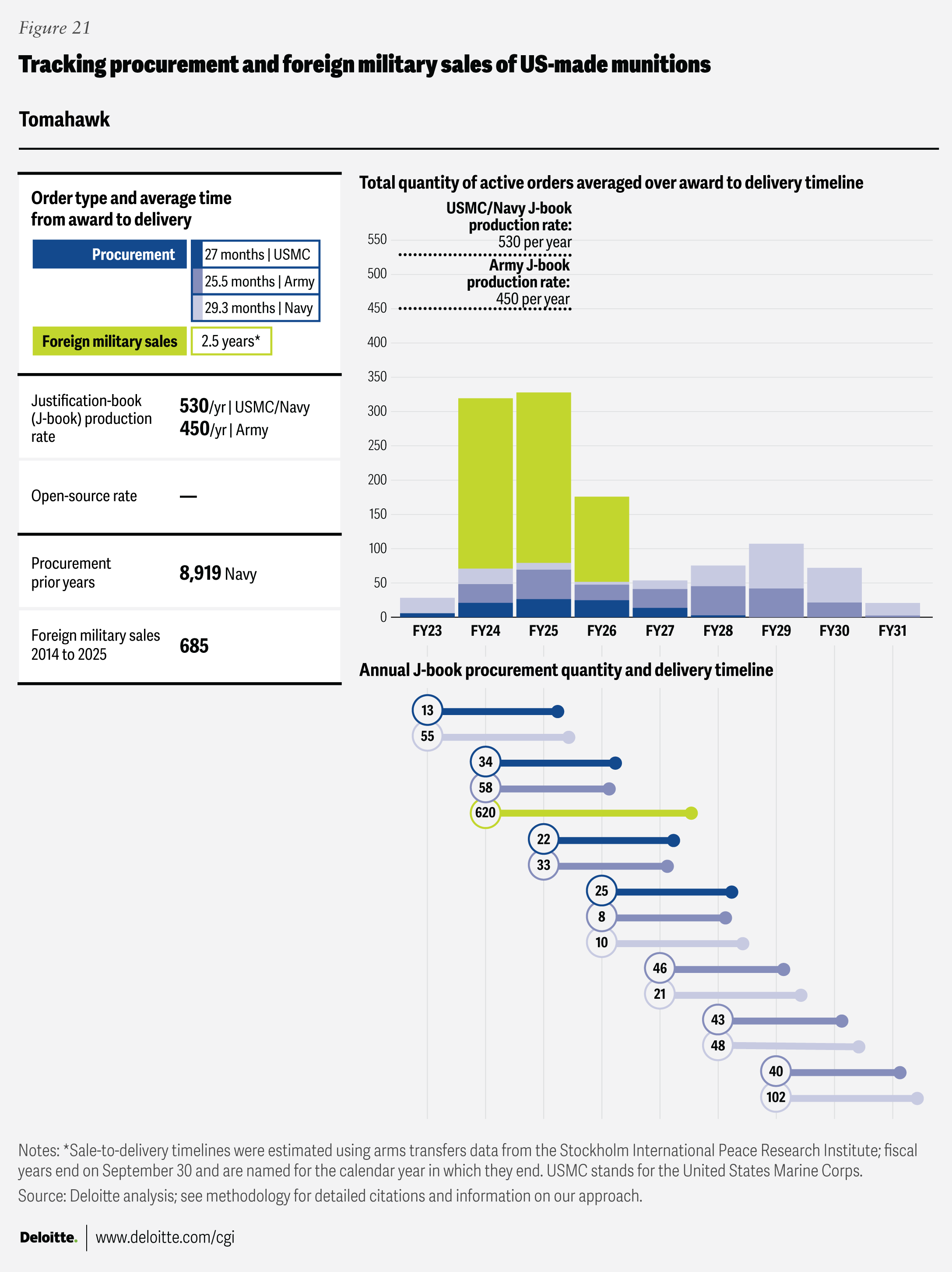
Data for J-book production rate, procurement all time, production timelines, and procurement quantities was compiled from the Department of War’s PB25 Justification books to provide a baseline view of recent trends in munitions procurement and delivery patterns. These measures capture only part of the end-to-end production system, but examining what was procured, how long delivery was expected to take, and the variability in these data helps illustrate prospective throughput constraints that shape broader discussions about munitions requirements and production capacity. This analysis reflects the PB25 snapshot and may not incorporate subsequent funding, contracting, or industrial-base changes; it should not be used to forecast future production or delivery performance.
Where “open-source production rates” are cited, the figures come from publicly available sources listed in the endnotes section. Foreign military sales quantities were drawn from the Defense Security Cooperation Agency, and average foreign military sales award-to-delivery timelines were calculated using data from the Stockholm International Peace Research Institute’s Arms Transfers Database. Blank fields indicate that no data was available in the relevant J-book or other open-source references.
The average time from contract award to delivery for US procurements was calculated using J-book Exhibit P-5a in the Department of War’s President’s Budget 2025 (PB25) Justification books. Award-to-delivery timelines are often impacted by, among other things, operational requirements, contract structures, testing, manufacturing capacity, production efficiency, and fiscal choices (for example, single- vs multiyear awards and budget constraints). To approximate overall production capacity, the award-to-delivery averages were used to spread total procurement quantities across the delivery window in the chart titled “Total quantity of active orders averaged over award to delivery timeline.” Specific production schedules vary by munition and program.
This document contains general information only and Deloitte is not, by means of this document, rendering accounting, business, financial, investment, legal, tax, or other professional advice or services. This document is not a substitute for such professional advice or services, nor should it be used as a basis for any decision or action that may affect your business. Before making any decision or taking any action that may affect your business, you should consult a qualified professional advisor. Deloitte shall not be responsible for any loss sustained by any person who relies on this document.
As used in this document, “Deloitte” means Deloitte Consulting LLP, a subsidiary of Deloitte LLP. Please see www.deloitte.com/us/about for a detailed description of our legal structure. Certain services may not be available to attest clients under the rules and regulations of public accounting.
Copyright © 2026 Deloitte Development LLC. All rights reserved.
Continue the conversation
Meet the industry leader
Mark Cotteleer
by
Mark Cotteleer
Adam Routh
Thirumalai Kannan
Joe Mariani
This project would not have been possible without the incredible data visualization and design work of Molly Piersol and Harry Wedel. The authors would also like to thank the Deloitte Insights team for their editorial and publication support, including Annalyn Kurtz and Sayanika Bordoloi.
Editorial (including production and copyediting): Annalyn Kurtz, Sayanika Bordoloi, and Pubali Dey
Design: Sonya Vasilieff, Molly Piersol, and Harry Wedel
Cover image by: Sonya Vasilieff; Shutterstock
Knowledge Services: Vanapalli Viswa Teja
Visit the Deloitte Center for Government Insights
Access more insights for the defense, security and justice, government health care, state and local government, transportation and infrastructure, human services, and higher education sectors.