
Crossing boundaries to transform mission effectiveness
Government agencies are collaborating with other entities and the private sector to solve wicked problems, achieving a 10x boost in mission effectiveness.
Big problems like homelessness or climate change extend beyond the boundaries of any particular branch of government. These wicked problems require cross-boundary collaboration—between multiple government agencies, the private sector, nonprofits, and the communities most directly impacted, and sometimes across geographies, states, and even the globe.
For instance, homelessness is a cross-boundary problem. There are many reasons for homelessness, and no one government agency has a simple fix. Attempts by government and civic organizations to help often yield benefits, but they can be difficult to scale.
Coordinating among different organizational cultures, funding structures, and missions is no easy task. It requires systems thinking, looking at the relationships between people and organizations with competing priorities, and understanding the “structures” that underlie complex situations.1 But cross-boundary missions can lead to dramatic, “10x-level” outcomes:
- Between 1990 and 2003, the Human Genome Project mapped the human genome—a groundbreaking achievement with massive benefits for biological research, medicine, and pharmaceuticals. Investing roughly US$3 billion, the US Department of Energy and the National Institute of Health tapped into a network of universities and research centers in 20 countries to achieve this invaluable feat.2
- Since 2011, the city of Houston, Texas, has reduced homelessness by 64%, thanks to a collaborative effort of more than 100 organizations working together on a shared goal.3
- India’s Mission Shakti program aims to empower women through local partnerships by providing employment opportunities and financial security. The program has successfully created over 7 million female entrepreneurs.4
- The US Department of Health and Human Services reports that the government has invested more than US$100 billion in US President's Emergency Plan for AIDS Relief (PEPFAR) till date to fight the HIV/AIDS epidemic. This investment has resulted in the prevention of millions of HIV infections and saved over 25 million lives.5
Few problems respect organizational boundaries. A prime example of this is recidivism, where the successful reintegration of an individual back into society involves a multitude of organizations. Interventions may begin during incarceration, with in-prison counseling, education, and work experience. Upon release, the individual may require additional support from the government, such as mental health services, substance-abuse counseling, housing, or job training. Helping released individuals find social connections and jobs in the community may involve nonprofits, churches, and businesses. No single agency—not even the government alone—can address all these tasks.6
Complex challenges are often best addressed by working across different organizational boundaries. However, collaboration between government agencies is not always easy, as funding streams, legislative authority, and operational hierarchies tend to encourage silos that isolate agencies.7 Governments are developing mechanisms to break down these barriers and collaboratively tackle thorny problems.
Breaking trade-offs
Traditionally, lowering costs would mean compromising on quality or slowing down speed. Similarly, achieving improvements in quality would result in higher expenses. To accomplish a 10x boost in performance, leaders must break the constraints of traditional trade-offs. This may involve leveraging technology to minimize the cost of serving clients, partnering with organizations that already offer a service, or relinquishing complete control—and credit—to collaborate. Sharing responsibilities across bureaucratic boundaries can make room for exponential growth. Governments can catalyze innovation and access additional resources to address a problem by tapping into a network.8 Consider these approaches that break the “iron triangle” (cost, speed, and quality) model of service delivery trade-offs:
- Financial incentives: Initial seed or matching funding from the government can attract nonprofit, academic, and corporate investment, multiplying each dollar’s impact.9
- Skills marketplace: Specialists in some specific topics may not be readily available within the public sector, especially in just one department. Collaborative efforts gather a range of key skills that can be difficult (and expensive) to hire.
- Trust amplifiers: The government can reach wary constituents by collaborating with organizations that have preexisting trusting relationships.
- Multiplier effects: A network increases in value with every new participant. Creating a network of stakeholders can start a virtuous cycle. Depending on the problem, it may even be possible to build a self-propelling market that drives toward a solution on its own momentum.
Convergence: A key to 10x change in mission effectiveness
Several tools and tactics can improve cross-boundary collaboration. Certain innovations like cloud-based data-sharing, common application programming interfaces, and new funding models make it easier for partners to steer distinct organizations toward common goals. Other tools like data analytics, ecosystem mapping, nudges, and artificial intelligence will help teams achieve those goals.
Leaders will find an impressive menu of tools to tailor to their specific problems. The public sector now has access to tools that, when used wisely, can make collaboration easier and more effective.
- Employer-designed training + talent matchmaking + wraparound support = Skilled workers with higher wages (see the Network2Work example below)
- Birth registration mobile app + interagency data-sharing = Easy birth registration (see the Singapore LifeSG example below)
- Skills training + partnership with banks + access to social networks = Boost in female entrepreneurship (see the Odisha Mission Shakti example below)
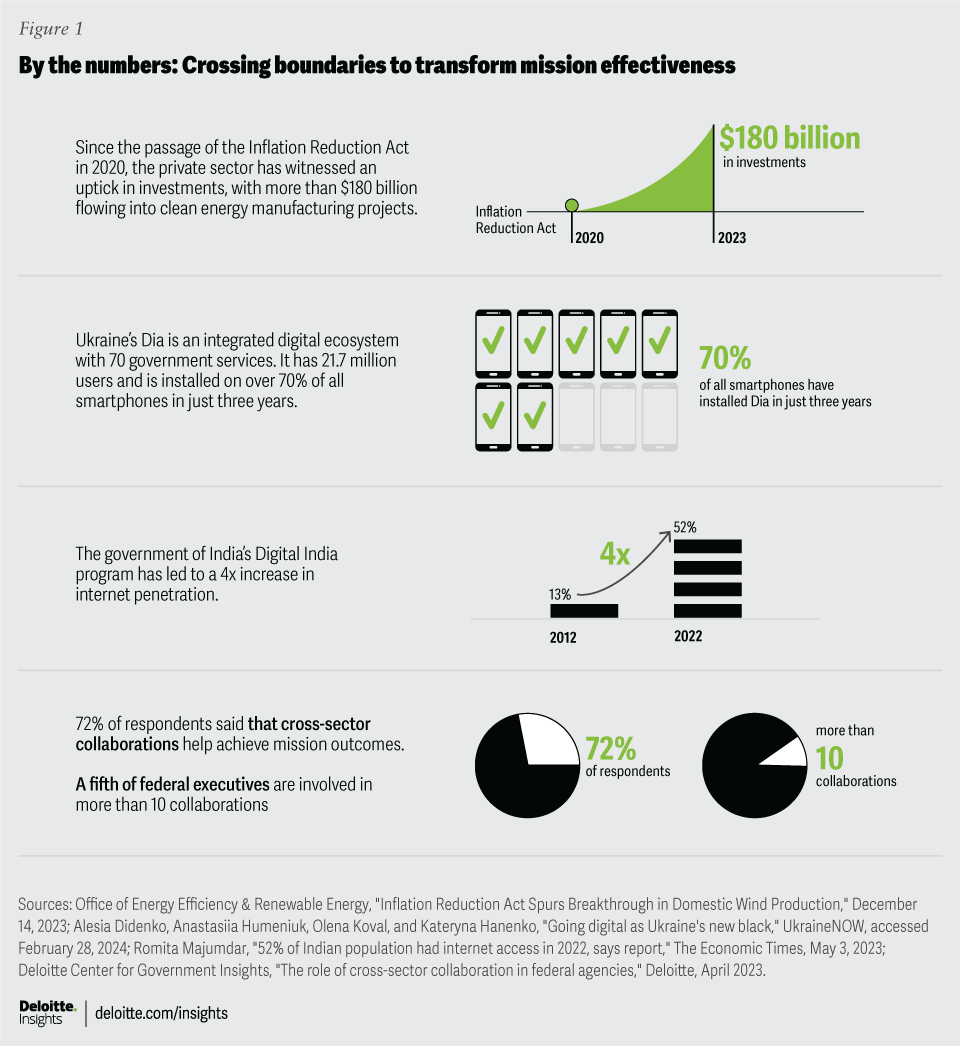
Trend in action
Governments are using several approaches to converge around cross-cutting problems. They are achieving better outcomes through three main strategies:
Tapping into boundary-breaking partnerships: Innovative partnerships bring together all stakeholders needed to address a complex problem—whether from different agencies, levels of government, the private sector, academia, or nonprofits. This sometimes means the objectives of programs need to be adjusted to catch up to new, shared definitions of success. One key boundary to break is who should be involved in helping to develop solutions. This so-called “co-production” involves engaging those experiencing a problem in designing a solution.
Using data and technology to focus shared efforts: Governments are building a robust digital infrastructure with data-sharing capabilities, enabling better collaboration among individuals and agencies working on the same problem.
Governance, measurement, and policy shifts to break down silos: Through shared governance, goal-based funding, and other policy shifts, the back-end structure of government can support coordination between stakeholders. When success is designed from multiple perspectives, solutions can address all aspects of a problem and avoid a “one-size-fits-all” definition of success.
Tapping into boundary-breaking partnerships
Myriad problems faced by the government are not confined to the boundaries of individual government agencies. They arise from market forces, dynamic relationships, and entrenched habits. Solutions then require multiple actors to collaborate across a range of disciplines, both within and outside government.
By breaking down silos and encouraging interconnectedness, many governments have achieved 10x improvements on these complex problems.
United Arab Emirates’ Government Accelerators program brings together private and public sectors for innovative solutions
In 2016, the United Arab Emirates launched the Government Accelerators program led by the former assistant director general for Strategy and Innovation at the prime minister’s office. The program focuses on cross-boundary issues and brings together teams comprising participants from various government agencies, the private sector, and academia.
These teams work on 100-day challenges to develop potential solutions with a sense of urgency, exercising full autonomy to experiment without interference from leadership. On the 50th day, the teams are expected to show progress, and on the 100th day, they present results with ideas to sustain and scale impact. The program’s approach has yielded impressive results, with participating teams successfully addressing diverse issues such as road safety and newborn services.
One team aimed to reduce traffic deaths on the country’s high-risk highways, and the team comprised local officials, road engineers, police, and ambulance drivers. It developed a solution that included road redesign, highway radar, social media awareness campaigns, and faster first-response strategies. At the end of the 100-day challenge, the accelerator team had reduced traffic deaths by 63%.
In 2021, the success of the United Arab Emirate's Government Accelerators inspired the World Health Organization to adopt a similar model to speed up the achievement of its strategic goals.10
Building a strong workforce development ecosystem: The importance of reskilling and coordination among key players
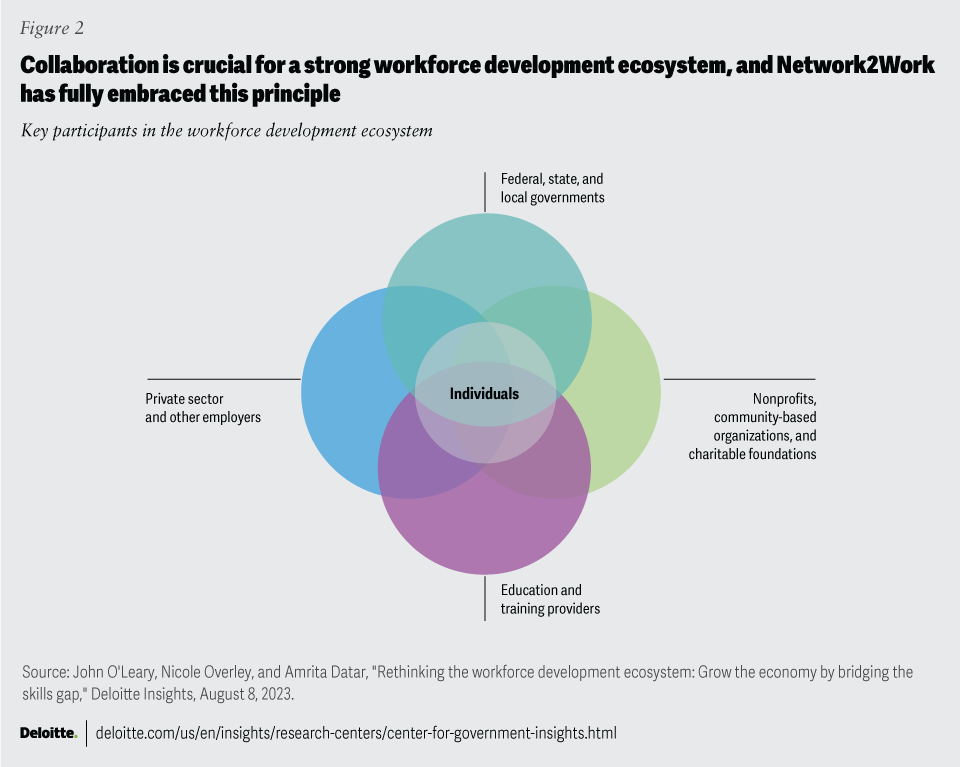
Workforce development occurs in a dynamic ecosystem(figure 1). Each participant—including job seekers, training providers, and employers—has different roles and motivations. It can be challenging to align their incentives to ensure job seekers are trained for in-demand jobs. As technology changes, what is in demand will change as well. Artificial intelligence may be able to write code for an electric vehicle’s 220V charger initialization but can’t physically install the charger. Differentiated training, including those in future trending skills, is critical to equip a wide range of workers.
Coordinating between different players in the labor market has helped regions boost skills and match job seekers with employment. In Charlottesville, Virginia, the nonprofit Network2Work plays the matchmaker role between local employers and job seekers.11 Network2Work coordinates with local employers to identify job needs, while community leaders identify suitable individuals to receive job training at Piedmont Virginia Community College. The organization also provides wraparound support such as childcare, transport, and health care to ensure the success of the newly hired. On average, program graduates more than doubled their income.12 The success of Network2Work in the Charlottesville area has led to an expansion of the program to other parts of Virginia.
Using data and technology infrastructure to focus shared efforts
Data and technology can help focus the efforts of disparate actors as they work on a difficult, boundary-breaking challenge. By serving as a critical conduit to information, they can encourage the cooperative effort of different players addressing a challenge and spur contributors toward eventual true co-creation.
India Stack boosts financial inclusion through technology
In 2010, India sought to improve financial inclusion for its citizens, particularly among the poor and marginalized. Only one in three citizens had a bank account, and fewer than 50% had a nationally recognized ID to present to bankers.18 India built a technological foundation for dramatic improvements with India Stack—a digital financial platform that includes digital identity, government benefits, and a financial transactions engine. Over 500 million new bank accounts were opened, more than half of which were opened by women. Additionally, banks’ cost to conduct e-KYC has plummeted from US$23 to US$0.1.19 Today, more than 75% of all retail transactions in India go through India Stack.20 Over the last decade, almost 90% of Indian citizens signed up for a digital ID.21 By working together, India’s government and the banking industry transformed the way financial transactions occurred.
India Stack comprises application programming interfaces, digital products, and frameworks that enable large-scale data-sharing, digital payments, and e-identity. It is owned by various Indian government agencies and subsidiaries.22 (To learn more about India Stack, read our CX trend.)
Enhancing customer experience through life event service delivery: The success of Singapore’s LifeSG app
Across the globe, from the United Kingdom to Estonia to Singapore, governments are adopting a life event service delivery structure, which can dramatically enhance a citizen’s customer experience.23 In this structure for organizing government services, a life event—such as a job loss, birth of a child, or death of a loved one—proactively triggers service interactions with multiple government agencies. Without life event services, individuals must navigate various government agencies for a single life change. The United Kingdom, for instance, found that, to register a death officially, the bereaved needed to notify government entities from federal pensions to local tax authorities up to 44 times.24
Life event services can be challenging for governments to implement due to the involvement of multiple government agencies, but the results can be dramatic.
The LifeSG app, an upgraded version of the app formerly known as “Moments of Life,” was introduced in Singapore to assist new parents in handling paperwork related to newborns. By streamlining the process, the app reduced the time needed to register a birth from an hour to just 15 minutes. Since 2018, 70% of Singaporean births have been registered using the app.25 The app has expanded beyond birth notification to cater to the diverse needs of the entire population. In an interview with GovInsider, Gabriyel Wong, director of Moments of Life, said, “We are always looking to onboard service journeys that are intuitive to citizens.”26 With over 1.2 million downloads, LifeSG aims to simplify life by providing one app with a unified interface for over 100 government services.27
Governance, measurement, and policy shifts to break down silos
To tackle cross-boundary problems, leaders need to reevaluate leadership mechanics, including governance, policy, and performance measurement, to foster collaboration.
Odisha’s Mission Shakti program leads to a dramatic boost in female entrepreneurship
The government of Odisha—a state in eastern India with a population of 41 million—launched the Mission Shakti program in 2001 to empower women by expanding employment and financial security. (The term “shakti” means “power” and, in Hindu philosophy, is often associated with feminine creative powers.) The government recognized that women faced three critical barriers to entrepreneurship: lack of skills, limited access to networks, and difficulty in securing institutional finance. Women often relied on informal high-interest loans from unscrupulous lenders, and the government sought to address this issue with this initiative.
Mission Shakti partners with nationally known skill development institutes, including nonprofits and academic institutes, to help women upskill. Women are organized into self-help groups to strengthen their networks, a form of co-production that involves them in developing solutions. Further, these groups form block-level federations that provide institutional support for everything from marketing products to lobbying. A strategic partnership between the Mission Shakti organization and the banking sector ensures that the self-help groups have access to institutional credit. To improve the creditworthiness of members, Mission Shakti provides seed money to each eligible self-help group. It also provides a revolving fund of 2.5 million rupees to the self-help groups to strengthen capacity and provide financial autonomy.28
Mission Shakti self-help groups grew from about 40,000 in 2001 to 600,000, covering 7 million women in 2021.29 The program has transformed the lives of its members across both rural and urban parts of Odisha. For example, according to the 2022 annual report, the Maa Vaibhav Laxmi self-help group, which does woodwork, including making nameplates, souvenirs, and key chains, earns a monthly profit of 35,000 rupees to 40,000 rupees. Likewise, the Debasis self-help group set up a semi-mechanized pickle unit that makes about 800,000 kilograms of pickles annually. The group has an annual turnover of six million rupees with a monthly profit of 50,000 rupees to 60,000 rupees.30 Mission Shakti program’s robust governance has brought all the stakeholders together, making such a significant impact possible.
Collaborative efforts lead to over 60% decrease in homelessness in Houston
Since 2011, Houston has remarkably reduced homelessness by 64%. This success was the result of the coordinated effort of more than 100 organizations aligning on goals and working together to achieve them. As part of the effort, a cross-sector data platform gave all providers access to critical information. Sylvester Turner, the former mayor of Houston, emphasized that collaboration was instrumental in achieving this success. “Collaborate, collaborate, collaborate,” Mayor Turner noted on a Deloitte podcast. “No one group can do this by itself.”31
What the 10x future holds
- Bridgebuilder organizations: As governments converge to solve wicked problems, expect more bridgebuilding activities that handle coordination between different agencies. For example, the US Army and Air Force have formed the Combined Joint All-Domain Command and Control oversight group to combine data and assets for greater synchronization of effort.35
- Shared funding: While “shared funding” models are not widespread at scale, the future could see an increase in “issue-focused funding” instead of department or program funding—to support multiple agencies in combined efforts. For example, to advance clean energy nationwide, the Australian federal government established the Rewiring the Nation initiative with AU$20 billion in funding to transform the country’s electric grid.36
- Blurred lines between public and private: Governments are increasingly partnering with private sector participants to pool resources and capabilities. Government incentives can help nudge businesses to embrace social and environmental responsibilities and adopt purpose-driven business models that can help deliver public solutions.
Steps governments can take now
Recognize your organization’s limitations: Sometimes, we all need a helping hand. Recognizing when a problem may be bigger than a single organization is a key first step.
Challenge orthodoxies: Reconsider “how we do things here,” and revisit historical policies that hinder the scope of cross-sector collaboration. Consider moving from a model that funds just one program to a shared funding model.
Focus on outcomes: Shift the focus from processes to outcomes. Define clear objectives, and measure success based on the impact on citizens. Remember that success measures can and should be tailored to organizations’ unique contributions to the coalition of partners tackling the problem.
Embrace digital: Embrace digital technologies and the power of human accelerators like AI to improve overall efficiency, freeing up key stakeholders to focus on the toughest part of the challenge. More and more, the routine aspects of coordinated service delivery can be sourced to “multimodal” cognitive automation tools like AI models trained on working processes across organizations.
By
John O'Leary
Aaron Silverman
Lydia Murray
Emma Cooper
Sushumna Agarwal
The authors would like to thank Thirumalai Kannan from the Center for Government Insights for his research and operational support; Meenakshi Venkateswaran for designing the article’s graphics; and Mahesh Kelkar and William Eggers for providing feedback and suggestions at critical junctures. In addition, the authors would like to thank Mike Nichols for his valuable input in the “My take” section.
Cover image by: Jim Slatton
Visit the Deloitte Center for Government Insights
Access more insights for the defense, security and justice, government health care, state and local government, transportation and infrastructure, human services, and higher education sectors.