
JAPAN ECONOMIC OUTLOOK, AUGUST 2026
Low inflation may not be enough to prevent further tightening of monetary policy in Japan
Strong exports and healthy consumer spending are supporting the Japanese economy, amid evolving policy conditions and rising debt pressures
As a net energy importer, the Japanese economy is susceptible to fluctuations in energy prices. But despite the spike in oil and gas prices due to the conflict in the Middle East, business sentiment held up in the second quarter of 2026. The Tankan survey of business conditions remained at 18—tied with the first quarter for the highest reading since 1991.1 Manufacturers’ sentiment has been particularly strong, supported by a weak yen, which has bolstered export gains.
Households, however, have been less optimistic since oil prices spiked, although their economic conditions have mostly improved since then.2 Inflation remains relatively low, partly due to subsidized fuel prices. At the same time, wage growth is picking up amid a tightening labor market. Despite subdued consumer confidence, consumer spending has grown quite quickly. However, underlying inflationary pressures and loose fiscal policy are pushing interest rates higher, which could temper consumer spending and real gross domestic product growth.
Monetary tightening despite low inflation
Inflation has eased in 2026, with year-over-year headline inflation standing at 1.7% in June, which is just over half of the 2025 average inflation rate.3 Nearly every measure of core inflation stood at 1.6% or lower in June. This includes the Bank of Japan’s three measures of core inflation: mode, trimmed mean, and weighted median. It also includes Japan’s regular core inflation, which excludes fresh food, as well as western core, which excludes all food and energy prices. Core-core inflation, which excludes fresh food and energy prices, was the only measure above 1.6%. However, at 1.7%, even this measure of core inflation was below the central bank’s 2% target (figure 1).4
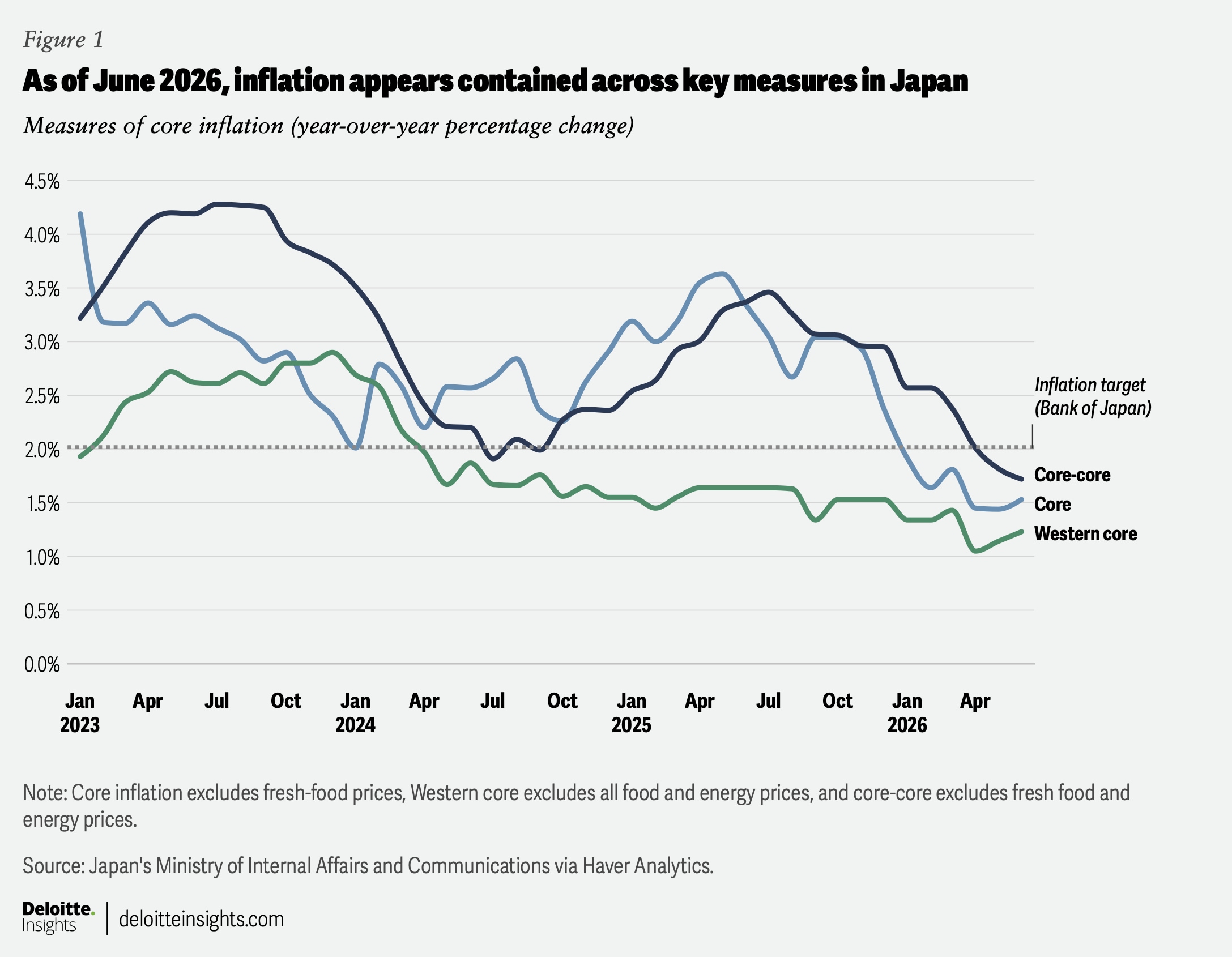
Typically, such benign inflation would not warrant tighter monetary policy. Yet, the Bank of Japan raised its policy interest rate in June from 0.75% to 1%, and is expected to tighten policy further.5
This is partially due to government subsidies that have helped hold down inflation. Many of the subsidies have focused on containing rising energy prices resulting from the conflict in the Middle East. Indeed, energy prices were 0.1% lower than a year earlier in June.6 Subsidies have also been used to contain childcare and education costs.7
Not only are inflation numbers artificially low, but there is also evidence that inflationary pressure is building. For example, the producer price index was up by more than 7% from a year earlier in June.8 Meanwhile, import prices were up 29.7% over the same time period, when denominated in yen.9 This suggests that the weakening of the yen is exerting upward pressure on inflation, thereby encouraging the more hawkish policy stance of the Bank of Japan. For example, the value of the yen fell by more than 11% from a year earlier in June.10 Despite the intervention by the Ministry of Finance and the US Treasury Department, which caused the yen to appreciate sharply at the start of August, a higher policy rate is likely needed to prevent the yen from backsliding.11
Aggregate demand is also picking up again. The real consumer activity index, which adjusts for inflation, was up 2.7% in May—the strongest rate of growth in more than three years.12 Although some of this rise in consumer spending was likely due to consumers pulling forward their spending on durable goods ahead of interest rate increases, growth has been relatively broad-based.
Additionally, labor-market fundamentals have improved. The unemployment rate was 2.5% in June, down from an average of 2.7% in the first quarter of 2026. Moreover, nonfarm employment grew by 0.5% year over year in June—a relatively healthy performance given Japan’s demographic profile.13 Lower inflation has given households more purchasing power. Inflation-adjusted wages were up 1.6% in May on a year-ago basis after falling throughout 2025.14
But this is not just an inflation story: Nominal wages have also picked up, growing above 3% year over year for four consecutive months—up from an average growth rate of 2.2% in 2025.15
Fiscal stimulus is pushing up interest rates
There is little doubt that fiscal policy is supporting economic growth. Fuel and household utility subsidies, free high school tuition, and free lunches for elementary school students have freed up money that can be spent elsewhere in the economy.16 These measures have also helped shield most households from some of the economic implications of the conflict in the Middle East.
More support is expected next year when food items become tax-exempt for two years.17 The support is not limited to cost-of-living measures. Defense-related spending is also on the rise. From a year earlier, military spending was up by more than 13% in 2025.18 In the current fiscal year, which began in April, the draft budget for all spending is up 9.4% from the previous one.19
Such strong fiscal spending has also raised concerns over debt sustainability. Indeed, the 10-year treasury yield was 2.88% on July 9, the highest reading since 1996, just before the Asian financial crisis.20 As of this writing, the yield was only modestly lower. Rising interest rates are particularly concerning given that Japanese government debt remains more than 200% of GDP.21 Rolling over that debt will put upward pressure on the government’s interest expense and make it more difficult to spend in other areas of the economy.
Despite the extremely high stock of debt and rapidly rising interest rates, a debt crisis is highly unlikely in the next few years. For one, much of the rise in yields is due to inflation rather than an increase in the risk premium. The inflation-adjusted yield on the five-year government bond, although rising, was still negative in June,22 meaning that the government can essentially borrow for free for five years.
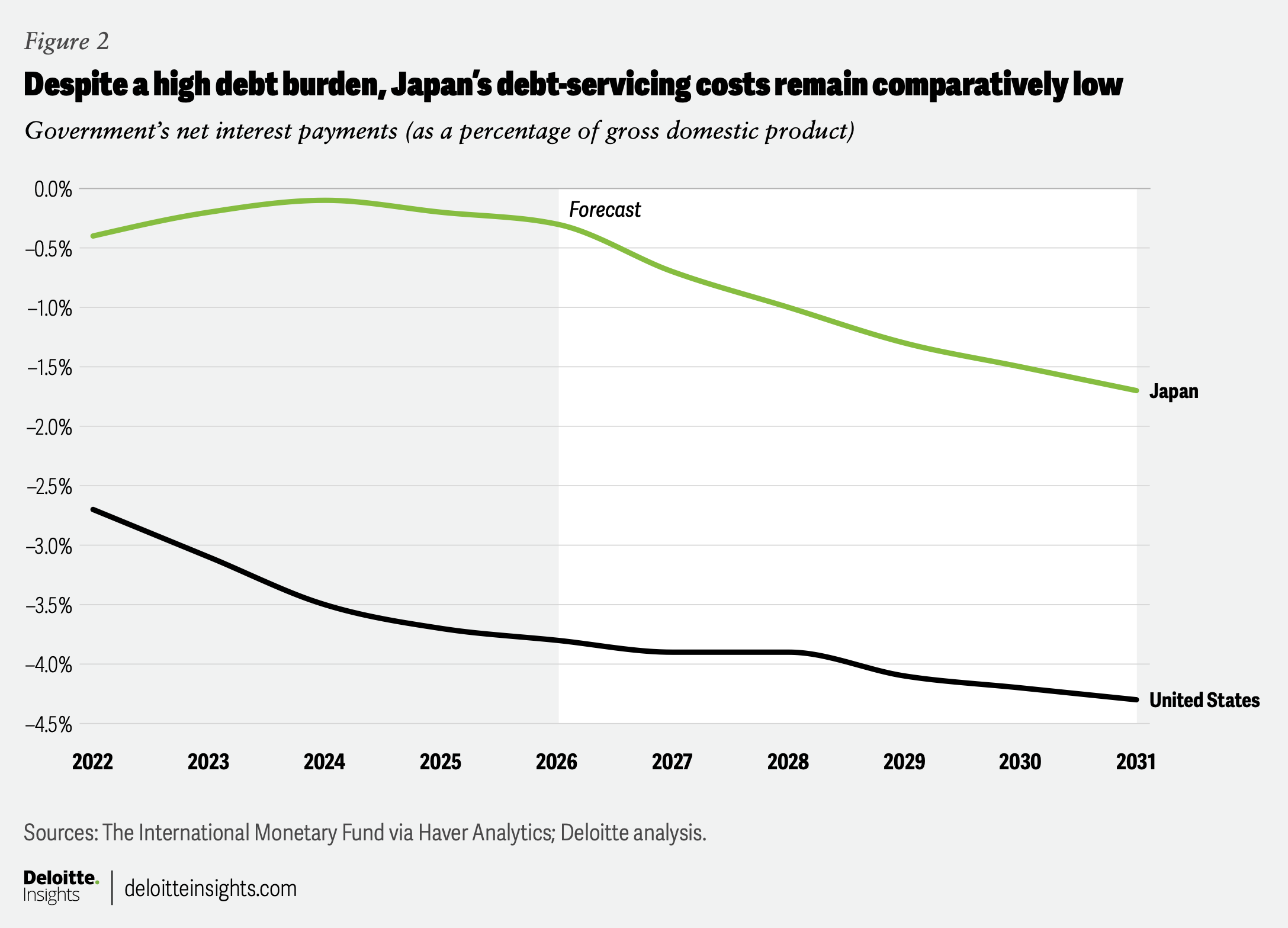
The International Monetary Fund also estimated that Japan’s net interest payments in 2025 amounted to just 0.2% of GDP.23 It expects net interest payments to rise to 1.7% of GDP in 2031, but that is still low compared with the United States’ net interest payments of 3.7% of GDP in 2025 (figure 2). Japan’s debt-to-GDP ratio is expected to fall from 207% in 2025 to 193% in 2031, even if real GDP growth remains below 1%.24
Exchange rates, geopolitics, and tech are driving exports
A weak yen has made Japanese pricing more competitive, boosting exports. Manufacturers are recording strong export growth in yen terms even when export volumes in some industries are declining slightly. For example, the volume of motor-vehicle exports was up 6% year over year in June, while the value of such exports was up 23% over the same period.25
Trade trends extend beyond exchange rate dynamics, with geopolitical issues and technological changes contributing to export fluctuations. The ongoing Middle East crisis caused Japan’s exports to the region to plummet by 17.6% in the first half of 2026 compared with the same period a year earlier.26 Trade tensions with the United States and China have led to a smaller share of overall exports heading to these major trading partners. The share of goods exports to the United States has dropped by 3 percentage points in the last 18 months.27 Meanwhile, the share of exports going to China remains below pre-pandemic levels.28
At the same time, countries across the rest of Asia and Oceania have accounted for a larger share of Japanese exports. For example, exports to Taiwan were up 46.4% from a year ago in June, while exports to Australia were up 45.9%.29 This trend is expected to continue as Japan attempts to build security ties with countries in the region.
Investment in artificial intelligence is also supporting economic growth and driving strong demand for Japanese exports. For example, more than one-third of the year-over-year real GDP growth in the first quarter was due to electronic components and devices alone. In addition, integrated circuit exports were up 74% year over year in May—a huge surge compared with the 6.1% growth recorded in 2025.30 Related exports are expected to remain strong as global demand for tech goods continues to grow amid the global AI buildout.
Export growth is expected to remain relatively strong amid a relatively weak exchange rate. Meanwhile, consumer spending is expected to pick up in the near term as purchasing power grows. However, as inflationary pressures build, interest rates are likely to rise further. As a result, there will be limits to the strength of economic recovery in the year ahead.
By
Michael Wolf
Editorial (including production and copyediting): Arpan Saha, Preetha Devan, and Anu Augustine
Design: Harry Wedel
Audience development: Pooja Boopathy
Cover image by: Rahul Bodiga
Knowledge services: Rohan Singh
Visit the Deloitte Global Economics Research Center
Access more insights for the consumer spending, housing, business investment, globalization & international trade, fiscal & monetary policy, sustainability, equity, & climate, labor markets and prices & inflation sectors.