
Financial well-being and career stability emerge as key influencers of workplace well-being
Deloitte’s 2025 Well-Being at Work Survey reveals that, for the fourth year in a row, workers are struggling with their well-being. How can leaders deliver what workers need?
Workforce well-being is having a moment—and the spotlight is shining light on just how challenging it can be to integrate well-being into work.
For years, many leaders have struggled to make progress on workplace well-being. Now in its fourth year of research, Deloitte’s 2025 Well-being at Work Survey, which surveyed 3,150 C-suite executives, employees, and managers in the United States, the United Kingdom, Australia, and Canada (see methodology), continues to reinforce that improving worker well-being can be a difficult and complex task.
How can leaders better understand their teams’ needs and make progress on workplace well-being? In our 2025 survey, respondents revealed that add-on perks and initiatives weren’t going far enough to address key present-day drivers of well-being, including financial well-being and career stability.
As workers continue to face economic uncertainty, their primary concerns appear to remain rooted in security and stability at work. Notably, 25% of workers report being immensely stressed about losing their job. At least one in 5 are compromising their own well-being to prove their value to their employer amid concerns that artificial intelligence is going to make their schedules more work intensive instead of freeing up their time.
There’s no one answer to “solve” workplace well-being. Making progress should be about continuously measuring, adjusting, and seeking to understand what workers need to meet the uncertainties of the current moment. This year’s survey finds that organizations that are willing to put in the effort to improve workers’ sense of stability will likely create a healthier, happier, and more satisfied workforce—one that’s more engaged, inspired, and willing to go above and beyond for their employer.
The well-being blind spot
While our survey shows that benefits that cover basic needs like health care are still important to workers, some organizations appear to be doubling down on add-on wellness perks and programs, such as meditation apps, wellness stipends, and virtual yoga. But underneath it all, worker well-being still seems to be stuck. Burnout is still high.1 Engagement is still low.2 And many workers are quietly wondering whether leaders actually see what’s going on.
For the fourth year in a row, workers report struggling with their well-being. Only about one-third of surveyed workers say their well-being improved over the past year, with most reporting that it either stayed the same or worsened. In stark contrast, about two-thirds of C-suite executives surveyed report their employees’ well-being improved over the past year (figure 1).
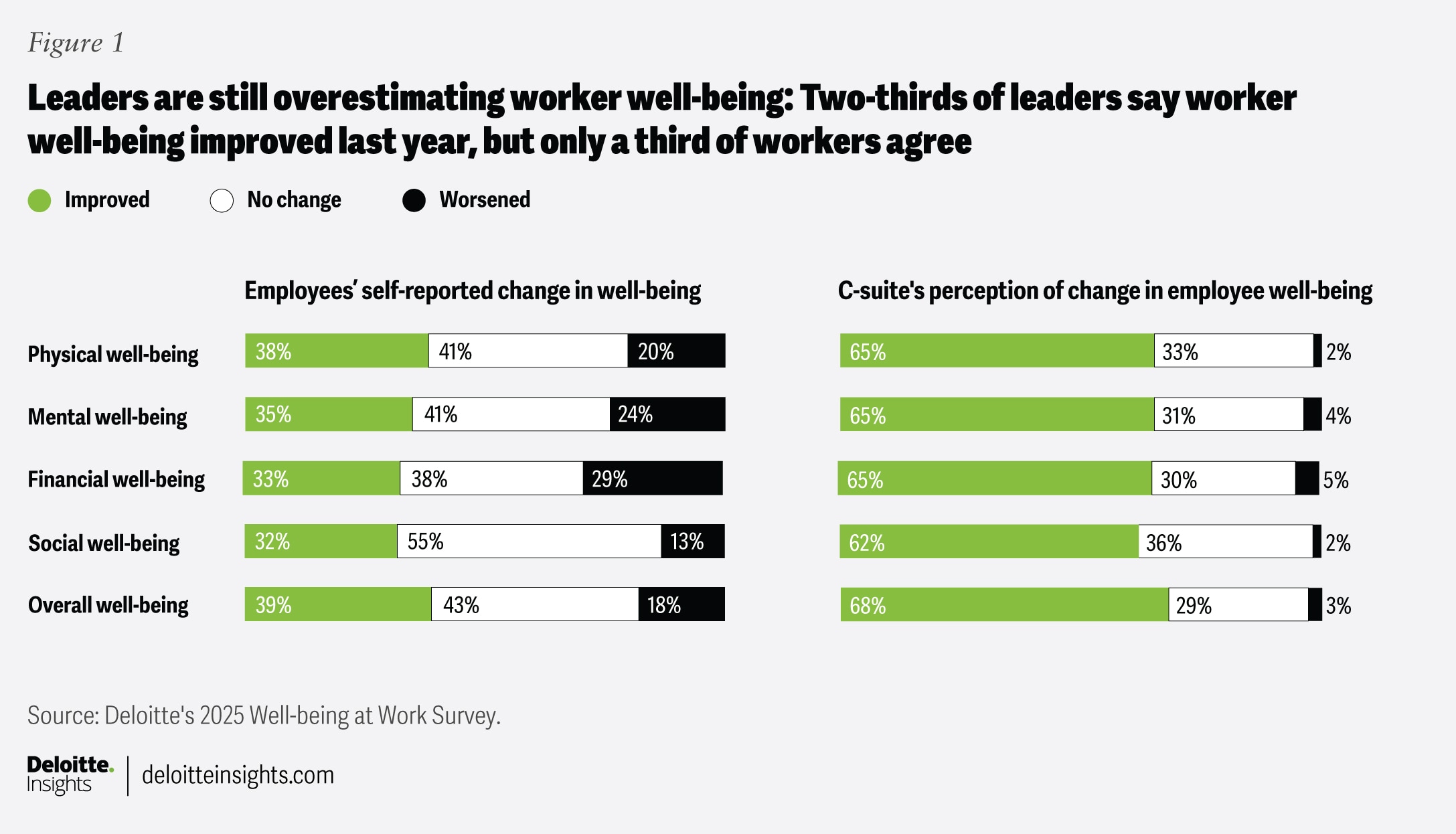
Our survey consistently finds that leaders overestimate worker well-being. For example, around 75% of the C-suite surveyed think work has a positive impact on employees, but just 1 out of 3 workers say their job has a positive impact on their physical (37%), mental (34%), and social (32%) well-being. This highlights a notable gap that exists between how leaders perceive worker well-being and how workers may actually be feeling.
These findings have remained relatively unchanged since we first conducted our research on this topic in 2022, emphasizing both some of the ongoing challenges with workforce well-being and a continued lack of awareness among executives.
What’s it going to take to shift the workforce well-being trajectory and make more noticeable progress? In today’s economic and technological environment, financial well-being and career stability have emerged as two of the most powerful levers for improving workforce well-being.
Financial insecurity: The hidden stress multiplier
Survey respondents across all levels of the organization—C-suite, managers, and workers—identified financial health and security as the top influencer of their overall well-being (figure 2).
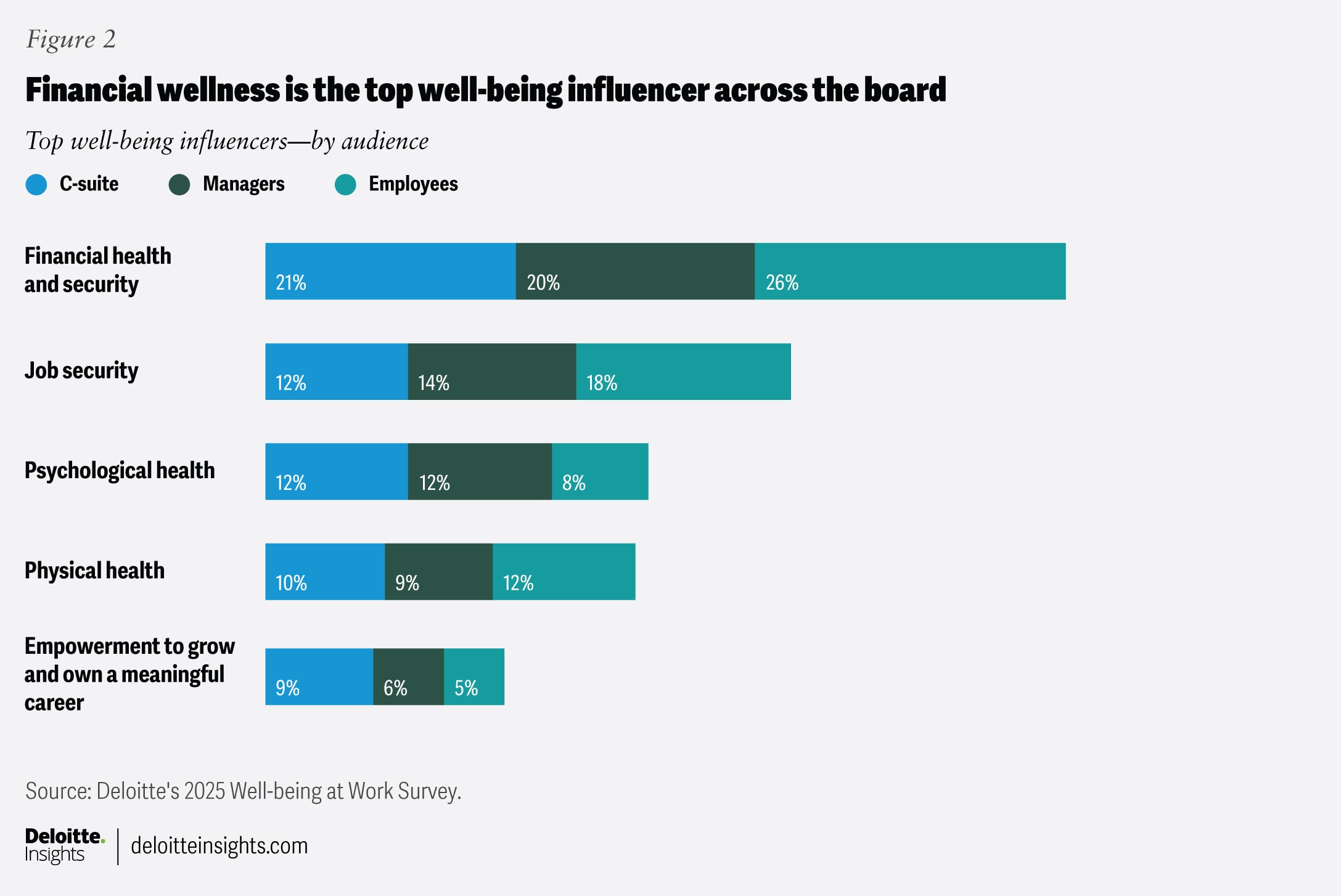
But leaders appear to be especially uninformed about the extent to which their workers are struggling financially. While 73% of the surveyed C-suite believe their workforce’s financial state is “excellent” or “good,” just 39% of the surveyed workers agree.
Seventy-three percent of the surveyed C-suite believe their
workforce’s financial state is “excellent” or “good.” But just 39% of surveyed
workers agree.
Only 33% of our survey respondents say their financial well-being improved over the past year, with 29% saying it has worsened. But even for workers who report feeling secure in their careers, financial stress can be a constant undercurrent. Inflation, student debt, rising housing costs—these pressures can follow workers to their desks every day. And they’re not just affecting morale; they’re also affecting focus, productivity, and even physical health. According to BrightPlan’s 2024 wellness barometer survey, workers say they lose more than seven hours of productivity every week to financial worries, and for younger generations, that stress is even greater.3
According to Deloitte’s 2025 Gen Z and Millennial Survey, more than 80% of Gen Z and millennial respondents cited their long-term financial future and their day-to-day finances as contributors to feelings of anxiety or stress. More than half of both Gen Zs and millennials reported living paycheck to paycheck, and more than one-third struggle to pay basic monthly living expenses. These generations are also worried about their financial future, with about 40% of surveyed Gen Zs and millennials indicating they are concerned about their ability to retire comfortably.4
While many leaders continue to invest in mental health resources and flexibility initiatives, financial well-being is often overlooked in the broader workforce well-being equation. Workers appear to be increasingly looking for fair pay and practical, long-term financial well-being support rather than one-off perks. For organizations seeking to improve retention and resilience, bridging this financial well-being gap may be just as important as addressing emotional well-being or workload.
Career stability: A fragile foundation
Discussions about workplace well-being are often dominated by talk of benefits and programs. But the well-being lever that leaders may be overlooking is the sense of security workers feel when they know they’ll be employed—or employable—down the road.
That safety net appears to be wearing thin amid current uncertainties. In fact, 42% of surveyed employees are at least “a little” concerned about losing their job, while 25% say they’re immensely stressed about this.
This anxiety is often compounded by fatigue with constant change. The average worker experienced 10 planned enterprise changes—including organizational restructuring, culture transformation, large technology initiatives, and more—in 2022, up from two in 2016, Gartner research shows.5 Workers in Deloitte’s survey say they believe AI will make their jobs harder in the future, not easier.
When workers are concerned about organizational changes, it’s reportedly difficult for them to focus on their well-being. The result is often a workforce constantly bracing for impact.
Surveyed workers say concerns about their job security have negatively affected their mental (27%) and physical (21%) health, as well as their sleep (24%). Meanwhile, 17% of respondents say such concerns have affected their personal relationships or caused them to isolate themselves from friends and family.
Twenty-two percent of respondents say their job concerns are negatively affecting their engagement and motivation at work. In addition, 28%—including 34% of Gen Z workers—report that they’re actively looking for another job or considering doing so because they’re worried about their job security.
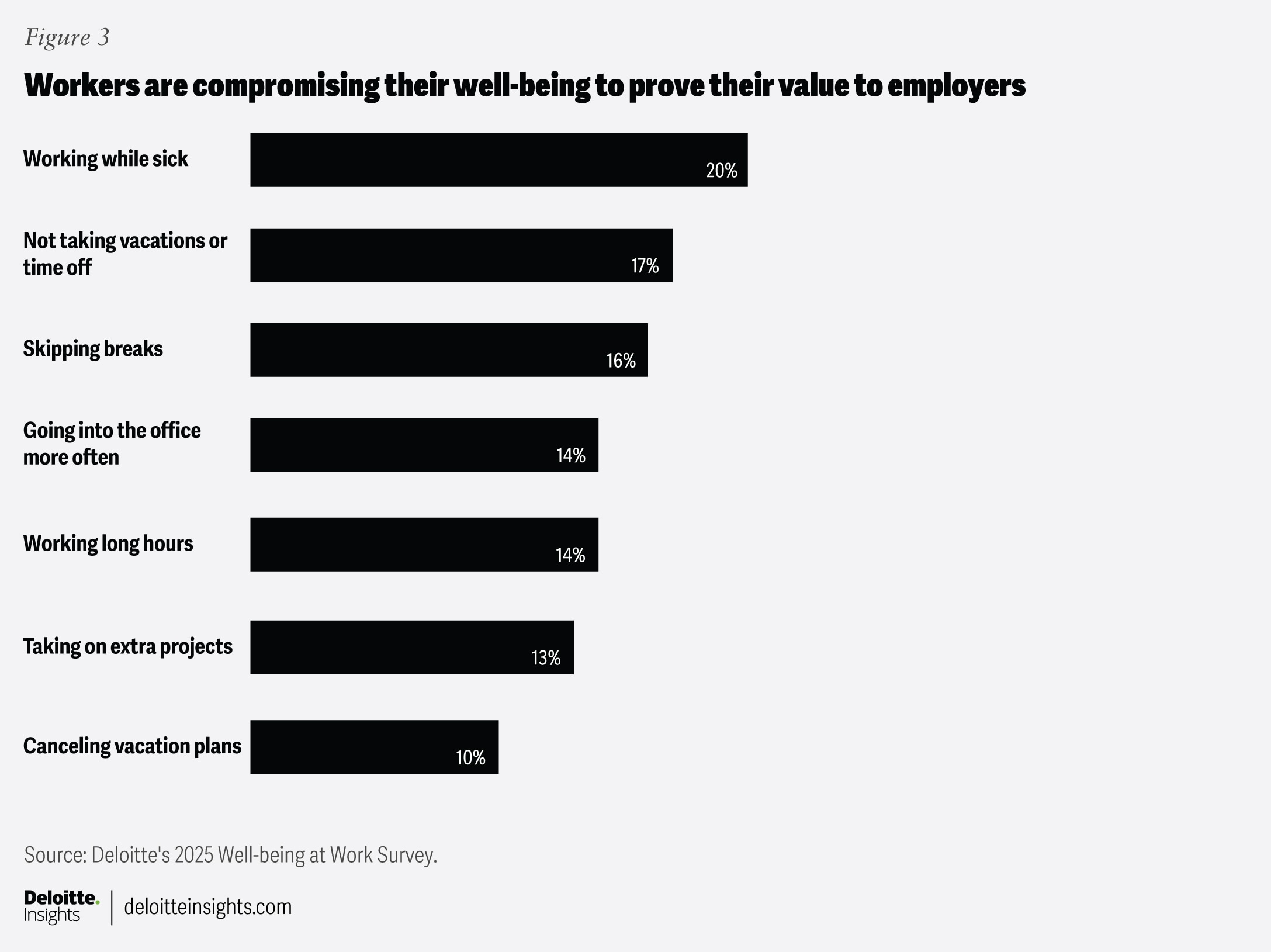
What’s more, at least 1 out of 5 surveyed employees are taking at least one step to prove their value to their employer. However, most of these come at the expense of their work/life balance and well-being (figure 3). The survey indicates that younger workers, specifically Gen Zs and millennials, are the most likely to be taking these steps—perhaps an indicator that job security may be more uncertain for these workers than their tenured counterparts.
Additionally, while surveyed workers agree that AI can be helpful, 68% of those using AI tools report that they have also increased their workload in at least one way. For Gen Z respondents, 82% of those using AI say it’s increased their workload.
For example, some employees say they’re spending more time fact-checking content and that their coworkers or managers are now relying on them to generate content, while others report that they’re being assigned more work because using AI tools has freed up more of their time.
Sixty-three percent of surveyed workers using AI tools believe
their employer will add to their workload if using AI makes them more
efficient.
Other survey findings further underscore the potential impacts of AI on employee well-being. Among those using these tools, 26% surveyed say using AI has increased their feelings of burnout and exhaustion, 31% say learning to use AI has been stressful, and 63% feel their employer will add to their workload if AI makes them more efficient.
Rethinking the well-being playbook
When employees feel stable—financially and professionally—they can show up with more clarity, confidence, and creativity. But what does it actually look like to work the levers of career stability and financial well-being in service of workforce well-being? Below, we outline some practical actions organizations can take to help make an impact.
Ensure leaders have the full picture of worker well-being
The path to improvement should begin with a commitment to uncovering the true state of workforce well-being. It’s promising that 89% of C-suite respondents say their company uses at least one metric to assess employee well-being; however, drilling down further into the numbers reveals that organizations could be doing much more to comprehensively measure and understand it. For example, while some companies are monitoring number of hours worked or employees’ self-reported well-being, factors such as using paid time off or working after hours appear relatively overlooked (figure 4).
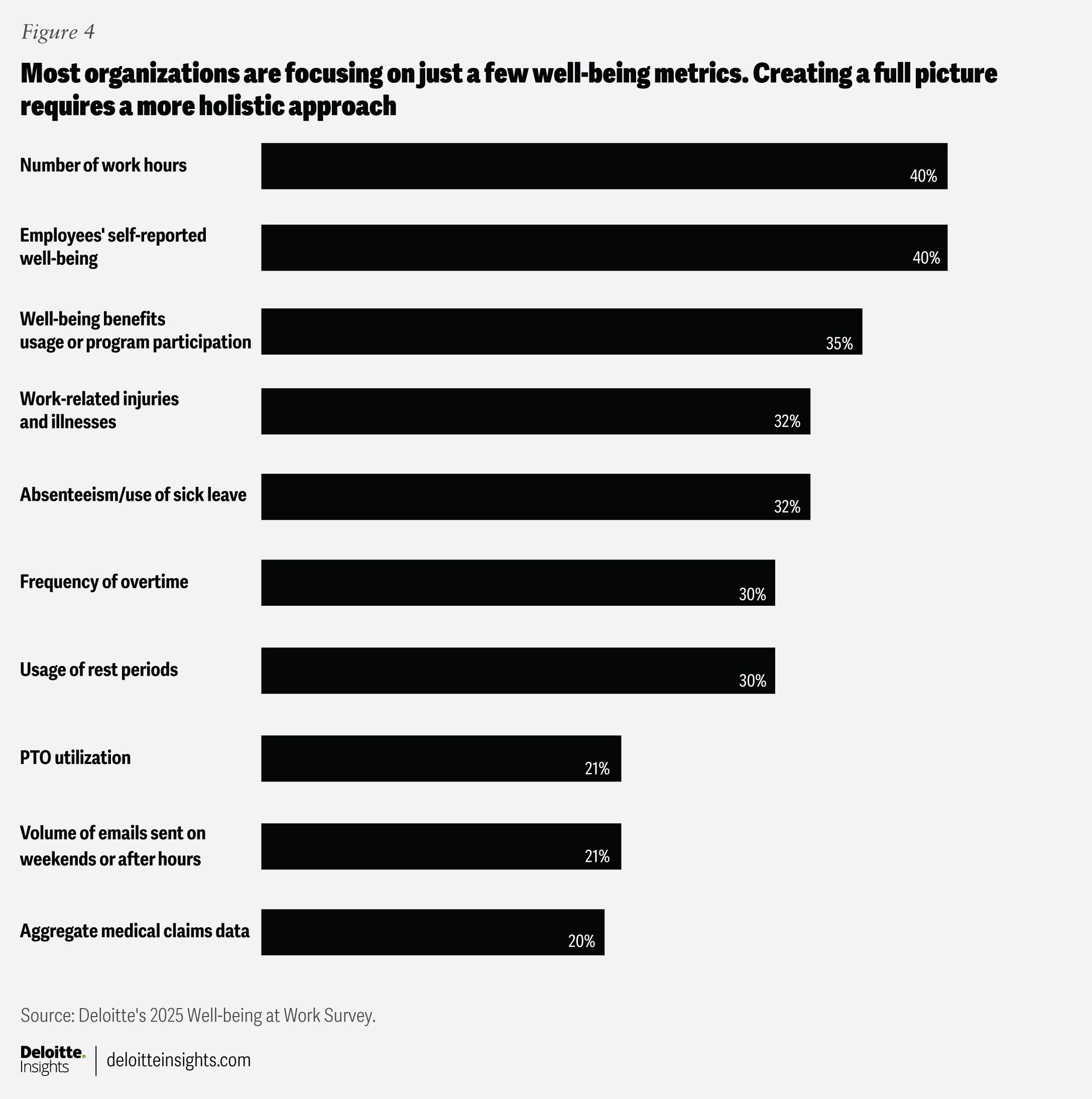
In addition, organizations should consider shifting to a real-time measurement approach—one that favors ongoing assessment of employee well-being over annual surveys. Doing so can help enable a more agile and responsive approach to supporting workforce well-being, which can be especially important during times of uncertainty and change. Pulse surveys are one way to achieve this, but utilizing in-person forums and encouraging regular meetings between managers and their teams can provide additional value from open communication channels and human-to-human connections.
Bridge the gap between leaders and workers by empowering managers to support worker well-being
Managers can play a key role in improving employee well-being. Not only do they have the ability to have an impact on their staff’s day-to-day activities, but our study reveals that they have a far more accurate picture of employee well-being than executives. However, just 28% of surveyed managers say they feel completely empowered and capable of supporting their employees’ well-being and have all the tools and support they need.
In addition, 66% of surveyed managers say they’re facing at least one organizational barrier that is preventing them from doing more to support their employees’ well-being. These include company policies such as rigid scheduling requirements (32%), being busy with critical work tasks (26%), and an unsupportive workplace culture (20%).
There are many ways organizations can provide more support for managers, and these tools can be put in place for executives, too. In fact, 88% of C-suite respondents and 86% of managers say they need more help to improve employee well-being.
Training or coaching focused on employee well-being topped the list for both audiences. Being able to integrate well-being into company practices also emerged as an important lever. This makes sense, given that only around 1 out of 5 employees reported that their company has a strong focus on embedding well-being into their job (20%) and workplace culture (19%).
Frame financial well-being as a core part of the employee value proposition
Among surveyed workers who say financial well-being is the top influencer of their well-being, just 43% say their company is meeting their needs in this area. Providing fair pay tops the list of steps workers would like their company to take, followed by offering better well-being benefits and greater flexibility (figure 5).
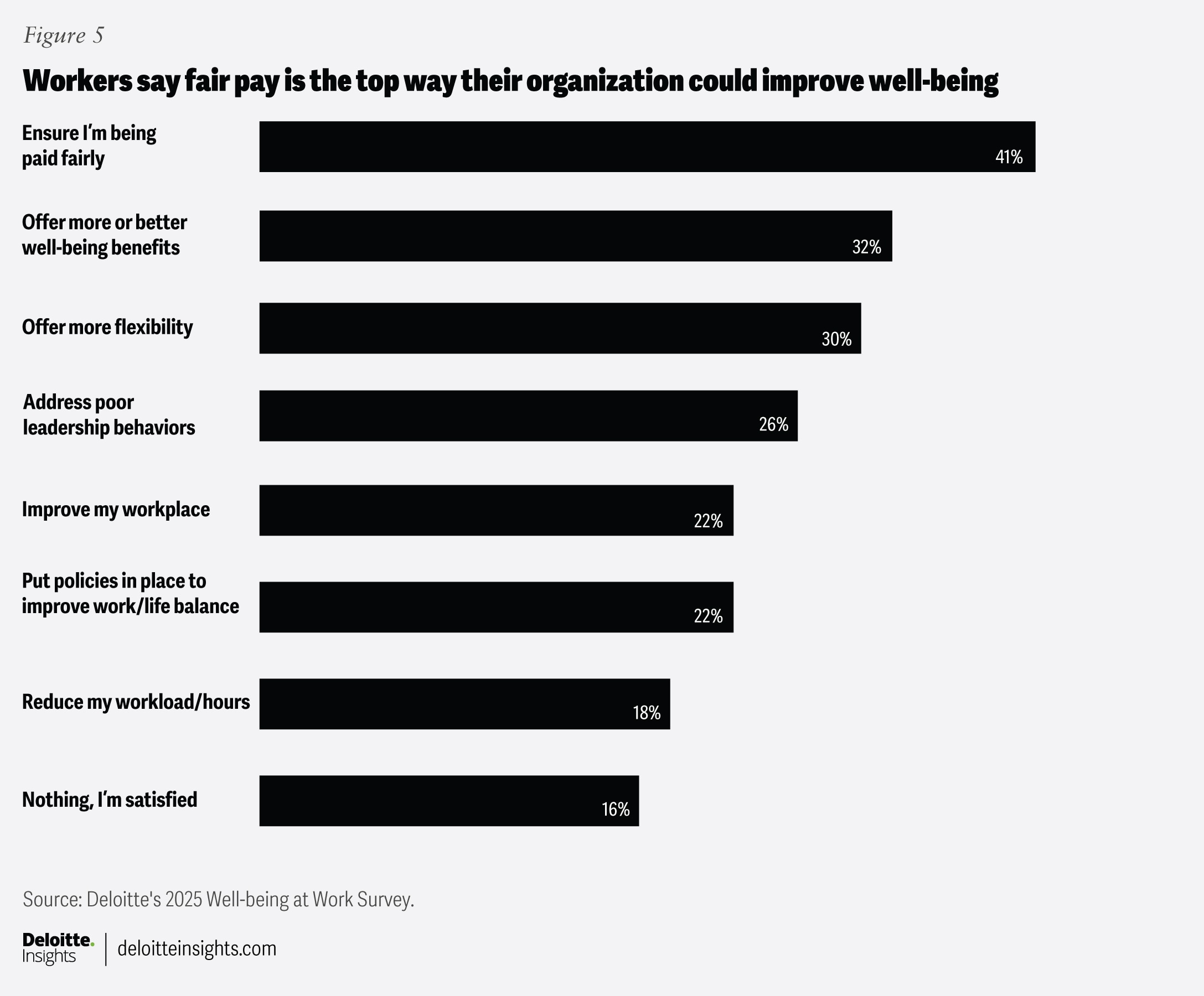
But a strong financial well-being strategy should go beyond compensation to help equip workers with the tools, guidance, and support they may need to make informed financial decisions and plan for the future. A commitment to transparent and fair pay may be a starting point, but workers also value access to financial planners or digital platforms that offer budgeting tools, personalized insights, and planning resources.
The survey indicates that younger workers, in particular, are seeking help in managing their financial anxiety. Organizations can support them by offering practical workshops and seminars on topics like saving, investing, and retirement planning. They can also consider collaborating with knowledgeable third-party professionals to help bring information to workers.
Some companies are taking even bolder steps toward financial well-being, such as contributing to employees’ 401(k) plans even when the employee is not,6 sending a clear signal that the organization is invested in their long-term financial well-being. Though not yet widespread, this kind of proactive support can make a difference, especially for workers carrying student debt or working toward major financial milestones.
Create more career stability through worker upskilling efforts
Organizations looking to help workers build more career stability can focus on a few high-impact strategies. Mentorship, coaching, and cross-training—especially in roles and skills that are in demand internally—can help workers build transferable experience and skills while also creating a stronger internal talent pipeline. Skills-based learning programs tied to certifications can also make a difference, particularly when they target critical talent or skills gaps and are backed by one-time bonuses or incentive pay for completed certifications. For workers who value fast and practical learning, microlearnings and hands-on “hackathons” can offer the kind of real-time application that keeps skill development both engaging and impactful.
Clarity around career paths within an organization can also help give workers a sense of stability and a clearer understanding of what they need to do to progress. Defining career paths, along with skills matrices that identify the critical skills needed at each level, should be a part of any strategy to provide workers with more career stability.
Make AI work for everyone, and share the rewards
Successfully integrating AI into the workplace isn’t just about what the tools can accomplish. It’s also about the training, support, and cultural shifts that help enable workers and organizations alike to benefit from AI.
To avoid leaving workers to navigate unfamiliar systems on their own, organizations should introduce AI tools gradually and provide proper training and support. Workers should be actively involved in the implementation process, with clear communication around how AI can support key aspects of their roles. As AI becomes more embedded in everyday tasks, workers need support in developing AI awareness and learning how to apply it creatively to streamline more of their transactional work.
In addition, as workers begin to master AI tools in their day-to-day work, it will be important to ensure that workers can benefit from the gained efficiencies. In other words, avoid simply rewarding efficient work with more work. According to Deloitte’s 2025 Global Human Capital Trends report, more than half of respondents (56%) say it is very or critically important to share the rewards that AI creates with workers. Some organizations, for example, have used efficiency gains from AI to implement four-day work weeks, giving extra time back to their workers.7 When organizations do this well—when they ensure that their workers personally derive value from AI—they are almost six times as likely to gain significant financial benefits, according to an MIT Sloan Management Review article.8
Prioritizing a people-first approach to well-being
Improving workforce well-being is a continuous journey that requires a holistic approach, one that can balance people’s physical, mental, financial, and social health. The organizations that pull ahead on this journey are likely the ones that can accept that their perspectives on the subject may be flawed and make a commitment to meeting the current moment with strategies to better focus on the factors affecting employee well-being the most: financial and career stability, AI concerns, and flexibility. These companies should support managers too, so they can step into their role as the first line of defense against poor workforce well-being.
Above all, those leading the charge should embrace a people-first approach to doing business, recognizing that there’s a clear economic and talent imperative for prioritizing the well-being of those who serve their organizations each day.
Continue the conversation
by
Jenny Ahn
Michael Gilmartin
The authors would like to thank Corrie Commisso for their generous contributions to the report.
Cover image by:Sonya Vasilieff; Adobe Stock